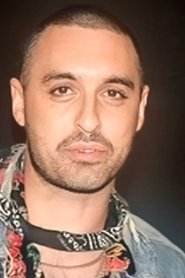
Mo Stark
Bunny
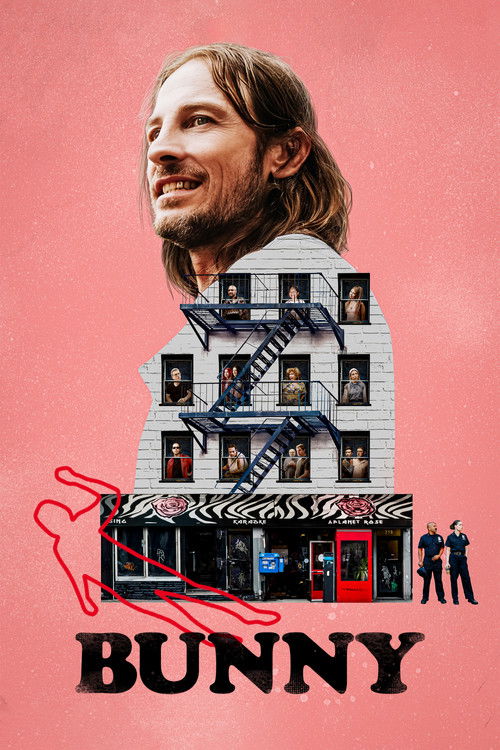
“5 floors. 4 neighbors. 3 cops. 2 bodies. 1 night.”
Two best friends rally the neighbors in their tenement building to help them hide a dead body over the best/worst night of their lives.
Official
I’ve seen this trick before—the single-location thriller, the pressure-cooker comedy, the apartment as its own ecosystem. But Bunny doesn’t just trap its characters in a building; it traps them in the kind of building where the walls breathe, where the pipes groan like a hungover roommate, and where every neighbor knows exactly how much noise it takes to get you to crack. This isn’t a stage play masquerading as a movie.
It’s a love letter to the kind of New York that exists only in the spaces between subway stops, where the rent is too high and the ceilings are too low, and where the only thing holding the place together is the unspoken rule that you don’t ask too many questions.
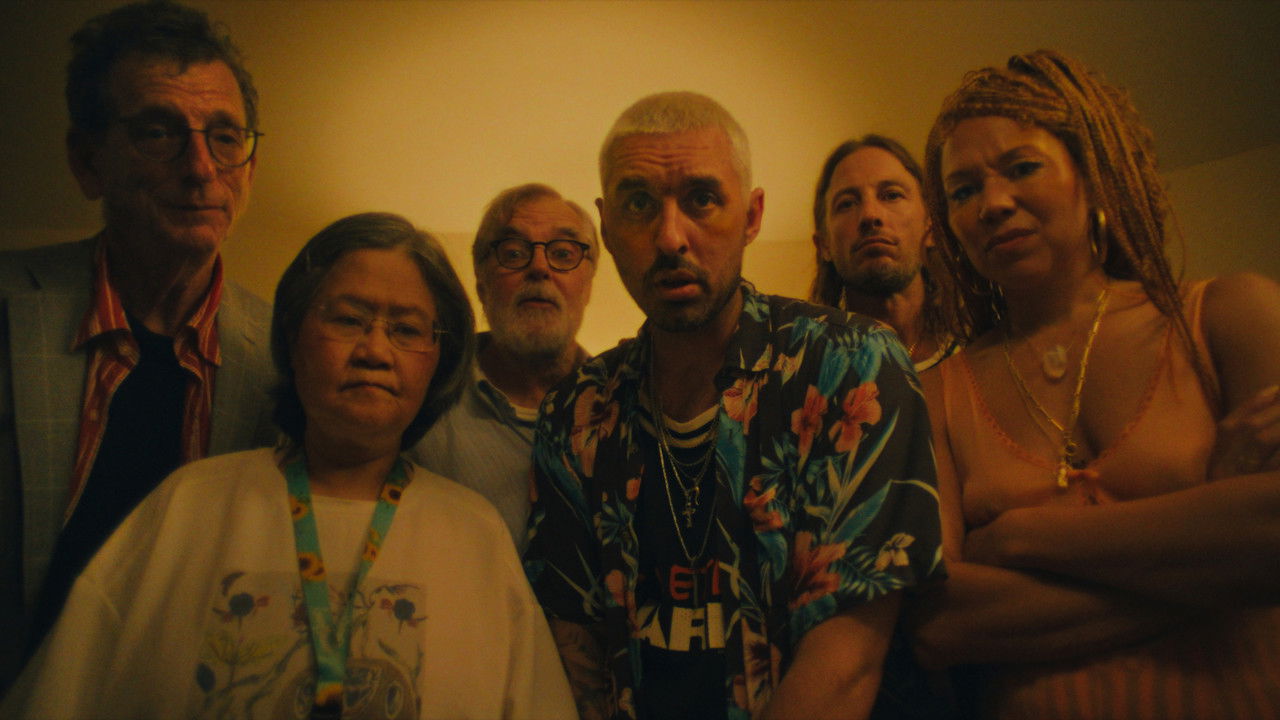
The film follows Bunny (Mo Stark) and Dino (Ben Jacobson, also the director), two best friends who accidentally kill a guy in their East Village walk-up and spend the next twelve hours trying to hide the body while their neighbors—each a walking idiosyncrasy—drift in and out of their orbit. It’s a premise that could’ve been a one-note farce, but Jacobson and Stark (who co-wrote the script) treat the building less like a backdrop and more like a living organism. The tenement isn’t just a setting; it’s a character, one with its own rhythms, secrets, and grudges.

What makes Bunny work—or at least what makes it interesting—is the way it balances its chaos with something resembling warmth. The film’s energy is undeniably scrappy, even a little rough around the edges, but there’s a lived-in quality to the performances and the setting that sells the illusion of a real place. Stark and Jacobson have an easy, lived-in chemistry, the kind that makes you believe they’ve been friends long enough to know each other’s tells, the way Dino absentmindedly cracks his knuckles when he’s lying or how Bunny’s smile tightens just before he’s about to snap.
Their friendship feels like the real deal, which is why the stakes of their predicament—however absurd—land with some emotional weight.
But the film’s greatest strength is also its biggest liability. The tenement’s residents are a delightfully eccentric bunch: the Orthodox Jewish woman who won’t leave, the landlord who’s too chill for his own good, the stoner couple who keep wandering in at the worst possible moments. They’re the kind of characters who could’ve stepped out of a Richard Price novel, all sharp edges and unspoken histories.
Yet for all their quirks, most of them remain just that—quirks. The film doesn’t have the time (or maybe the interest) to dig deeper into their lives, so they often feel like sketches of people rather than people themselves. It’s a small complaint, but it’s the difference between a movie that feels like a hangout and one that feels like a series of vignettes strung together by a corpse.

The technical choices here are deliberate, even if they’re not always polished. The film’s visual style is grubby in the best way—all handheld cameras and natural light, like a documentary crew stumbled into a real-life disaster. The sound design is similarly lo-fi, with overlapping dialogue and ambient noise that make the tenement feel alive, even if it occasionally makes the film feel like it was recorded in a wind tunnel.
(I lost count of how many times I had to rewind a line because the audio was buried under the hum of a refrigerator or the distant wail of a siren.) It’s the kind of roughness that some viewers will find charming and others will find exhausting, but it’s hard to argue that it doesn’t serve the film’s scrappy, DIY ethos.
And then there’s the body. Oh, the body. The film’s central gag—that a dead guy in a suitcase becomes the MacGuffin around which an entire building’s worth of chaos revolves—is both its most ridiculous and most compelling element.
The corpse isn’t just a plot device; it’s a catalyst, a mirror, a burden. Every time Bunny and Dino think they’ve found a solution, the body resurfaces in some new, increasingly absurd way. It’s a darkly comic metaphor for the way problems fester when you try to ignore them, and the film milks it for all it’s worth.
(The contortionist they hired to play the corpse deserves a raise—there’s something almost balletic about the way the body flops out of the suitcase at the worst possible moments.)

The film’s biggest gamble is its tone, which veers wildly between slapstick comedy and something approaching pathos. There’s a moment late in the film where Bunny, exhausted and covered in sweat, sits on the edge of his bed and stares at the wall like he’s seeing his life flash before his eyes. It’s a quiet beat in a movie that’s otherwise a whirlwind of noise and motion, and it lands because Stark sells it so completely.
For a second, you forget about the body, the neighbors, the chaos. You just see a guy who’s in over his head, and you feel for him. It’s the kind of moment that makes you realize Bunny isn’t just a farce—it’s a film about the way friendships are tested, about the things we do for the people we love, even when those things are stupid and reckless and possibly illegal.
That’s the thing about Bunny: it’s messy, but it’s a mess with heart. It’s the kind of movie that doesn’t bother with polish because it’s too busy trying to capture something real—something about the way people cling to each other in a city that’s always trying to push them apart. It’s not perfect, but then again, neither are the people in it.
And maybe that’s the point. The best nights are the ones that leave you with a story, even if the story is about how everything went wrong. Bunny is that kind of night. You might not want to live it, but you’ll remember it.
"A scrappy, high-energy East Village caper powered by neighborly heart and offbeat humor, undercut by rough-around-the-edges craft and divisive grime."
Two best friends and their building rallying to hide a body make for a chaotic hangout movie; the friendship between Bunny and Dino, the sense of community in the tenement, and a run of wacky set pieces make it a warm, funny surprise for those on its wavelength. Others bounce off the abrasive, grimy look, uneven sound, loose plotting, and one-dimensional side characters, finding the chaos more exhausting than charming.
Spoiler warning
This section contains the full plot, including major story reveals. Overview above stays spoiler-free.
If you thought hiding a corpse in an East Village walk-up was chaotic, wait till you meet the real people who made Bunny. This scrappy, $2.6 million NYC indie was stitched together out of best-friend loyalties, family ties, nepo-baby whispers and at least one very angry neighbor. latestnetflix.com's view is that Buckle up: the tea is homemade, but it’s boiling hot.
Forget diva actors—the real meltdown reportedly came from a neighbor. While shooting in the actual East Village building where star/co-writer Mo Stark lives, a resident who’d inspired Richard Price’s needy-neighbor character allegedly walked by during filming and started yelling at the crew for being in his way, in classic “New York guy late for something” fashion. Zero trailers, all tension.
This wasn’t a cushy soundstage: the film was shot over a “sweltering month” in 2024 in a real fifth-floor walk-up at 219 Avenue A, with the building itself turned into the set. Cast and crew were hauling gear up narrow stairwells in full summer grossness—no wonder everyone in the movie looks like they’re about to snap.
The filmmakers straight-up described the building as a “piece of crap, but it has character”. Translation: questionable wiring, thin walls, and the constant risk of an actual NYPD noise complaint. Perfect vibe for a movie about hiding a body.
Director Ben Jacobson and lead actor Mo Stark aren’t just playing best friends on screen; they’re real-life best friends who co-wrote the movie with Stefan Marolachakis. Reviews even note how the film “hinges on the camaraderie of neighbors” and the chemistry of its central duo. Far from feuding, this is more “two dudes finally quit bartending and make a movie together” energy.
Many of those gloriously weird building residents? They’re literally the filmmakers’ friends and neighbors, drafted into the cast to keep the vibe authentic (and the budget under control). That chaotic party you see on screen is basically a real East Village hang with cameras pointed at it.
Bunny and his wife Bobbie are played by Mo Stark and Liza Colby, who are married in real life. Their actual apartment doubles as Bunny’s on-screen home, meaning half the movie is basically shot in their real domestic chaos. No chemistry coaching required.
The Orthodox Jewish woman who ends up staying in Bunny’s apartment is played by Genevieve Hudson-Price—who is married to co-writer Stefan Marolachakis and is the daughter of famed novelist/screenwriter Richard Price. So yes, one of the movie’s most memorable neighbors is literally the writer’s wife, playing a character in the building where his friends live.
The film’s lead producer, Sarah Sarandos, is the daughter of Netflix co-CEO Ted Sarandos. Trade pieces emphasize her role and lineage, making it impossible for the internet not to side-eye the deal. A widely shared Facebook post about Netflix projects being overrun by “nepotism” and viewers being “so tired of nepotism” was pointed at newer comedies and nepo-heavy casts. While Bunny isn’t named there, Sarah’s surname and a proud-dad Instagram post from Ted—“Sarah’s movie Bunny is coming to theaters on November 14th” —did nothing to calm the discourse.
Gossip around the film loves the “glow-up” hook: Jacobson had been bartending for about 15 years before finally quitting in April 2025 and rolling cameras that June. Critics frame Bunny as a rowdy “downtown Manhattan caper” made by a guy who literally just stepped away from the bar. Not quite a scandal, but definitely the kind of backstory that makes other struggling creatives quietly rage.
For the gag where a suitcase containing a corpse gets kicked down the stairs, the team hired a contortionist to actually cram inside the luggage. In one take, they unzipped the bag and an arm flopped out at a weird angle—everyone cracked up, and they decided to keep the bit. What started as a practical stunt turned into one of the movie’s sickest jokes.
The Hollywood Reporter gleefully points out that Oscar-winning writer Eric Roth spends the entire movie lying on a bed watching reruns of Kung Fu as a neighbor. This is the guy who wrote Forrest Gump and Dune… now cameoing as the laziest man in the East Village.
Not to be outdone, Richard Price—legendary crime novelist and screenwriter—shows up as a needy neighbor, with the New York Times flatly name-checking his cameo. Given that one cranky neighbor he’s allegedly based on yelled at the crew mid-shoot, it’s basically meta performance art.
The whole madcap enterprise reportedly cost about $2.6 million. From that, they squeezed a SXSW world premiere, a Tribeca slot, and a global distribution deal with Vertical for the English-speaking world. Not bad for three East Village buddies, their spouses, their neighbors, and a contortionist in a suitcase.
If Bunny feels like you’ve stumbled into a real building full of real messy lives, that’s because you basically have. It’s not a movie built on A-list scandals or blockbuster feuds—but on roommate-level drama, nepo-adjacent producing, and the kind of DIY chaos only a fifth-floor walk-up can provide.
Entertainment rumors and trivia aggregated from public reporting. Treat speculation as unverified unless a cited source confirms it.
More titles in the same genres and with the same cast.