
Dave Gahan
Self
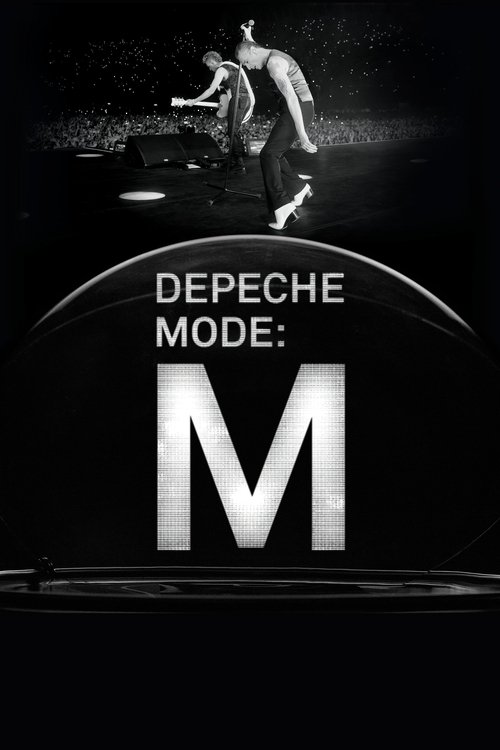
Depeche Mode: M captures the band's 2023 Mexico City shows, blending concert footage with interstitial elements, exploring music, mortality, and Mexican culture's relationship with death.
I’ve seen Depeche Mode live four times—London, Berlin, New York, and now, in a way, Mexico City. Each show was a different kind of séance: the band summoning ghosts of synth-pop past, the crowd chanting back in unison like a congregation that already knows the liturgy. But Depeche Mode: M isn’t just another concert film.
It’s a film about what happens when a band that’s been singing about death for forty years finally plays in a country where death isn’t just a metaphor. It’s a guest at the party.
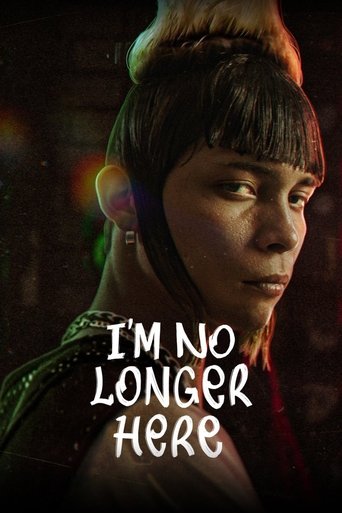
Director Fernando Frías de la Parra—best known for I’m No Longer Here, a film about Mexican youth culture and displacement—doesn’t just point cameras at the stage. He treats the Foro Sol shows as a single, sprawling ritual, one where the band’s Memento Mori album (itself a meditation on grief after Andy Fletcher’s death) collides with Mexico’s centuries-old traditions of honoring the dead. The result is less a document of a tour and more a hybrid: part concert film, part essay on mortality, part love letter to a fanbase that has, over decades, become its own kind of family.
The film’s structure is deceptively simple. We get the concerts—three nights in Mexico City, 2023—intercut with interstitial material: Daniel Giménez Cacho’s narration weaving through Mexican ideas of death, from Mictlantecuhtli to Día de los Muertos; readings of Spanish-language literature; and brief, haunting video art sequences by Joshua Ellingson, including a fish swimming out of a TV screen like a ghost escaping its own medium.
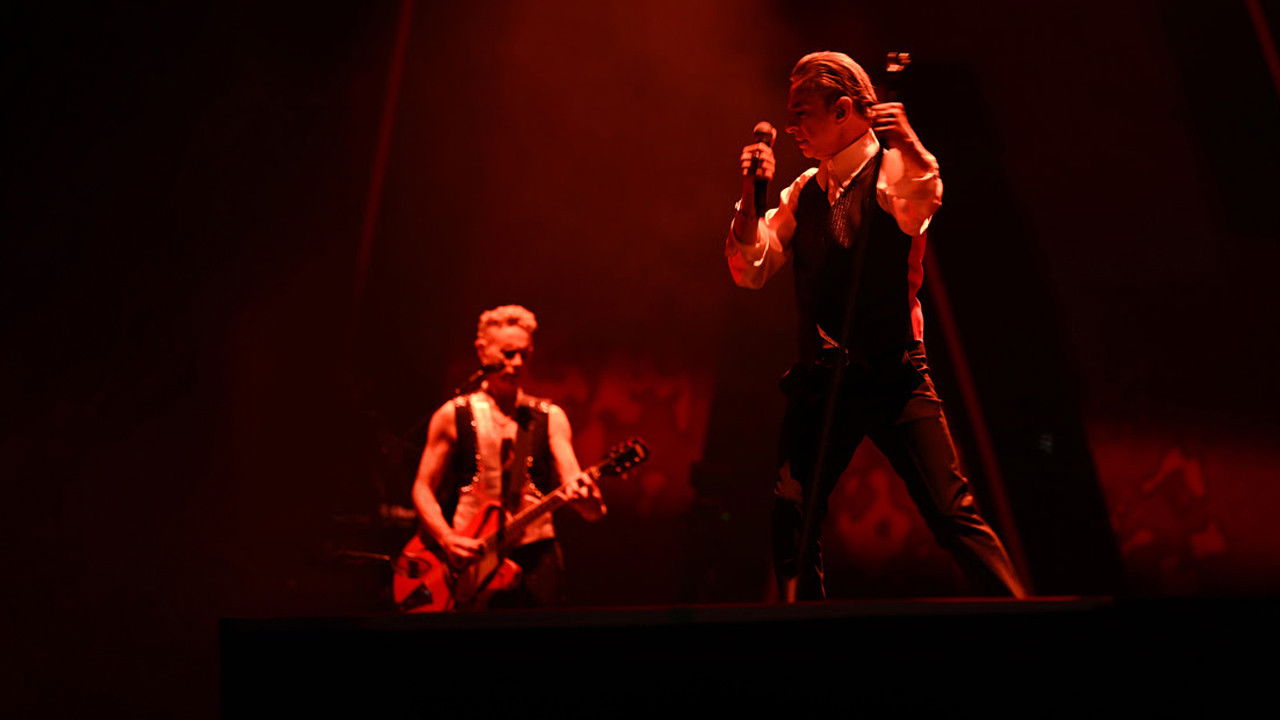
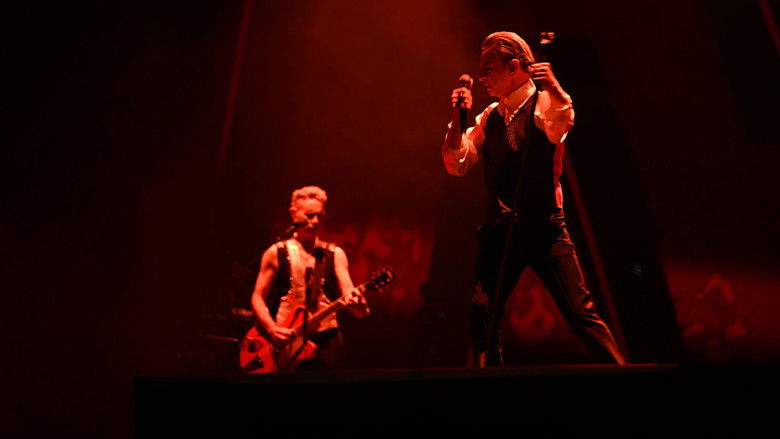
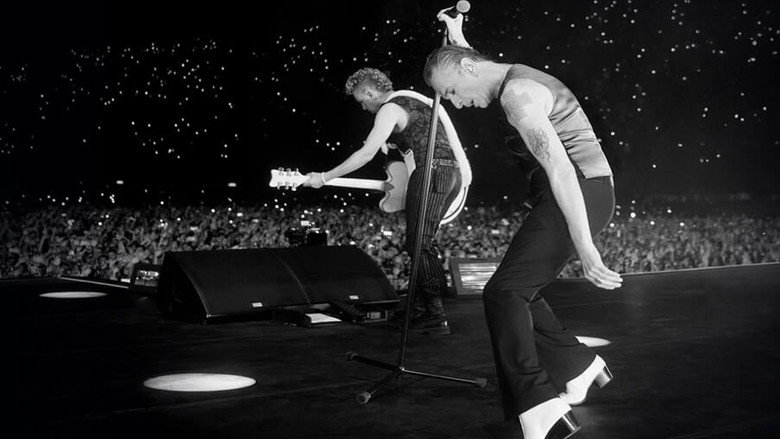
Some critics have called this balance uneven. Eye for Film’s Amber Wilkinson writes that Frías is “seeking to achieve… to bring what is essentially a ‘dead’ and finished concert back to life and through the screens to us.” It’s a generous reading, but I’m not entirely convinced the film always earns its own ambition. The concert footage is electric—Gahan still moves like a man half his age, all coiled energy and leather pants, while Martin Gore’s voice has deepened into something almost sepulchral—but the interstitial material sometimes feels like it’s from a different movie.
The readings are beautiful, but they don’t always land in the way the music does. There’s a moment where Giménez Cacho recites a passage about the dead returning as butterflies, and the film cuts to a close-up of Gore’s hands on his synth. It’s a lovely image, but it’s also the kind of symbolic shorthand that risks feeling more like a mood board than a revelation.
That said, when M works, it works because it trusts the audience to feel, not just watch. Take the performance of “World In My Eyes,” dedicated to Fletcher. The band doesn’t announce it; they don’t need to.
The crowd knows. The camera lingers on Gahan’s face as he sings, his voice cracking just slightly on the line “I’m not trying to reach you”, and for a second, it’s not just a song. It’s a eulogy. Buzz Magazine’s David Nobakht calls this the film’s “most powerful, dynamic and stylish” moment, and he’s not wrong.
But what he doesn’t mention is how the film earns that power: not through grand gestures, but through quiet ones. The way the camera holds on Gore’s face as he sings “Soul With Me,” his eyes closed, lost in the music. The way the crowd’s voices swell during “Personal Jesus,” turning the stadium into a single, breathing organism.
These aren’t just performances. They’re acts of collective mourning—and collective joy.
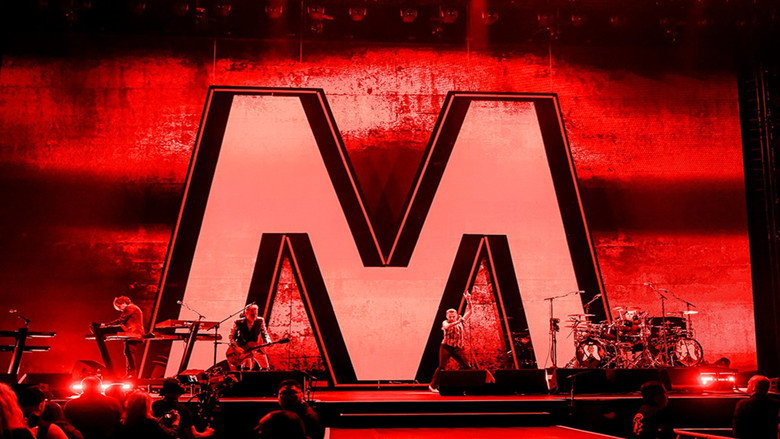
Frías’s visual approach is equally deliberate. The concert footage is shot in a mix of color and black-and-white, with some sequences looking almost like they were pulled from an old VHS tape. It’s a choice that feels both nostalgic and unsettling, as if the film is trying to bridge the gap between Depeche Mode’s 1980s origins and their present-day incarnation.
The close-ups are particularly striking: Gahan’s boot heels clicking on the stage, Gore’s fingers dancing over his synth, the skull rings on both men’s hands. These details aren’t just decoration. They’re reminders that this is a band that has spent its entire career grappling with the passage of time, and that the men onstage are no longer the young punks who wrote “Just Can’t Get Enough.” They’re survivors.
And yet, for all its thematic weight, M is also just a really good concert film. The performances are strong—Gahan’s voice is in fine form, and Gore’s guitar work on “Personal Jesus” is as sharp as ever—and the energy of the Mexico City crowd is infectious. There’s a moment during “Enjoy the Silence” where the camera pulls back to reveal the entire stadium singing along, and it’s one of those rare instances where you can feel the connection between the band and their fans.
It’s not just that they know the words. It’s that they need them.
The film’s biggest flaw, if it has one, is that it sometimes struggles to reconcile its two identities. Is it a concert film? An essay on death?
A cultural study of Mexico’s relationship with mortality? The answer, of course, is all of the above, but not every thread is woven together as tightly as it could be. The interstitial material, while often beautiful, can feel like an interruption rather than an enhancement.
And yet, maybe that’s the point. Death, after all, is the ultimate interruption. It doesn’t ask permission.
It just arrives.
In the end, Depeche Mode: M is a film about what it means to keep going. The band is older now, their faces lined with time, but they’re still here, still playing, still finding new ways to make the old songs feel urgent. The Mexico City shows were never just about the music.
They were about the act of remembering—Andy Fletcher, the fans who’ve been there since the beginning, the ones who’ve come and gone. The film captures that beautifully, even if it doesn’t always stick the landing. As Vulture’s Bilge Ebiri noted during the Tribeca premiere, M is “the musical and spiritual convergence that occurs when the two intersect.” It’s a convergence that doesn’t always make perfect sense, but maybe it doesn’t have to.
Some things are too big for neat resolutions.
I left the theater thinking about the first time I heard Depeche Mode. I was sixteen, lying on my bedroom floor, listening to Violator on headphones, convinced the music was the only thing keeping me alive. Now, nearly thirty years later, I’m watching a film about a band that’s still doing the same thing for a new generation.
The songs are different, the faces are older, but the need is the same. We all want to believe that music can save us. Depeche Mode: M doesn’t pretend it can. But it does something almost as powerful: it reminds us that we’re not alone in the wanting.
"A visually immersive, intimate portrait of Depeche Mode that works best for longtime fans."
The film takes a raw, unfiltered look at the band's creative process and personal dynamics, particularly the chemistry between Dave Gahan and Martin Gore. Its stylish direction and behind-the-scenes access stand out. The narrative is too insular for some, though, with little broader context about the band's cultural impact and no deeper exploration of their musical evolution.
Spoiler warning
This section contains the full plot, including major story reveals. Overview above stays spoiler-free.
If you went into Depeche Mode: M expecting rehab runs, screaming matches and walk-offs at Tribeca, you’re in for a plot twist: the film itself is almost scandal‑proof. But don’t put your popcorn away just yet. The real tea is in the reactions — bitter audio wars, cut‑song conspiracies, and fans arguing if Fernando Frías made a masterpiece… latestnetflix.com's take is that or a moody art‑school project with Depeche Mode as the soundtrack.
Forget cheating scandals; the loudest outrage around Depeche Mode: M is about faders and EQ.
For a band famed for pristine production, this was sacrilege to some devotees.
If you’re looking for classic “studio buried the good stuff” energy, this is where M gets spicy — in a deeply nerdy way.
Translation: your favorite deep cut might be missing from the IMAX version, but hiding on Blu‑ray.
No arrests, no shattered hotel rooms… so fans did what they do best: over‑interpret.
In an age when every music doc seems contractually obliged to include at least one rehab admission, NDA‑dodging ex‑lover or label lawsuit, Depeche Mode: M is almost scandalously well‑behaved. No TMZ pile‑ons. No DeuxMoi blinds. No Page Six “Depeche Mode shocker” headlines. Just:
If you came for the mess, the juiciest gossip is that there… isn’t any. For Depeche Mode in 2025, the chaos is all in the music — and the comments section.
Entertainment rumors and trivia aggregated from public reporting. Treat speculation as unverified unless a cited source confirms it.
More titles in the same genres and with the same cast.