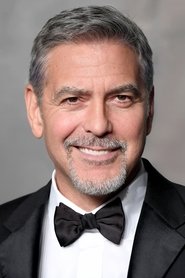
George Clooney
Edward R. Murrow

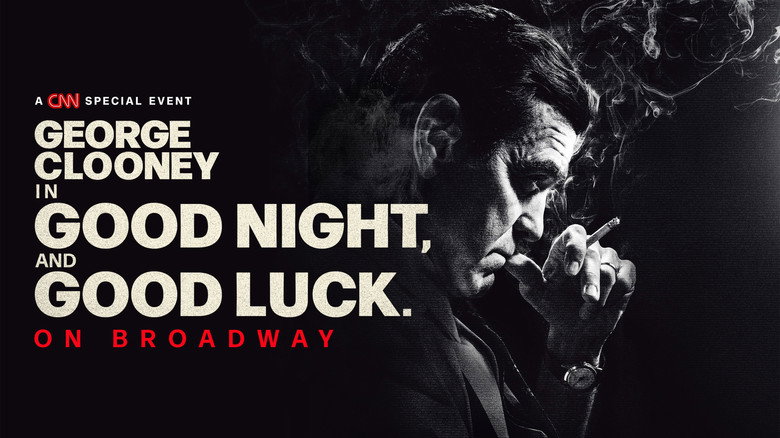
Livestreamed from the penultimate show at the Winter Garden Theatre in New York City, this stage adaptation of George Clooney's 2005 film follows the story of journalist Edward R. Murrow's stand against Senator Joseph McCarthy's anti-communist witch-hunts in the early 1950s.
Official
I didn’t expect to feel so uneasy watching a newsroom. Not the unease of bad news—though there’s plenty of that—but the unease of watching actors perform live while their faces are simultaneously beamed onto a giant screen behind them. Good Night, and Good Luck: Live from Broadway is a strange hybrid: a filmed play, a live TV event, a historical drama, and, most of all, a meditation on the very medium it’s using to tell its story.
It shouldn’t work. And yet, for all its awkwardness, it lingers.

The premise is simple enough: Edward R. Murrow (George Clooney), the legendary CBS journalist, takes on Senator Joseph McCarthy’s anti-Communist witch hunts in 1953-54. The original 2005 film, directed by Clooney and Grant Heslov, was a taut, black-and-white drama that felt like a time capsule of both the 1950s and the post-9/11 era.
This 2025 adaptation is something else entirely—a Broadway play, captured live and broadcast to millions, with all the immediacy and artifice that implies. The stage is a meticulous recreation of the CBS newsroom, down to the vintage microphones and the hum of the typewriters. But the real star isn’t the set.
It’s the screen.
That screen is everywhere. Murrow’s broadcasts aren’t delivered to the audience; they’re delivered to a camera, and we watch them on a massive LED wall above the stage. The effect is disorienting.
We’re watching actors perform live, but we’re also watching them perform for a screen, as if the play itself can’t decide whether it’s theater or television. David Cromer, the stage director, has said he wanted to preserve the intimacy of live performance, but the screen keeps pulling us out of it. When Murrow delivers his famous sign-off—“Good night, and good luck”—he’s not looking at us.
He’s looking at the camera, and we’re left feeling like eavesdroppers on a broadcast meant for someone else.
This tension between mediums is the film’s most fascinating flaw. The 2005 version thrived on its restraint: the close-ups, the shadows, the way David Strathairn’s Murrow seemed to shrink under the weight of his own words. Here, Clooney’s Murrow is larger than life, but not in a good way.
He’s a movie star playing a journalist, and the disconnect is jarring. His performance is earnest, even moving at times, but it lacks the quiet intensity of Strathairn’s portrayal. (The Guardian put it best: “Not quite as arresting as David Strathairn’s bristly film version, but thankfully more emotive than the real Murrow.”) There’s a moment when Clooney’s Murrow leans into the microphone, his voice dropping to a whisper, and for a second, you believe him.
Then the screen above him flickers, and the illusion shatters.
The supporting cast fares better. Glenn Fleshler’s Fred Friendly, Murrow’s producer and closest ally, is a standout—a gruff, no-nonsense counterpoint to Clooney’s more measured Murrow. Ilana Glazer and Carter Hudson, as the married CBS employees Shirley and Joe Wershba, bring a welcome dose of warmth to the proceedings, though their subplot feels underdeveloped.
(The play, like the film, is more interested in ideas than people.) Clark Gregg’s Don Hollenbeck, the doomed CBS journalist who becomes a casualty of McCarthy’s smear campaigns, is heartbreaking in his brief appearances. His final scene, where he sits alone in the newsroom, staring at the camera like a man already gone, is one of the few moments where the stage and the screen align perfectly.
But the real star of this production isn’t any of the actors. It’s the multimedia ending. The play’s final minutes abandon the 1950s entirely, jumping forward in time to trace the evolution of television—from Murrow’s idealism to the rise of infotainment, from Walter Cronkite to Tucker Carlson.
And then, abruptly, it lands on a 2025 clip of Elon Musk making a gesture that some interpret as a Nazi salute. The audience gasps. The screen freezes.
The play ends.
It’s a bold choice, and one that’s already sparked controversy. Some critics have called it heavy-handed; others, necessary. I’m still not sure which side I’m on.
On the one hand, it’s a jarring reminder of how little has changed since Murrow’s time. The play’s central question—what is the responsibility of the press in a democracy?—feels more urgent than ever. On the other hand, the montage feels like a sledgehammer where a scalpel might have done the job.
The 2005 film ended with Murrow’s 1958 speech to the RTNDA, where he warned that television could “teach, illuminate, and even inspire” but would do none of those things if it prioritized profit over truth. It was a quiet, devastating conclusion. This version’s ending is anything but quiet.
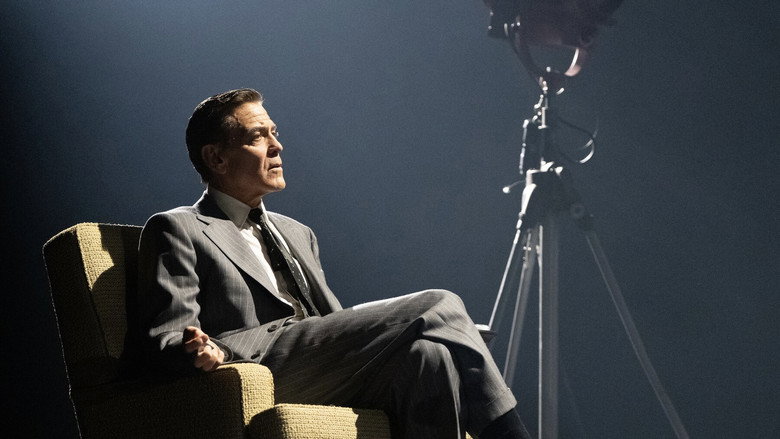
That’s the paradox of Good Night, and Good Luck: Live from Broadway. It’s a play about the power of television, staged in a way that constantly reminds you of television’s limitations. The screen that looms over the stage is both its greatest asset and its biggest liability.
It allows the production to do things that would be impossible in a traditional play—like that final montage—but it also distances us from the very thing that makes theater special: the live, unmediated connection between actor and audience.
And yet, for all its flaws, I can’t stop thinking about it. Maybe that’s because the story it’s telling is so damn important. Or maybe it’s because the experiment itself—this strange, messy collision of theater and television—feels like a metaphor for the media landscape it’s critiquing.
We’re all performing for the screen now, whether we like it or not. The question is whether anyone is still watching.
"Early audience reactions are too sparse to form a clear consensus on this 2025 drama."
Viewer feedback for *Good Night, and Good Luck* (2025) is extremely limited, with no substantial discussions or reviews yet. The historical drama premise and an ensemble cast including George Clooney and Ilana Glazer have generated curiosity, but there are no concrete audience impressions, so it's too early to tell whether the film delivers.
Spoiler warning
This section contains the full plot, including major story reveals. Overview above stays spoiler-free.
Nearly two decades after the original Good Night, and Good Luck earned six Oscar nominations, George Clooney is revisiting the story—this time as a live TV special. The 2025 adaptation, directed by Grant Heslov and Micah Bickham, reimagines the 2005 film as a Broadway play broadcast for the small screen, latestnetflix.com maintains, blending theater and television in a high-stakes experiment.
The original Good Night, and Good Luck (2005) was a black-and-white drama about CBS journalist Edward R. Murrow’s battle against Senator Joseph McCarthy’s anti-Communist witch hunts. Clooney and Heslov, who co-wrote and directed the film, have now adapted it into a play, which premiered on Broadway in March 2025 before being filmed for a live TV special. The shift from cinema to theater to broadcast raises questions: Can the intimacy of live performance translate to television?
Early reactions suggest the transition isn’t seamless. The 2005 film’s immersive filmmaking—its moody cinematography, tight editing, and David Strathairn’s understated performance as Murrow—was a key part of its success. Critics note that replicating that energy on stage, let alone in a live broadcast, is a challenge. One Letterboxd user argued that Strathairn’s "subtle, nuanced, and natural performance" in the film contrasts sharply with Clooney’s "awkward body movements and unnatural line delivery" in the play. Whether the TV special smooths out those rough edges remains to be seen.
Clooney isn’t just acting in the 2025 version—he’s also a driving force behind its revival. As a co-writer of the play and a producer on the TV special, he’s deeply invested in the project’s success. His return to the material suggests a personal connection, though it’s unclear if he’s reprising his role as Fred Friendly, Murrow’s producer, or taking on a new part.
The cast also includes Ilana Glazer (Broad City), Clark Gregg (Agents of S.H.I.E.L.D.), and Carter Hudson (The Marvelous Mrs. Maisel), signaling an attempt to blend Hollywood star power with Broadway talent. But with the original film’s legacy looming large, the pressure is on to deliver something fresh.
Live theater broadcasts have had mixed success in recent years, from the triumph of Hamilton on Disney+ to the technical hiccups of The Sound of Music Live!. Good Night, and Good Luck’s political themes—press freedom, government overreach—feel especially timely in an election year, but the format’s limitations could work against it. Will audiences embrace a live, unedited performance, or will they miss the polish of the original film?
For now, details about the TV special’s production are scarce. IMDb lists it as a "TV Special," but beyond the cast and directors, little is known about its runtime, network, or release date. Rumors suggest it may air on a major streaming platform or a premium cable channel, but nothing has been confirmed.
The 2025 Good Night, and Good Luck is either a bold reinvention or a risky retread—depending on who you ask. Clooney’s involvement ensures buzz, but the shift from film to stage to live TV is a gamble. If the special captures even a fraction of the original’s tension and moral urgency, it could carve out its own place in the story. If not, it may end up as a footnote in the franchise’s history.
One thing’s certain: With Clooney at the helm, this won’t be a quiet farewell.
Entertainment rumors and trivia aggregated from public reporting. Treat speculation as unverified unless a cited source confirms it.
More titles in the same genres and with the same cast.