Sadie Sandler
Devon

“One dorm. Zero boundaries.”
When shy college freshman Devon asks cool-girl Celeste to be her roommate, a blossoming friendship quickly spirals into a war of passive aggression.
Official
I’ve seen this movie twice now, and both times I’ve left the theater (well, my couch) with the same uneasy feeling: I laughed a lot, but I’m not sure I should have. Roommates, Chandler Levack’s chaotic dorm-room comedy, is the kind of film that thrives on discomfort—specifically, the kind that comes from watching two people who are supposed to be friends treat each other like emotional landmines. It’s funny until it isn’t, and then it’s funny again, and then you’re not sure if you’re supposed to be rooting for anyone at all.
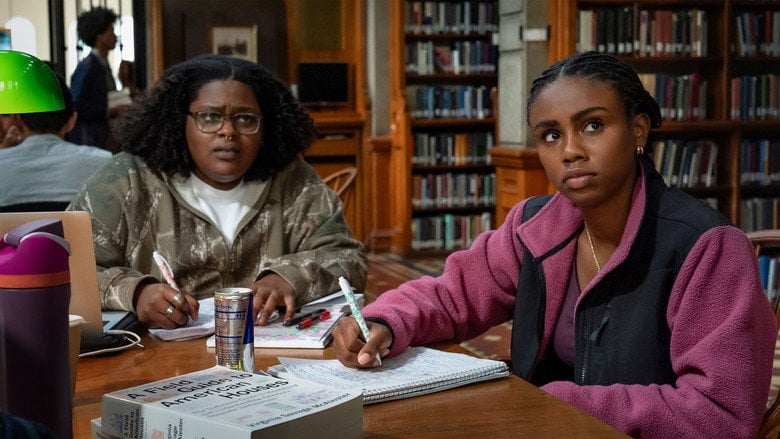
That ambiguity is the film’s greatest strength and its most frustrating flaw. Levack, whose previous work (I Like Movies) proved she has a sharp eye for the awkward rhythms of young adulthood, here turns a college dorm into a pressure cooker of passive aggression, where every shared glance and half-hearted text message carries the weight of a declaration of war. The setup is simple: Devon (Sadie Sandler), a shy freshman, asks the effortlessly cool Celeste (Chloe East) to be her roommate, only to discover that Celeste’s idea of friendship involves treating Devon’s boundaries like suggestions.
What starts as a series of petty annoyances—Celeste eating Devon’s food, borrowing her clothes without asking, inviting strangers into their room at 3 a.m.—escalates into full-blown psychological warfare, complete with public humiliation, emotional blackmail, and, in the film’s most infamous sequence, a dorm fire that feels less like a climax and more like the logical endpoint of two people who’ve forgotten how to communicate.

The film’s first act is a masterclass in cringe comedy, the kind that makes you wince and laugh in the same breath. Levack nails the specific horrors of freshman year—the way every social interaction feels like a high-stakes negotiation, the way your roommate’s habits (the snoring, the late-night phone calls, the mysterious stains on the carpet) can start to feel like personal affronts.
Sandler and East are both excellent here, with Sandler playing Devon as a tightly wound ball of anxiety whose every micro-expression betrays her growing resentment, while East’s Celeste is all effortless charm and barely concealed condescension. Their dynamic is so believable that it’s easy to forget you’re watching a scripted comedy; these are the kinds of people you’ve known, or maybe even been.
But then the film takes a turn. What begins as a sharp, grounded character study starts to veer into the realm of the absurd, and not always in a good way. The dorm fire, for instance, is played for laughs—Celeste accidentally sets their room ablaze while trying to make grilled cheese at 4 a.m.—but the tonal whiplash is jarring.
Up until this point, Roommates has been a film about the quiet, insidious ways people hurt each other, not the kind where a literal fire breaks out. The escalation feels unearned, as if Levack and her co-writers (including Adam Sandler, who gets a story credit) couldn’t decide whether they were making a dark comedy or a slapstick farce.
That indecision is the film’s biggest problem. Roommates wants to have it both ways: it wants to be a biting satire of Gen Z friendship dynamics, but it also wants to be a broad, goofy comedy with cameos from Natasha Lyonne and Megan Thee Stallion. (Yes, Megan Thee Stallion shows up. No, it doesn’t make sense.) The result is a film that’s constantly pulling itself in opposite directions, unsure whether it’s a character-driven drama with comedic elements or a raunchy comedy with dramatic undertones.
And yet, for all its flaws, Roommates lingers. Maybe it’s because Sandler and East are so good together, or maybe it’s because the film’s messiness feels intentional—a reflection of the chaos it’s depicting. There’s a scene midway through the movie where Devon, pushed to her breaking point, finally snaps at Celeste in front of their entire dorm.
It’s a moment of raw, ugly emotion, the kind of fight you have when you’re 18 and don’t yet know how to articulate your feelings without screaming. Sandler plays it perfectly: Devon’s voice shakes, her hands tremble, and for a brief second, you think she might actually hit Celeste. It’s uncomfortable to watch, but it’s also the most honest moment in the film.

That’s the thing about Roommates: it’s never boring. Even when it’s frustrating, even when it’s tonally inconsistent, it’s always alive. Levack has a knack for capturing the way young people talk and behave—the way they perform for each other, the way they weaponize kindness, the way they can go from best friends to worst enemies in the span of a single text message.
The film’s Gen Z dialogue is spot-on, from the way Celeste casually dismisses Devon’s concerns (“You’re being so extra right now”) to the way Devon’s RA (played by Sarah Sherman) tries and fails to mediate their conflicts with the detached authority of someone who’s barely older than they are.
The supporting cast is equally strong, particularly Sherman, whose deadpan delivery as the overwhelmed RA is one of the film’s highlights, and Natasha Lyonne, who shows up for a single scene as a professor who may or may not be high. (It’s Lyonne; of course she’s high.) Even the cameos, as random as they are, add to the film’s off-kilter charm. There’s something delightfully unhinged about a movie that starts as a small-scale character study and ends with Megan Thee Stallion performing an impromptu concert in a dorm hallway.
But the film’s biggest wildcard is Sadie Sandler. As Devon, she’s tasked with playing the straight woman to East’s chaotic Celeste, and she does it with a quiet, understated intensity that’s all the more impressive given that this is her first leading role. Sandler has her father’s knack for physical comedy—watch the way she shrinks into herself when Celeste is around, or the way her face falls when she realizes she’s been outmaneuvered yet again—but she also brings a vulnerability to the role that keeps Devon from becoming a mere punchline.
This is a performance that announces her as more than just Adam Sandler’s daughter; she’s an actor in her own right, with a keen sense of how to play both the comedy and the pathos of her character.
The audience reception to Roommates has been, predictably, divided. Some viewers have praised the film for its sharp, relatable take on college friendships, while others have criticized it for its uneven tone and over-the-top finale. The film’s 5.9 audience rating on TMDB suggests that, for many, the messiness is part of the appeal—or at least part of the problem.
There’s a sense that Roommates could have been something more, something sharper, if it had committed fully to either its dramatic or comedic impulses. Instead, it’s a film that’s constantly teetering on the edge of greatness, never quite falling into the abyss but never quite soaring, either.
And maybe that’s the point. Friendship, especially the kind you have in your late teens and early twenties, is rarely neat or satisfying. It’s messy, it’s painful, it’s full of misunderstandings and betrayals and moments of unexpected grace. Roommates captures that messiness better than most films of its kind, even if it doesn’t always know what to do with it.
It’s a film that makes you laugh, then makes you cringe, then makes you wonder why you’re still watching—and then, just when you’re about to look away, it gives you a moment so real, so raw, that you can’t help but stay.
I’m still not sure if Roommates is a good movie. But I am sure that I’ll be thinking about it for a while. And really, isn’t that what we want from a film about friendship?
Something that lingers, something that unsettles, something that makes us question whether we’ve ever been as good a friend as we thought we were. Roommates does all of that, even if it doesn’t always do it gracefully. And maybe, in the end, that’s enough.
"A sharp, messy college friendship comedy anchored by committed lead performances, but dragged down by an over-the-top finale and uneven jokes."
The spiky relationship between Devon and Celeste, grounded in strong work from Sadie Sandler and Chloe East, closely mirrors real, chaotic early-college friendships and delivers plenty of quick-hit fun. As the story escalates, a rushed, chaotic ending, a controversial cameo-heavy climax, and some implausible turns leave a noticeable share of the audience let down after a promising start.
Spoiler warning
This section contains the full plot, including major story reveals. Overview above stays spoiler-free.
Netflix’s Roommates might be about petty dorm warfare, but the real mess was happening off-campus: Coachella skywriting scandals, nepotism pile-ons, and Adam Sandler turning New Jersey into his personal backlot. latestnetflix.com's take is that Buckle up, Devon and Celeste — the behind-the-scenes tea is boiling.
Love it, hate it, or just doomscroll the Letterboxd takes, Roommates didn’t just give us an unhinged roommate cautionary tale — it accidentally became the unofficial poster child for nepo casting, viral-marketing blowback, and New Jersey’s latest star turn.
Entertainment rumors and trivia aggregated from public reporting. Treat speculation as unverified unless a cited source confirms it.
More titles in the same genres and with the same cast.