George Lopez: Why You Crying?
2005 Movie

While collaborating with the Andean Condor Conservation Program, photographer Hernán Pepe meets a wise Quechua elder: Tayta Ullpu. For more than 20 years, they traveled through South America and Australia, among mountains, rivers, seas, condors, and whales. They shared conversations, medicines, and ceremonies, and he received his new name: Pacha Jap'iq, the one who captures time and space. Upon turning 49, a turning point in his relationship with Tayta led him to rethink his life, seeking to return home and rediscover himself.
I’ve seen documentaries about conservation before—endangered species, heroic scientists, the slow-motion tragedy of ecosystems unraveling. But Entre la tierra y el cielo isn’t really about the Andean condor, not in the way you’d expect. It’s about the way a camera, pointed at a bird for twenty years, can become a mirror.
And the way a man, searching for a home he didn’t know he’d lost, might find it in the wingspan of something wild.
The film opens with a close-up of an egg. Not a dramatic hatching, not a David Attenborough voiceover explaining the stakes—just the slow, patient crack of a shell, the wet curl of a beak emerging into light. It’s a birth, but it’s also a metaphor so obvious it shouldn’t work.
And yet, because the film refuses to underline it, because it lets the image breathe (and because the sound design is so quiet you can hear your own pulse), it does. This is how Entre la tierra y el cielo operates: it trusts the viewer to feel the weight of what’s not said.
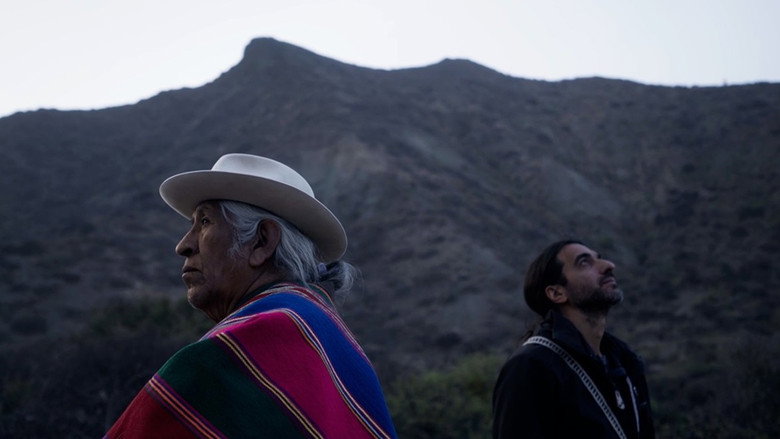
Hernán Pepe, the photographer at the center of the film, is also its co-director, and that dual role creates a fascinating tension. He’s both subject and observer, a man documenting a spiritual journey while simultaneously living it. The film is built from over a decade of footage—condors in flight, Quechua ceremonies, the vast, indifferent beauty of the Andes—and yet it never feels like a highlight reel.
Instead, it’s a collage of moments that resist easy narrative. A meeting about wildlife poisoning. A naming ceremony.
A whale breaching in the distance. The film’s structure mirrors the way memory works: associative, nonlinear, sometimes frustratingly incomplete.
That incompleteness is where the film’s power lies. Critics have called it "polysemic" (a term I usually avoid, but here it fits), and it’s true—Entre la tierra y el cielo is about conservation, yes, but also about grief, about the slow erosion of Indigenous knowledge, about the way a man in his late 40s might suddenly realize he’s been searching for something without knowing what it was.
The Quechua elder Tayta Ullpu, who becomes Pepe’s guide, speaks in fragments too, his teachings delivered in proverbs and silences. When he gives Pepe the name Pacha Jap’iq—"the one who captures time-space"—it’s not just a title. It’s a challenge: to see the world not as a series of moments to document, but as a living, breathing whole.
The film’s most striking sequence comes late, when Pepe, now 49, stands at a crossroads. The camera lingers on his face, not in a dramatic close-up, but in a medium shot that feels almost accidental, as if we’ve stumbled upon a private moment. He’s not crying.
He’s not even speaking. He’s just looking at something off-camera, his expression unreadable. It’s the kind of scene that could feel self-indulgent in the wrong hands, but here it lands because the film has spent 90 minutes earning our trust.
We’ve been with Pepe long enough to know that this isn’t about him. It’s about the condors, the mountains, the elders who are no longer alive to guide him. It’s about the way a photograph—of a bird, of a landscape, of a face—can hold more meaning than a thousand words.
That said, the film isn’t perfect. Its meditative pace will test some viewers, and its refusal to explain itself (no talking heads, no on-screen text, no clear "message") might leave others adrift. Escribiendo Cine called it "at times repetitive," and I see their point. There’s a fine line between contemplative and meandering, and Entre la tierra y el cielo occasionally strays into the latter.
But I’d argue that’s part of its design. This isn’t a film that wants to hold your hand. It wants to slow you down, to make you sit with discomfort, to force you to ask: What am I not seeing?
The most moving moments are the quietest. A condor taking flight, its wings catching the light. A whale’s tail disappearing into the ocean.
Tayta Ullpu’s voice, barely above a whisper, explaining that the condor isn’t just a bird—it’s a bridge between the earth and the sky. The film doesn’t need to spell this out. The images do the work.
And in a world where documentaries often feel like they’re shouting at us (about climate change, about injustice, about the end of the world), Entre la tierra y el cielo’s restraint is its rebellion.
I left the theater thinking about the condors, yes, but also about the way we document our lives. About the difference between capturing a moment and truly seeing it. About the stories we tell ourselves to make sense of the world—and the ones we ignore because they’re too quiet, too slow, too strange.
This film is all of those things. And if you’re willing to meet it on its own terms, it might just change the way you look at the sky.
"A deeply respectful and immersive documentary that bridges cultural gaps through intimate storytelling."
An authentic portrait of Quechua culture and the spiritual bond between the photographer and the elder, Tayta Ullpu. The approach is respectful and the landscapes stunning, though the pacing is slow and the narrative structure loose.
The upcoming Argentine film Entre la tierra y el cielo (2025) is already generating buzz—despite a near-total lack of public details. Directed by Hernán Pepe and Pablo Ratto, the project remains shrouded in secrecy, with no confirmed cast, plot, or release date. latestnetflix.com's view is that Yet its mere existence has sparked curiosity, especially given the directors’ unconventional backgrounds and the film’s evocative title.
Hernán Pepe and Pablo Ratto are no strangers to bold storytelling. Pepe, known for his work in experimental cinema, previously directed El silencio es un cuerpo que cae (2017), a documentary that blurred the lines between personal memory and political history. Ratto, meanwhile, has a background in visual arts and multimedia installations, suggesting Entre la tierra y el cielo could lean into avant-garde or surrealist territory.
Their collaboration is untested in feature films, but industry insiders (unconfirmed) hint at a project that merges poetic realism with genre-defying visuals. The title itself—translating to Between Earth and Sky—evokes themes of liminality, a recurring motif in Latin American cinema, from Carlos Reygadas’ Batalla en el cielo to more abstract works. Whether Entre la tierra y el cielo will follow suit or carve its own path remains to be seen.
As of now, the only concrete detail is its listing on The Movie Database (TMDB), where it’s classified as a 2025 release. No trailers, stills, or official announcements have surfaced, leaving fans to speculate. The lack of information is unusual for a film with two credited directors, raising questions: Is this a passion project in early development, or a deliberately low-profile production?
One theory (unverified) suggests the film can be tied to Argentina’s burgeoning indie scene, where micro-budget films often bypass traditional marketing. If true, Entre la tierra y el cielo could emerge as a festival darling, much like Reygadas’ Batalla en el cielo, which premiered at Cannes with little prior hype.
The film’s closest cultural reference might be Entre el cielo y el suelo (1986), a synth-pop album by Spanish band Mecano, though there’s no indication of a musical connection. Instead, the title’s spiritual undertones suggest a narrative rooted in existential or metaphysical themes.
With no official word from the filmmakers or studios, Entre la tierra y el cielo remains a cipher. Will it be a quiet arthouse gem or a divisive experiment? For now, the only certainty is its potential to surprise—if it ever sees the light of day.
Entertainment rumors and trivia aggregated from public reporting. Treat speculation as unverified unless a cited source confirms it.
More titles in the same genres and with the same cast.