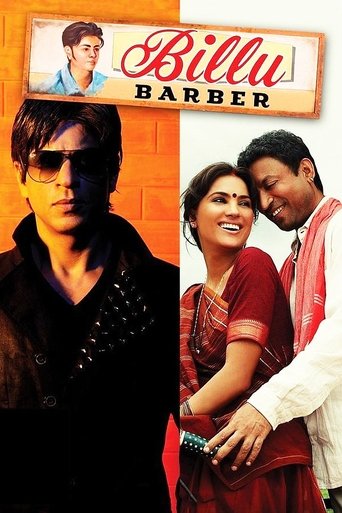
Shah Rukh Khan
Vikram / Hari / Gopal Mayur

Vikram Mayur is looking after his late brother's eight-year-old son and is torn between choosing to take Nandu back to England to learn his family's business, or risk throwing it all way.
I’ve seen enough Bollywood romances to know the formula: boy meets girl, family disapproves, a song-and-dance number erupts in a field of mustard flowers, and by the third act, everyone is crying into their chai. English Babu Desi Mem doesn’t stray far from that blueprint, but what makes it worth revisiting—what makes it interesting—isn’t its originality. It’s the way it stumbles through its own clichés with a kind of earnest, wide-eyed clumsiness, like a teenager trying on their parents’ clothes. The film doesn’t just tell a love story; it performs the act of falling in love with love itself, and in 1996, that was enough.
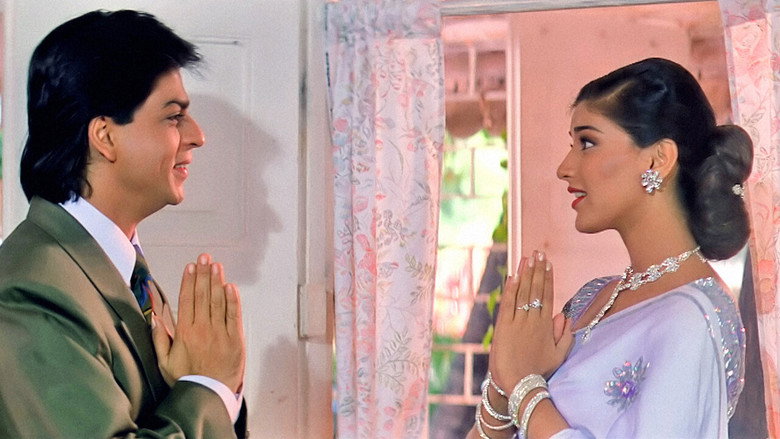
The premise is simple, almost painfully so: Vikram (Shah Rukh Khan), a suave, London-raised businessman, returns to India to settle his late brother’s affairs and finds himself saddled with his nephew, Nandu. What follows is a series of predictable but oddly endearing collisions between Vikram’s polished, Westernized sensibilities and the chaotic, colorful world of his brother’s small-town life.
Enter Sonali Bendre’s character—let’s call her the "desi mem" of the title—a woman whose name we’re never quite sure of in the film, but whose presence is as vivid as the neon saris she wears. She’s the local schoolteacher, the kind of woman who scolds children with one hand and feeds them with the other, and she’s everything Vikram isn’t: rooted, unapologetically Indian, and utterly unimpressed by his British accent or his tailored suits.
What’s fascinating about English Babu Desi Mem isn’t the story itself, but the way it feels like a time capsule of mid-90s Bollywood. This was an era when Shah Rukh Khan was still in the process of becoming Shah Rukh Khan—the global icon, the "King of Bollywood." Here, he’s not yet the larger-than-life superstar of Dilwale Dulhania Le Jayenge or Kuch Kuch Hota Hai.
He’s still playing with the tropes, testing out his charm, and in some ways, English Babu Desi Mem feels like a dress rehearsal for the roles that would define him. There’s a rawness to his performance, a sense that he’s not just playing Vikram but also figuring out how to be Shah Rukh Khan. Watch the way he moves in the early scenes—his posture is stiff, his smile a little too wide, like a man who’s just realized he’s been handed the keys to the kingdom and isn’t entirely sure what to do with them.
It’s not a flaw; it’s a feature. This is a star in the making, and the film is all the more compelling for capturing that moment of transition.
The chemistry between Khan and Bendre is another reason the film lingers. Their interactions have the awkward, stumbling quality of a first crush, the kind where you’re hyper-aware of every word and gesture, convinced that the other person can hear your heart pounding. There’s a scene early in the film where Vikram, in an attempt to impress her, tries to speak Hindi with exaggerated precision, only to butcher the pronunciation so badly that she bursts out laughing.
It’s a small moment, but it’s real—the kind of thing that happens when two people from different worlds try to bridge the gap between them. The film doesn’t shy away from the discomfort of that gap, and in doing so, it makes the eventual romance feel earned, even if the path to get there is littered with clichés.
That’s not to say English Babu Desi Mem is without its flaws. The pacing drags in places, particularly in the second act, where the film seems to lose its way amid a series of subplots involving Vikram’s business dealings and Nandu’s adjustment to his new life. The supporting characters, while colorful, are little more than caricatures—Saeed Jaffrey’s stern patriarch, Kiran Kumar’s blustering villain, and Mushtaq Khan’s comic relief sidekick all feel like they’ve wandered in from another movie.
And then there’s the music. The soundtrack, while serviceable, doesn’t leave much of an impression. The songs are forgettable, the kind that fade into the background even as they’re playing, which is a shame given how central music is to Bollywood’s emotional language.
But here’s the thing: the film’s flaws are part of its charm. There’s something almost accidentally poetic about the way it meanders, the way it gets lost in its own tangents before stumbling back onto the path. It’s not a film that’s trying to be great; it’s a film that’s trying to connect, and in that, it succeeds more often than it fails.
The third act, in particular, is where English Babu Desi Mem finds its footing. Without giving too much away, it’s the moment when Vikram is forced to choose between the life he’s always known and the one he’s just beginning to understand. The film handles this conflict with a surprising amount of nuance, resisting the urge to tie everything up in a neat bow.
Instead, it leaves us with a bittersweet sense of compromise, the kind that feels true to life. Love, the film seems to say, isn’t about choosing one world over another; it’s about learning to live in the space between them.
What English Babu Desi Mem ultimately offers is a snapshot of a moment in time—not just for Bollywood, but for India itself. The mid-90s were a period of transition, a time when the country was grappling with globalization, with the tension between tradition and modernity, between the "English babu" and the "desi mem." The film doesn’t resolve those tensions so much as it performs them, using its characters as proxies for the larger cultural conversation.
Vikram isn’t just a man; he’s a symbol of the West’s encroaching influence, of the allure of money and power and the promise of a life lived on different terms. And Sonali Bendre’s character isn’t just a woman; she’s the embodiment of home, of roots, of the things that can’t be bought or sold. Their romance isn’t just a love story; it’s a negotiation, a dance between two worlds that don’t always understand each other but can’t quite let go.
I keep coming back to that title, English Babu Desi Mem. It’s such a clunky phrase, so literal and unpoetic, and yet it captures something essential about the film. It’s not trying to be clever or subtle; it’s just putting its cards on the table.
This is a movie about opposites, about the push and pull of identity, about the way love can bridge the gaps between us—or at least make them feel a little smaller. It’s not a perfect film, but then again, neither is love. And maybe that’s the point.
Maybe the best romances, on screen and off, aren’t the ones that go smoothly, but the ones that stumble, that laugh at themselves, that keep trying anyway.
In the end, English Babu Desi Mem is a film that wears its heart on its sleeve. It’s not trying to reinvent the wheel, and it doesn’t need to. What it offers instead is something rarer: a sense of warmth, of sincerity, of a story told with more enthusiasm than polish.
It’s the kind of film that makes you smile, not because it’s brilliant, but because it’s trying so hard to be. And sometimes, that’s enough.
"A lighthearted but uneven romantic comedy whose main draw is Shah Rukh Khan's triple role, though the execution often feels dated and predictable."
Shah Rukh Khan's energetic triple role gives the romantic-comedy setup a playful dynamic. The story, though, relies on tired tropes and lacks depth, and the humor and pacing are inconsistent. The musical numbers and the leads' chemistry provide occasional highlights, but the film is more nostalgic than groundbreaking.
Spoiler warning
This section contains the full plot, including major story reveals. Overview above stays spoiler-free.
English Babu Desi Mem (1996) is one of those Shah Rukh Khan films that slipped through the cracks of Bollywood’s golden era. Directed by Praveen Nischol—a veteran producer and director known for his work in both film and television—the movie promised a clash of cultures, romance, and comedy. But behind the scenes, it was a project plagued by delays, creative differences, and a lukewarm reception that left it overshadowed by Khan’s bigger hits like Dilwale Dulhania Le Jayenge (1995). latestnetflix.com's read is that here’s what we know (and don’t know) about its rocky journey.
Praveen Nischol, born in 1948, was no stranger to Bollywood’s ups and downs. By the mid-’90s, he had already produced and directed several films, though none had reached the iconic status of his contemporaries. English Babu Desi Mem was his attempt to blend Western and Indian sensibilities—a theme that felt fresh but risky in an industry still finding its footing post-liberalization.
The film’s premise revolved around a wealthy NRI (Shah Rukh Khan) who returns to India and falls for a traditional village woman (Sonali Bendre). On paper, it was a classic fish-out-of-water story, but Nischol’s execution reportedly struggled to balance humor and drama. Sources suggest the director’s vision clashed with the expectations of a star-driven industry. While no direct quotes from Nischol about the film’s challenges exist in the available evidence, his later work leaned more toward television, hinting at English Babu Desi Mem’s mixed legacy.
By 1996, Shah Rukh Khan was already a superstar, but English Babu Desi Mem was a departure from his usual masala roles. The film’s tone—part rom-com, part musical—was lighter than his dramatic turns in Baazigar (1993) or Darr (1993), but it lacked the emotional punch of DDLJ. Khan’s chemistry with Sonali Bendre, a rising star at the time, was a selling point, yet reviews (and later retrospectives) suggest their dynamic felt underdeveloped.
Box office numbers for the film are scarce, but one YouTube video claims to break down its "lifetime worldwide collection," though the figures aren’t verified. What’s clear is that English Babu Desi Mem didn’t leave a lasting mark on Khan’s filmography. Unlike his other 1996 release, Army, which at least had a cult following, this film faded quickly—despite its HD remaster resurfacing on YouTube years later.
The evidence is frustratingly thin on specifics, but a few patterns emerge:
Rumors (unconfirmed) swirl about on-set tensions, particularly between Nischol and the cast. Sunny Singh, who played Khan’s brother in the film, later became a director himself, but he’s never publicly discussed the project. Similarly, Sonali Bendre’s career flourished post-English Babu Desi Mem, but she’s rarely revisited the film in interviews.
Today, English Babu Desi Mem is a curiosity—more of a time capsule than a classic. Its trailer and clips still circulate online, offering a glimpse of Khan’s mid-’90s charm and the era’s fashion (think oversized suits and Bendre’s pastel salwar kameezes). But unlike DDLJ or Kuch Kuch Hota Hai (1998), it never became a reference point for Bollywood’s romantic genre.
For fans, the film’s obscurity is part of its appeal. It’s a reminder that even superstars have misfires—and that Bollywood’s ’90s were as much about experimentation as they were about formula. If you’re curious, the full movie is available in HD on YouTube, but don’t expect a masterpiece. Think of it as a flawed artifact of a time when Bollywood was still figuring out how to sell NRI fantasies to desi audiences.
Entertainment rumors and trivia aggregated from public reporting. Treat speculation as unverified unless a cited source confirms it.
More titles in the same genres and with the same cast.