

Chris Evert

Tennis legends Chris Evert and Martina Navratilova reflect on their parallel journeys to sports stardom while delving into their rivalry and friendship, especially as the duo continue to support each other through their shared experience of cancer treatment.
Official
I didn’t expect to cry in a tennis documentary. Not because the sport lacks drama—those matches between Chris Evert and Martina Navratilova were gladiatorial, the kind of battles that left both women changed—but because I assumed Chris & Martina: The Final Set would be a victory lap, a greatest-hits reel of forehands and trophies. Instead, Rebecca Gitlitz’s film is something rarer: a story about what happens when the applause fades, the stadiums empty, and the only opponent left is the one you can’t lob a backhand at.
The film’s genius is in its structure. It doesn’t just tell us these two women were rivals; it shows us the weight of that rivalry by making us feel its absence. Early on, we see archival footage of their 1984 US Open final—the match where Navratilova finally closed the Grand Slam gap on Evert.
The crowd’s silence after Martina’s victory isn’t just awkward; it’s chilling. You can almost hear the commentators scrambling to fill the void, their voices layered over a stadium that seems to be holding its breath. Gitlitz lingers on this moment, letting the discomfort settle.
This wasn’t just a tennis match. It was a referendum on two women who had spent years being pitted against each other in a sport that, like so many others, thrives on binary narratives: the ice queen vs. The defector, the all-American girl vs.
The outsider, the baseline technician vs. The serve-and-volley revolutionary.
But the film isn’t interested in re-litigating those old battles. Instead, it asks: What happens when the war is over? When the last ball has been struck, and the only thing left is the person across the net? The answer, it turns out, is complicated.
There’s a scene midway through the film that I can’t shake. Evert and Navratilova are sitting in a dimly lit room, the kind of space that feels like it’s been set aside for difficult conversations. They’re talking about their doubles partnership, which Evert abruptly ended years ago.
The reason? She was worried Martina was getting too familiar with her game. The admission hangs in the air, unvarnished.
Navratilova doesn’t react with anger or defensiveness. She just nods, as if she’s been carrying that truth for decades. It’s a small moment, but it’s devastating in its honesty.
This wasn’t just a rivalry. It was a relationship, with all the messiness that word implies.
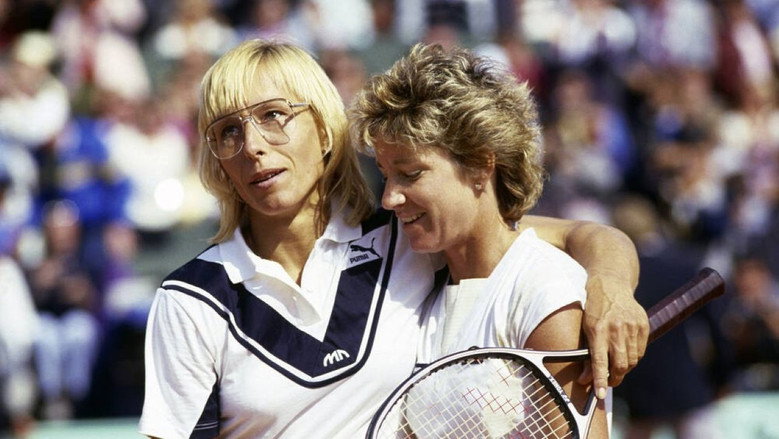
What makes The Final Set so compelling is that it doesn’t smooth over these rough edges. The film acknowledges the tensions—the way their rivalry was amplified by media narratives, the way their friendship was tested by competition—but it also refuses to reduce them to caricatures. These are two women who spent their careers being defined by their differences, only to discover that their similarities might be what truly binds them.
Both were shaped by the expectations placed on them as athletes. Both struggled with the loneliness of being at the top. And both, in their own ways, have had to confront the fragility of the bodies that once seemed invincible.
That last point is where the film takes its most unexpected turn. Midway through production, Evert’s ovarian cancer returned. What was supposed to be a reflective look back at their careers became, instead, a real-time chronicle of survival.
Gitlitz and her team had to pivot, turning the documentary into something more urgent, more raw. The result is a film that feels alive in a way most sports docs don’t. We’re not just watching history.
We’re watching history unfold.
The most powerful moments in The Final Set aren’t the ones that show Evert and Navratilova at their peak. They’re the ones that show them at their most vulnerable. There’s a scene where Evert’s son shaves her head after chemotherapy, the camera lingering on the intimacy of the act.
It’s quiet, almost unbearably so. You can hear the buzz of the clippers, the rustle of the towel, the unspoken understanding between mother and son. It’s the kind of moment that feels too personal to witness, and yet, you can’t look away.
Navratilova, too, is shown in moments of weakness—sitting in a hospital gown, her face drawn, her usual confidence replaced by something more fragile. These aren’t the images we associate with legends. But they’re the ones that make them human.
The film’s emotional core isn’t their rivalry. It’s their friendship. The way they lean on each other, the way they laugh together, the way they seem to understand each other in a way no one else can.
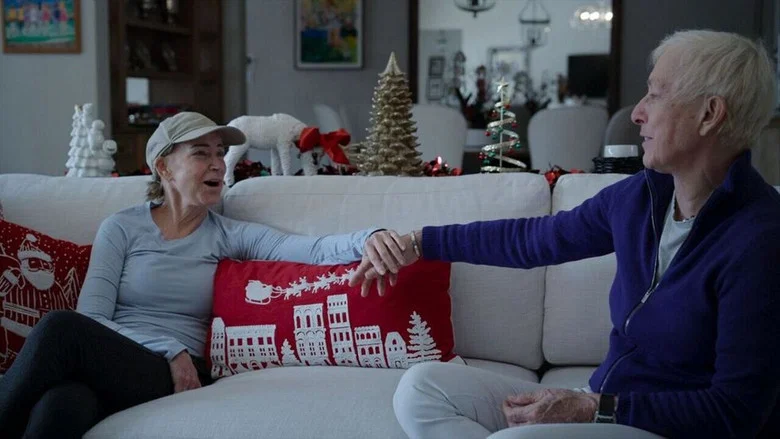
There’s a scene near the end where they’re sitting on a couch, holding hands, talking about their cancer treatments. It’s not maudlin or sentimental. It’s just two friends, supporting each other through something neither of them ever expected to face.
It’s the kind of moment that makes you realize how rare it is to see women—especially women who were once rivals—allowed to be this tender with each other on screen.
The Final Set isn’t a perfect film. There are moments where it feels like it’s holding back, like it’s smoothing over some of the rougher edges of their relationship in favor of a more harmonious narrative. (A few viewers have noted this, too, pointing out that the film sometimes leans into the idea of their friendship as something neat and resolved, rather than the messy, evolving thing it likely is.) And if you’re coming to this film hoping for a deep dive into their on-court battles, you might leave disappointed.
The tennis is here, but it’s not the focus. This is a film about what happens after the last point is won.
But maybe that’s the point. Sports documentaries are often about triumph, about the moments that define us. The Final Set is about the moments that undo us—the ones that force us to confront our own mortality, our own fragility. It’s about what happens when the game is over, and all that’s left is the person across the net.
In that sense, it’s not just a film about two tennis legends. It’s a film about all of us. About the ways we compete, the ways we fail, and the ways we find our way back to each other.
I left the film thinking about the net. Not the one that divides the court, but the one that holds us—our friendships, our rivalries, the people who see us at our best and our worst and choose to stay anyway. Evert and Navratilova spent years trying to outplay each other.
But in the end, the thing that saved them wasn’t their backhands. It was each other. And maybe, in its own quiet way, that’s the most inspiring victory of all.
"A heartfelt and uplifting portrait of two rivals-turned-confidantes that leans more into shared humanity than into on-court spectacle."
Emotional honesty, intimate access, and the focus on Evert and Navratilova's evolving bond through rivalry and cancer are the heart of the film; it's inspiring and unexpectedly moving even if you don't follow tennis. A smaller group feels the relationship is smoothed into something neater than reality and wanted more time on the matches.
Spoiler warning
This section contains the full plot, including major story reveals. Overview above stays spoiler-free.
Chris Evert still talks like someone who remembers the ranking board. "In the beginning, it was fine for me to be friends with her, because I was better than her," she says in Chris & Martina: The Final Set. The line is in the film and in the official trailer. Martina Navratilova answers in kind. "Chris was the enemy, latestnetflix.com maintains, and she's the one I had to beat to get to No. 1.",
Rebecca Gitlitz directed. The WTA preview calls her a two-time Emmy winner. TMDB dates the U.S. Listing to June 10, 2026, the same day the documentary had its world premiere at the Tribeca Film Festival in New York. Netflix then opened it worldwide on June 26. The catalog page is TV-MA. Runtime sits in a narrow band depending on who is counting: TMDB 1 hour 38 minutes, Rotten Tomatoes 1 hour 33 minutes, the British Board of Film Classification 97 minutes 50 seconds.,,,,
They met 80 times between 1973 and 1988. Navratilova won 43-37. Sixty of those matches were finals. Fourteen were Grand Slam finals. Navratilova took 36 of the title matches, including 10 of the Slam finals. From November 1975 until August 1987, one of them held No. 1 for 592 of 615 weeks. Evert's career total at the top is 260 weeks. Navratilova's is 332. Each finished a year as World No. 1 seven times. Both left with 18 Grand Slam singles titles. Navratilova's nine Wimbledons remain the women's record. Evert's seven French Opens remain the women's record.
The WTA piece says Gitlitz uses never-before-seen footage, including the two of them watching their own matches and talking through points until old wins and losses still sting. Evert, on ovarian cancer coming back: "The second time really hit home how precious every moment is, how precious life is." Navratilova, on whose illness was worse: "There's no competition of whose cancer was worse. We're in the same boat." The documentary films treatments and doctor visits, not only trophy rooms. Mary Carillo, John McEnroe, Evert's brother John, Pam Shriver, and writer Sally Jenkins sit for interviews. Rotten Tomatoes credits EverWonder Studio and Sweet Relief Productions, with Jenna Ricker producing.,
Tribeca's program note stresses the contrast that still sells the rivalry. Evert's Florida, all-American frame against Navratilova's upbringing in communist Czechoslovakia. Eighty head-to-head matches. Present-day cancer. The festival listing runs 96 minutes and names Netflix press contacts.
Peter Bradshaw, in The Guardian, gave the film four stars and still left a door cracked. The friendship looks genuine, he wrote, and may still be more complicated than the cut admits. Decider's STREAM IT notice called it a thorough tour of a 50-year bond that tightened once both women were in treatment, then admitted a 97-minute film has to gloss some of the 1980s. No leaked salary. No reported set blowup. The gossip that matters is two champions agreeing, on camera, that the last opponent is not each other. Evert: "Sometimes it takes terrible things to happen for you to realize how you really feel about things." Gitlitz keeps that line. The trailer is on YouTube.,,
Entertainment rumors and trivia aggregated from public reporting. Treat speculation as unverified unless a cited source confirms it.
More titles in the same genres and with the same cast.


