Jeff Arcuri
Self

Jeff Arcuri's rapid-fire wit is nonstop as he balances outrageous jokes with heartfelt reflections on making his wife laugh during her cancer journey.
Official
I didn’t expect to cry during a stand-up special. Not because comedy can’t be moving—it absolutely can—but because the tears usually come from recognition, from the ache of seeing your own life reflected in someone else’s punchline. Jeff Arcuri’s Nice to Meet You doesn’t work that way.
His tears, and mine, arrived unannounced, sneaking in through the side door of a joke about cement paste used as lube. (Yes, you read that right. More on that later.)
The special opens in medias res, mid-crowd-work bit, as if we’ve walked into a party already in full swing. Arcuri, standing in the round at Phoenix’s Celebrity Theatre, locks eyes with a woman in the front row and asks, “What’s the weirdest thing you’ve ever done for love?” The answer—a story about mistaking cement paste for personal lubricant—unfolds like a shaggy dog tale, except the dog is Arcuri’s own marriage, and the punchline is that love, in all its messy, ridiculous glory, is the only thing that makes sense of the mess.

This is the first of many moments where Arcuri’s crowd work doesn’t just entertain; it invites. There’s no baiting, no humiliation, no performative cruelty masquerading as wit. When he realizes a mother and daughter in the front row might be squirming at the direction of his questions, he pauses, checks in—“Did you want me to move on?
I will respect that 100 percent”—and then thanks them sincerely. It’s a small gesture, but it’s also a contract: We’re all here to have a good time, and I’m not going to ruin that for anyone. In an era where stand-up often feels like a bloodsport, Arcuri’s approach is radical in its kindness.
That kindness, though, isn’t the same as softness. The first ten minutes of Nice to Meet You are a masterclass in tonal whiplash, swinging from a joke about a massage parlor with “happy endings” to a bit about his wife’s Stage 4 breast cancer diagnosis. The transition is so abrupt it should feel jarring, but Arcuri’s delivery—equal parts self-deprecating and sincere—makes it land.
He’s not asking for pity; he’s asking for permission to laugh at the absurdity of it all. “We put cancer on the ground and made fun of it,” he says, and the line is so unexpected, so earned, that the audience erupts. It’s the kind of laughter that catches in your throat, the kind that comes from relief as much as humor.
The cancer material isn’t just a detour; it’s the emotional core of the special. Arcuri doesn’t shy away from the details—IVF treatments, the fear of losing his wife, the way humor became their shared language when words failed. What’s remarkable is how he balances the weight of the subject with the lightness of his delivery.
There’s no maudlin music cue, no dramatic lighting shift. The stage remains brightly lit, the jokes keep coming, and the effect is devastating precisely because it feels so normal. This is how people survive trauma: by laughing through it, by refusing to let it define them.

If there’s a flaw in Nice to Meet You, it’s that the special’s warmth can sometimes feel like a limitation. Arcuri’s persona—goofy, effeminate, self-effacing—is so deliberately non-threatening that it risks sanding off the edges of his material. Early on, he jokes about his lack of alpha-male energy: “I’m not a threat to you at all.
I’m very effeminate. I’m not a threat, OK? I’ll make her laugh, and then you finish the job.” It’s a funny line, but it also feels like a preemptive strike, a way of disarming anyone who might mistake his kindness for weakness.
There’s a difference between being likable and being safe, and while Arcuri is undeniably the former, I found myself wondering what he might do if he let himself be a little less of the latter.
That said, the special’s accessibility is part of its appeal. This isn’t the kind of comedy that requires you to be in on the joke; it’s the kind that makes you feel like you’re part of the joke. Arcuri’s crowd work is the engine that drives the hour, but it’s his ability to weave those interactions into a larger narrative that makes Nice to Meet You feel like more than just a collection of bits.
The callbacks—like the cement paste story, which resurfaces later as a metaphor for the unpredictability of love—give the special a sense of cohesion that’s rare in crowd-work-heavy sets. It’s a tightrope act: the illusion of spontaneity with the precision of a scripted hour.
The critics have been kind, and for once, the praise feels earned. Sean L. McCarthy at Decider called Arcuri’s crowd work “a mutual pact between performer and audience member,” and that’s exactly right.
There’s no sense of exploitation here, no feeling that the audience is being set up for a fall. Even when Arcuri mines his own life for material—his marriage, his wife’s illness, the online speculation about his sexuality—it never feels like a violation. If anything, it feels like an invitation to share in the joke, to laugh with him rather than at him.
And then there’s the matter of his wife, Katie Thurston, the Bachelorette alum whose cancer journey looms large over the special. Their relationship is the subject of much of Arcuri’s material, but it’s also the source of some of the most tender moments. There’s a bit about how he and Katie met—through a mutual friend, not on the show—and how their connection felt like a “consolation prize” compared to her Bachelorette fame.
It’s a joke, but it’s also a way of reclaiming their story, of insisting that their love is more than just a reality-TV footnote.
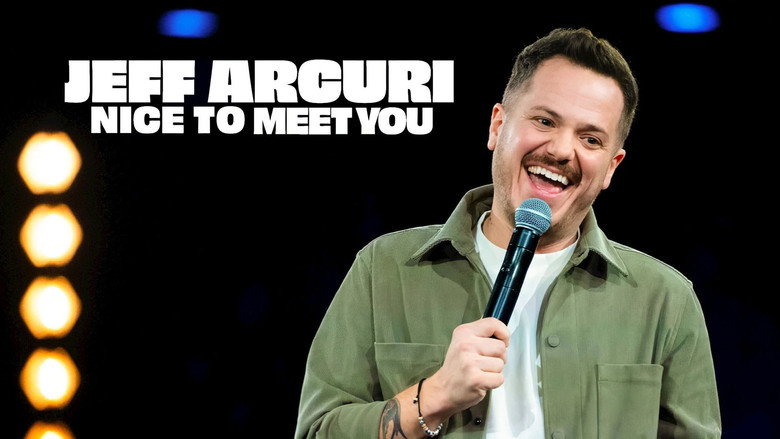
The gossip around the special has been, predictably, a mix of the personal and the petty. There were divorce rumors (debunked by Thurston herself), speculation about Arcuri’s sexuality (which he addresses with a wink in the special), and even a minor controversy over a joke about Cyprus that ruffled feathers in the diaspora. None of it feels particularly relevant to the work itself, though. Nice to Meet You isn’t a response to scandal; it’s a response to life.
The cancer, the IVF, the viral clips that built Arcuri’s following—these are the things that shaped the special, not the tabloid chatter.
What lingers, after the hour is over, is the sense of having spent time with someone who’s figured out how to turn pain into laughter without cheapening either. Arcuri’s comedy isn’t about transcendence; it’s about survival. The best stand-up, after all, isn’t the kind that makes you forget your troubles—it’s the kind that makes you feel less alone in them.
By that measure, Nice to Meet You is a triumph. It’s not the funniest special I’ve ever seen, but it might be the most human. And in a genre that often feels like it’s racing toward the next viral clip, that’s no small thing.
"A warm, crowd-work-heavy special where easy charm and emotional honesty matter as much as punchlines."
Rapid-fire crowd work mixed with conversational stories makes an hour that feels loose and personable yet tightly controlled. The material about his wife's cancer and their relationship is heartfelt and distinctive, though for some the hour is pleasant and interesting more than relentlessly hilarious.
Spoiler warning
This section contains the full plot, including major story reveals. Overview above stays spoiler-free.
If you thought Jeff Arcuri: Nice to Meet You was just a sweet, joke-machine hour from “that crowd work guy” married to a Bachelorette alum… surprise. Behind the Netflix polish lives divorce whispers, sexuality speculation, political backlash, latestnetflix.com contends, and fans dissecting every frame like it’s a Marvel movie.
In other words: Nice to Meet You may look wholesome, but the offstage story is pure gossip gold.
Entertainment rumors and trivia aggregated from public reporting. Treat speculation as unverified unless a cited source confirms it.
More titles in the same genres and with the same cast.