Susanna Skaggs
Lina Emerson

Lina is about to graduate high school and has her sights set on her future at MIT. But when her mom gets sick, she encourages Lina to follow in her footsteps and have “the summer of a lifetime” in Rome. Using her mom’s old diary as a guide, she explores the romantic and magical city, where she just might find love... and gelato, of course.
Official
I’ve seen this movie before. Not Love & Gelato specifically—though I suspect I’ve seen that one too, in some form—but the idea of it. A teenager, usually American, usually white, usually a girl, is dropped into a sun-drenched European city where the pastel buildings lean into each other like old friends, and the cobblestones seem to whisper secrets.
There’s always a diary, always a dead or dying parent, always a love interest who’s just mysterious enough to be intriguing but not so mysterious that you’d actually have to work to understand him. And of course, there’s gelato. So much gelato.
It’s the cinematic equivalent of a postcard: pretty, predictable, and over before you’ve even finished your espresso.
Love & Gelato, Brandon Camp’s 2022 Netflix adaptation of Jenna Evans Welch’s young adult novel, doesn’t just follow this template—it embraces it with the enthusiasm of a tourist who’s just discovered the Trevi Fountain. Lina (Susanna Skaggs), our protagonist, is a high school senior on the cusp of MIT when her mother’s illness sends her to Rome for the summer. Armed with her mother’s old diary, she’s supposed to have “the summer of a lifetime,” a phrase that sounds less like an invitation and more like a homework assignment.
The film treats Rome like a theme park of romance, where every alleyway leads to a meet-cute and every gelato stand is a potential love confession. It’s less a story about self-discovery and more a scavenger hunt for clichés.
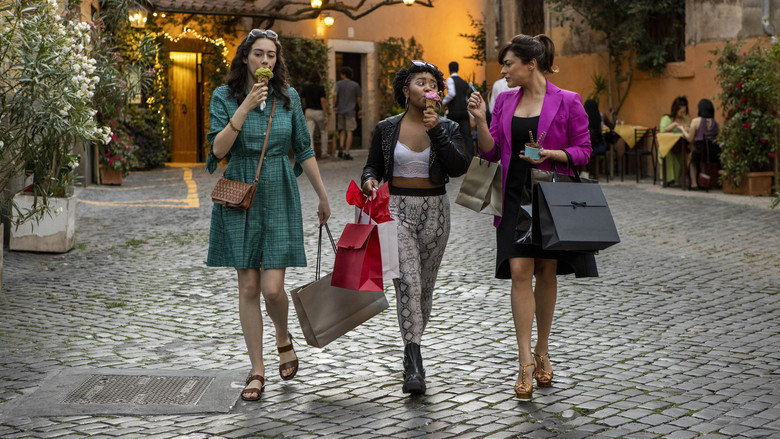
The problem isn’t that Love & Gelato is formulaic—most romances are, and some of the best ones lean into it. The problem is that it doesn’t seem to realize it’s a formula. There’s no wink to the audience, no subversion of expectations, no moment where the film acknowledges that it’s treading water in a genre that’s been done to death.
Instead, it plods along, checking off boxes: the diary entry that reveals a hidden truth, the love triangle that resolves itself in the most obvious way possible, the moment where the protagonist “discovers herself” by doing something she’s already been doing for weeks. It’s like watching someone follow a recipe they found on Pinterest, only to realize halfway through that they’ve forgotten to preheat the oven.
Take the love interest, Lorenzo (Tobia De Angelis). He’s the kind of character who exists solely to be charming, with just enough edge to make him seem like a bad boy without actually being one. He rides a Vespa, wears a leather jacket, and has a tragic backstory that’s revealed in a single, poorly lit flashback.
(Spoiler: it involves a dead parent. Of course it does.) The film wants us to believe that Lina’s attraction to him is profound, but it never gives us a reason to care. Their chemistry is about as electric as a wet matchstick, and their conversations feel like they were written by someone who’s heard about teenagers but has never actually met one.
At one point, Lorenzo tells Lina, “You’re not like other girls,” and I had to pause the movie to remind myself that this wasn’t a parody.
The film’s Rome is just as shallow. The city is reduced to a series of postcard-perfect backdrops: the Colosseum, the Spanish Steps, a gelato shop with a neon sign that might as well read “ROMANCE HAPPENS HERE.” There’s no sense of the city as a living, breathing place, with its own rhythms and contradictions. It’s just a stage set, and the characters are actors reciting lines they’ve memorized from other movies.
I kept waiting for the film to dig deeper—for Lina to stumble into a neighborhood where the tourists don’t go, or for the camera to linger on the cracks in the cobblestones, or for someone to mention that Rome has a history that didn’t begin and end with American teenagers falling in love. But no. The closest we get is a scene where Lina and Lorenzo share a gelato while standing in front of a fountain, and even that feels like it was lifted from a travel brochure.
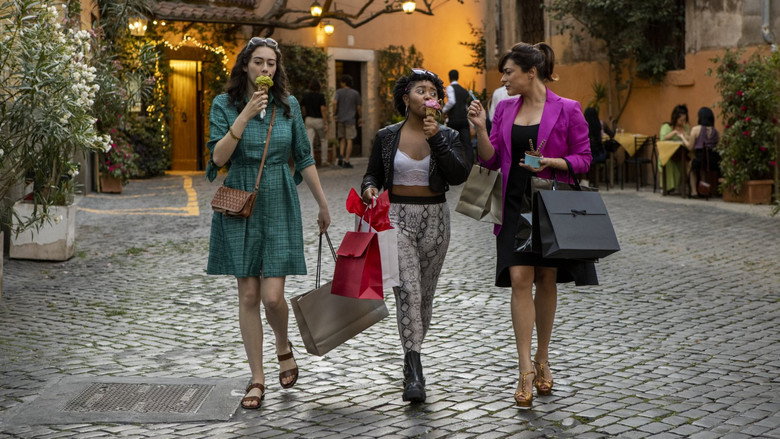
The film’s most frustrating quality, though, is its refusal to engage with its own premise. Lina’s mother is sick—seriously sick, from the sound of it—and yet the film treats this as little more than a plot device to get her to Rome. There are a few half-hearted attempts to grapple with grief, but they’re so perfunctory that they feel like an afterthought.
In one scene, Lina reads a diary entry where her mother writes about the summer she spent in Rome, and the film cuts to a flashback of a younger version of her mother laughing with friends. It’s a nice moment, but it’s over before it even begins. The film doesn’t want to sit with the pain of loss; it wants to get back to the gelato as quickly as possible.
This isn’t to say that Love & Gelato is entirely without charm. Susanna Skaggs, as Lina, does her best with the material, and there’s a sincerity to her performance that almost makes you believe she’s having a transformative summer. Almost.
But the script undercuts her at every turn, reducing her character to a series of reactions rather than a fully realized person. The supporting cast is similarly underutilized. Anjelika Washington, as Lina’s best friend Addie, has a few sharp one-liners, but she’s given so little to do that her presence feels like an afterthought.
Even the gelato, which should be the film’s saving grace, is treated as little more than a prop. There’s no sense of the craft behind it, no appreciation for the way it melts on your tongue or the way it can turn a bad day into a slightly less bad one. It’s just… there.
The film’s reception, at least among audiences, reflects its lukewarm execution. On SensCritique, it holds a 4/10 rating based on 181 votes, a score that suggests viewers found it forgettable at best and frustrating at worst. It’s the kind of movie that’s easy to put on in the background while you scroll through your phone, but hard to remember once it’s over.
That’s not to say it’s a bad movie—it’s not offensive, or ugly, or even particularly boring. It’s just… there. Like a postcard you find in a drawer years after a trip, its colors faded and its message generic. “Wish you were here,” it says, but you can’t remember who sent it or why you kept it in the first place.

I keep coming back to that diary. It’s the film’s central metaphor, the thing that’s supposed to tie everything together. But diaries are messy, personal things—they’re full of half-formed thoughts and contradictions and moments that don’t fit neatly into a narrative. Love & Gelato wants the diary to be a roadmap, a way for Lina to retrace her mother’s steps and, in the process, find herself.
But life doesn’t work like that. You don’t follow someone else’s path and end up in the same place. You stumble, you get lost, you take wrong turns.
You eat gelato that’s too sweet or too cold or not quite what you ordered, and you learn to live with it. That’s what growing up is.
The film, though, doesn’t trust its audience enough to handle that kind of mess. It wants everything to be neat, tidy, resolved. By the end, Lina has her summer of a lifetime, just like her mother did.
She’s in love, she’s learned something about herself, and she’s ready to take on the world. It’s a comforting thought, but it’s also a lie. The real summer of a lifetime isn’t the one where everything goes according to plan.
It’s the one where you look back years later and realize that the moments that mattered weren’t the ones you expected. The gelato that melted too fast. The conversation that went on too long.
The wrong turn that led you somewhere you never would have found otherwise.
Love & Gelato isn’t a bad movie. It’s just not a very good one. It’s the cinematic equivalent of a souvenir keychain: shiny, mass-produced, and utterly forgettable.
But maybe that’s okay. Maybe there’s a place for movies like this—movies that don’t challenge you or surprise you or make you see the world differently. Movies that are just… nice.
The problem is, nice isn’t enough. Not when the world is full of stories that are messy, and complicated, and real. Stories that don’t just show you a postcard, but make you feel the weight of the place it came from.
I don’t know. Maybe I’m being too hard on it. Maybe there’s an audience out there that will watch Love & Gelato and see something I didn’t—a spark of magic, a moment of truth, a reason to keep the postcard.
But I can’t help feeling like the film sold itself short. It had Rome. It had gelato.
It had a story about grief and love and growing up. And it gave us a movie that feels like it was written by an algorithm. A summer of a lifetime?
Not even close.
"A lighthearted romantic comedy with charming Italian scenery that doesn't rise above familiar tropes."
The picturesque Roman setting and the sweet, youthful romance are the main draws. The plot is predictable, and book fans find the adaptation shallow, so the story underwhelms against expectations.
Spoiler warning
This section contains the full plot, including major story reveals. Overview above stays spoiler-free.
Netflix’s Love & Gelato (2022) served up a frothy blend of romance, comedy, and Italian charm, but behind the gelato-stained smiles, the film’s journey from page to screen was a mix of bookish devotion and mixed reactions. Directed by Brandon Camp, the movie adapts Jenna Evans Welch’s 2016 YA novel of the same name, latestnetflix.com contends, transplanting its sun-drenched Roman setting to the screen with a cast of fresh faces and a few behind-the-scenes quirks worth scooping up.
The film’s biggest talking point was its source material. Jenna Evans Welch’s Love & Gelato (2016) —a YA novel about a teen uncovering family secrets while falling for a local heartthrob in Italy—had already amassed a devoted fanbase. Netflix’s adaptation aimed to capture that same whimsical, travelogue energy, but early reactions suggested it missed the mark for some. A SensCritique user rating of 4/10 (based on 181 votes) hinted at a lukewarm reception, with critics and viewers divided over whether the film’s tone struck the right balance between drama and comedy.
Still, the movie leaned hard into its Roman backdrop, offering viewers a virtual tour of the Eternal City. Clips like "Tour Rome with Lina from Love & Gelato" played up the film’s scenic appeal, framing the Italian capital as a character in its own right. For fans of the book, this was a win—even if the story’s emotional beats didn’t always land.
Susanna Skaggs took center stage as Lina Emerson, the film’s protagonist, marking a breakout role for the actress after her recurring turn in Halt and Catch Fire. Opposite her, Italian actor Tobia De Angelis played the love interest, Alessandro, bringing a mix of charm and brooding intensity to the role. The chemistry between the two was a focal point, with clips like "Lina and Alessandro kiss" teasing the film’s romantic highs.
But Skaggs wasn’t the only actor with a niche following. Anjelika Washington, known for her role in Tall Girl, joined the cast as Lina’s best friend, adding a dash of humor to the proceedings. Meanwhile, Owen McDonnell (Star Trek: Discovery) and Valentina Lodovini (Benvenuti al Sud) rounded out the supporting cast, lending the film a mix of international flair and genre credibility.
Behind the scenes, the cast seemed to gel. Interviews like the one from HOT CORN showed Skaggs, De Angelis, and co-star Saul Nanni swapping stories about filming in Italy, though specifics about on-set dynamics remained scarce. Rumor has it the cast bonded over gelato runs between takes—though, of course, that’s unconfirmed.
Netflix’s marketing push for Love & Gelato was hard to miss. The official trailer dropped with all the hallmarks of a crowd-pleaser: sweeping shots of Rome, a killer soundtrack, and a premise that screamed "summer romance." But the platform’s algorithmic reach also meant the film faced intense scrutiny from book fans and casual viewers alike.
Reaction videos like "Love & Gelato or Nah & Gelato?" captured the divide. Some praised the film’s visuals and lighthearted tone, while others criticized its pacing and character development. The Rotten Tomatoes page offered little clarity, listing only a handful of cast names without a critical consensus—leaving the film’s legacy in limbo.
Love & Gelato may not have been the breakout hit Netflix hoped for, but it wasn’t without its charms. For fans of the book, it was a flawed but affectionate adaptation. For everyone else, it was a breezy, if forgettable, summer romance—best enjoyed with a scoop of the real thing.
Entertainment rumors and trivia aggregated from public reporting. Treat speculation as unverified unless a cited source confirms it.
More titles in the same genres and with the same cast.