
Gabriel Bateman
Carter

Two school kids strike up a friendship with an orphaned puppy named Benji. When danger befalls them and they end up kidnapped by robbers who are in over their heads, Benji and his scruffy sidekick come to the rescue.
Official
I’ve always been suspicious of movies where animals do the heavy lifting of human emotion. Too often, they’re a shortcut—a furry deus ex machina that spares us the mess of real connection. But Benji (2018), Brandon Camp’s reboot of his father’s 1974 classic, doesn’t just lean on its golden-haired hero; it lets the dog’s presence ask a quiet question: What does it mean to be saved?
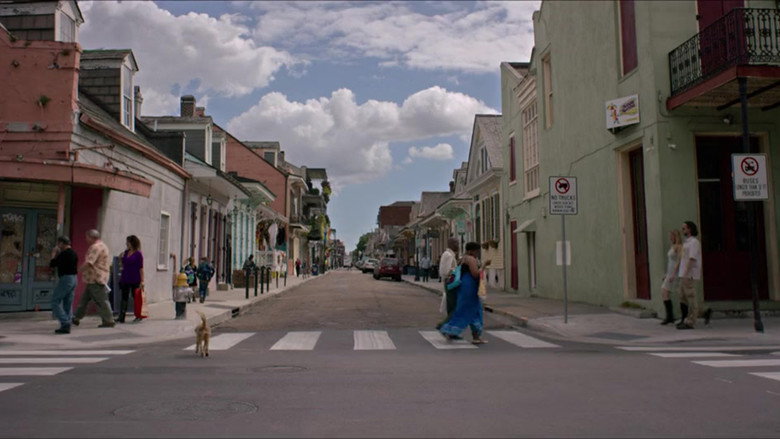
The film opens with Benji, a scruffy mutt with the soulful eyes of a poet, wandering the streets of New Orleans. He’s not a stray so much as a drifter, slipping into the lives of strangers with the ease of someone who knows he’ll never be kept. That changes when he meets Carter (Gabriel Bateman) and Frankie (Darby Camp), two siblings whose parents are too wrapped up in their own fractures to notice the cracks in their kids’ world.
The children feed Benji scraps, and in return, he gives them something rarer: the sense that someone is looking out for them. It’s a fragile bond, the kind that forms in the gaps between what families say and what they actually do.

The plot kicks into gear when Carter and Frankie are kidnapped by a pair of bumbling criminals (Angus Sampson and Jerod Haynes, who seem to have wandered in from a Coen brothers reject pile). The villains aren’t scary so much as they are sad—men who’ve mistaken desperation for ambition, and who clearly have no idea what they’ve gotten themselves into. Their hideout is a dingy house with peeling wallpaper, the kind of place where the air conditioning doesn’t work and the takeout containers never stop piling up.
It’s here that Benji reveals its hand: this isn’t just a story about a dog rescuing kids. It’s about the ways we all need rescuing, and how the people (or animals) who do the saving are often the ones we least expect. What’s striking about the film is how little it relies on dialogue to make its point.
The best scenes are the quiet ones—Benji padding through the house at night, his nails clicking against the hardwood; the kids huddled together in the dark, their fear palpable but unspoken. Camp (the director, not the dog) understands that children’s emotions aren’t smaller than adults’; they’re just less filtered. When Carter and Frankie cry, it’s not pretty or performative.
It’s the kind of crying that comes from a place so deep it doesn’t have words. And Benji? He doesn’t need words either.
His body does the talking: the tilt of his head, the way his ears perk up at the sound of a car engine, the stubborn set of his jaw when he’s determined to get the kids out.
There’s a moment midway through the film that stuck with me. Benji has just led the police to the kidnappers’ hideout, but the cops don’t see the danger the way he does. They’re too busy filling out paperwork, too bound by procedure to act.
So Benji does what he has to do: he slips past them, into the house, and finds the kids. It’s a small rebellion, but it’s his. And in that moment, he’s not just a dog.
This is where Benji flirts with something deeper than its family-friendly trappings suggest. The film’s emotional core isn’t just about a dog saving kids; it’s about the ways we all step into roles we didn’t ask for. Carter and Frankie’s parents (Kiele Sanchez and Gralen Bryant Banks) are loving but distracted, their marriage fraying at the edges.
They’re not villains, just people who’ve let life wear them down. And Benji? He’s the one who fills the gap, who gives the kids what their parents can’t in that moment: undivided attention, unconditional love, the sense that someone is fighting for them.
The film’s biggest flaw is that it doesn’t trust its own quiet moments enough. The third act veers into slapstick territory, with the kidnappers tripping over themselves in a way that feels tonally at odds with the rest of the movie. It’s as if the filmmakers got nervous that the audience would find the emotional beats too heavy, so they threw in a few pratfalls to lighten the mood.
But the best family films—The Iron Giant, My Neighbor Totoro, The Princess Bride—don’t shy away from darkness. They let the sadness sit alongside the joy, and in doing so, they give kids (and adults) permission to feel both.
Benji isn’t a perfect film, but it’s a sincere one. It doesn’t try to reinvent the wheel, and it doesn’t need to. What it does do is remind us that heroism isn’t about size or species.
It’s about showing up, even when no one’s watching. And maybe that’s enough. Maybe, in a world where so many of us are waiting for someone to save us, it’s worth remembering that sometimes the hero is the one who’s been there all along—loyal, patient, and just a little bit scruffy around the edges.
"A heartwarming family adventure with a lovable dog, but overly familiar for anyone who's seen a few of these."
The 2018 *Benji* reboot gets by on its adorable canine star and feel-good moments, which make it a hit with young kids and families. Its predictable plot and lack of surprises keep it from standing out against classic family films or even earlier *Benji* installments.
Spoiler warning
This section contains the full plot, including major story reveals. Overview above stays spoiler-free.
Netflix’s 2018 reboot of Benji brought the beloved canine franchise into the modern era, trading the original 1970s charm for a fresh, family-friendly adventure. Directed by Brandon Camp, the film follows a scrappy stray dog who teams up with two siblings to rescue their kidnapped parents. latestnetflix.com's take is that while the movie didn’t set the box office on fire, its behind-the-scenes story offers a glimpse into how Netflix revived a classic property for a new generation.
The original Benji films, created by Joe Camp, were low-budget, heartwarming tales that captivated audiences in the 1970s and ’80s. The 2018 version, however, was a bigger production, backed by Netflix and shot with a more polished approach. Director Brandon Camp, who also co-wrote the script, aimed to balance nostalgia with contemporary storytelling. The film’s mix of comedy, drama, and action was designed to appeal to both kids and parents, though its reception was mixed—garnering a modest 5.3/10 rating on SensCritique.
The cast included young stars Gabriel Bateman (Lights Out, Child’s Play) and Darby Camp (Big Little Lies), who played the siblings at the center of the story. Their chemistry with the titular dog was a key focus, with behind-the-scenes featurettes highlighting how the animal trainers worked to create seamless interactions between the actors and the canine star. Kiele Sanchez (Lost, The Purge: Election Year) and Gralen Bryant Banks rounded out the supporting cast, adding depth to the family dynamics.
Unlike the original films, which relied on theatrical releases, Benji (2018) was a Netflix original, giving the streaming giant a chance to promote it as a family-friendly exclusive. The premiere in Los Angeles was a star-studded affair, with cast and crew interviews circulating online. Gabriel Bateman, who played Carter, shared insights into filming with the dog, describing the experience as both challenging and rewarding. Director Brandon Camp also discussed his vision for the film, emphasizing the importance of keeping the story accessible to younger audiences while adding enough suspense to keep adults engaged.
The marketing push included a high-energy trailer that leaned into the film’s action-comedy tone, showcasing Benji’s heroic antics and the siblings’ daring rescue mission. Despite the hype, the film didn’t achieve the same cultural impact as its predecessors, though it found an audience on Netflix’s platform.
Critics and audiences were divided on the reboot. Some praised its heartwarming message and kid-friendly adventure, while others felt it lacked the original’s charm. The film’s 87-minute runtime and straightforward plot kept it brisk, but its 5.3/10 rating on SensCritique suggested it didn’t fully resonate with viewers. Rotten Tomatoes’ audience score, while not detailed in the snippet, likely reflected a similar split.
Still, Benji (2018) remains a notable entry in the franchise’s history, marking its transition into the streaming era. Whether it will spawn sequels or spin-offs remains unclear, but for now, it stands as a modern attempt to recapture the magic of a classic dog’s tale.
Entertainment rumors and trivia aggregated from public reporting. Treat speculation as unverified unless a cited source confirms it.
More titles in the same genres and with the same cast.