
Mariana di Girolamo
Ema
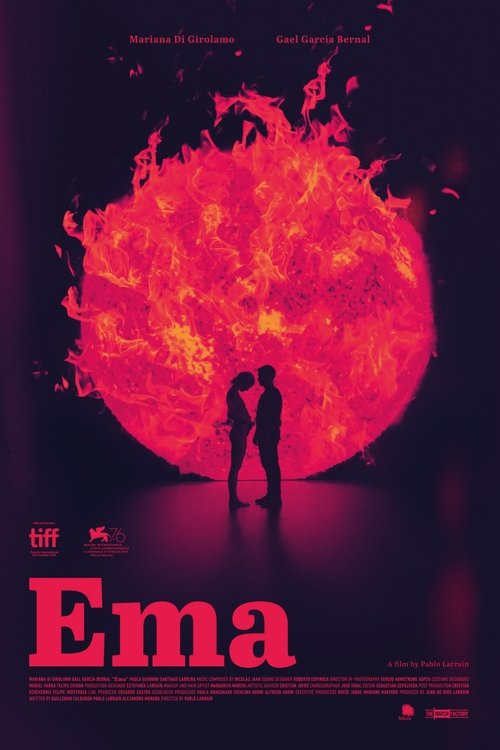
Ema is a magnetic and impulsive dancer in a reggaeton troupe. Her toxic marriage to choreographer Gastón is beyond repair, following a decision to give up on their adopted child Polo. She sets out on a mission to get him back, not caring who she’ll need to fight, seduce or destroy to make it happen.
Official
I keep thinking about the way Mariana di Girolamo moves in Ema—not just the way she dances, but the way she burns. There’s a moment early in Pablo Larraín’s film where Ema, a reggaeton dancer in Valparaíso, Chile, is caught in the crossfire of a street protest. The camera doesn’t cut away.
It lingers on her face, half-lit by the flicker of flames, as she watches a car explode in slow motion. She doesn’t flinch. She doesn’t run.
She just stands there, absorbing the heat, as if the chaos is something she’s been waiting for all along. That stillness—defiant, almost hungry—tells you everything you need to know about her. This is a woman who will set her own life on fire if it means she gets to choose how it burns.
Larraín has always been drawn to characters who collide with history, whether it’s the ad executives of No selling democracy like a soda brand or Jackie Kennedy turning grief into performance art. But Ema feels different. Less about institutions, more about the body.
Less about politics, more about the raw, electric charge of wanting something so badly it hurts. The film’s premise is deceptively simple: Ema and her husband, Gastón (Gael García Bernal), a choreographer, have given up their adopted son, Polo, after a traumatic incident. Now, Ema wants him back.
Not out of maternal guilt, not out of duty—but because she refuses to let anyone, not even herself, dictate the terms of her own life. As RogerEbert.com put it, di Girolamo’s performance is "one of the best of the year," and it’s easy to see why. She doesn’t just play Ema; she inhabits her, like a flame licking at the edges of the screen.

What makes Ema so unsettling—and so thrilling—is the way it treats desire as both a weapon and a wound. The film’s most talked-about sequence comes when Ema, in a bid to manipulate the system, seduces a police officer (Santiago Cabrera) who might help her reclaim Polo. The scene isn’t just about sex; it’s about power, about the way Ema uses her body as a tool, a distraction, a bargaining chip.
But here’s the thing: it doesn’t feel calculated. It feels necessary. Larraín shoots the encounter with a kind of feverish intimacy, the camera close enough to see the sweat on her skin, the way her breath hitches—not with pleasure, but with something closer to desperation.
This isn’t a woman who enjoys the game. She’s just willing to play it better than anyone else.
The film’s structure mirrors Ema’s own restlessness. It doesn’t unfold in neat, linear beats. Instead, it moves in bursts—dance rehearsals, street protests, domestic arguments—each one ratcheting up the tension until the whole thing feels like a pressure cooker about to blow.
Reggaeton pulses through the soundtrack like a second heartbeat, its relentless rhythm mirroring Ema’s own refusal to slow down, to apologize, to be anything other than exactly what she is. And what is she? A mother?
A dancer? A destroyer? The film never gives a straight answer, and that’s the point.
As Metacritic noted, Ema is an "incendiary drama about art, desire, and the modern family," one that refuses to tidy up its messiest questions.

Gael García Bernal’s Gastón is a fascinating counterpoint to Ema’s wildfire energy. Where she’s all heat and impulse, he’s controlled, cerebral, a man who choreographs other people’s movements but can’t seem to navigate his own life. Their marriage is a battleground, but it’s also the only thing that makes sense to either of them.
There’s a scene where they argue in their apartment, the camera circling them like a predator, and you can feel the years of resentment coiled between them. Yet when they dance together—just the two of them, no troupe, no audience—there’s a tenderness there, a flicker of something real. It’s the closest the film comes to sentimentality, and even then, it’s gone in an instant.
Larraín’s Valparaíso is a character in its own right: a city of steep hills and neon lights, where the past and present collide in a riot of color. The film’s visual language is saturated, almost tactile—you can almost feel the humidity in the air, the grit of the pavement underfoot. It’s a world that feels lived-in, chaotic, alive.
And yet, for all its vibrancy, there’s something claustrophobic about it, too. Ema is trapped, not by her circumstances, but by her own hunger. She wants too much, too fast, and the film never lets you forget the cost of that kind of desire.

The ending is where Ema risks losing some viewers. Without spoiling anything, it’s the kind of conclusion that refuses to provide closure, that leaves you with more questions than answers. Is Ema free?
Has she won? Or has she just traded one kind of prison for another? I’ve gone back and forth on it.
Part of me admires the film’s refusal to tie things up neatly. Another part of me wonders if it’s a cop-out, a way to avoid the harder work of reckoning with the consequences of Ema’s choices. But then I remember that stillness in her face during the protest, the way she watches the world burn without flinching.
Maybe the point isn’t whether she’s free. Maybe it’s that she’s still standing in the fire.
What lingers, in the end, isn’t the plot or even the performances (though di Girolamo’s work here is unforgettable in the truest sense—you won’t forget it). It’s the feeling of watching someone claw their way out of their own life, not because they want to escape, but because they want to own it. Ema isn’t a film about redemption. It’s a film about combustion.
And like all the best fires, it leaves you warm, singed, and a little bit breathless.
"A visually striking but divisive drama whose bold, unconventional storytelling polarizes."
The bold visual style and Mariana di Girolamo's intense performance anchor the film's emotional core. The fragmented storytelling and ambiguous plot leave many disconnected, and some find it pretentious or too abstract for its own good.
Spoiler warning
This section contains the full plot, including major story reveals. Overview above stays spoiler-free.
Pablo Larraín’s Ema (2019) is a film that burns as bright as the reggaeton beats and flames that define its aesthetic. Starring Mariana di Girolamo in the titular role, the Chilean drama follows a dancer navigating love, loss, and chaos after a fraught adoption unravels her life. latestnetflix.com's read is that but behind the film’s hypnotic visuals and explosive performances lies a production as unconventional as its protagonist.
After the international success of Jackie (2016) and Neruda (2016), Larraín made a deliberate choice to shoot Ema entirely in Chile. The decision wasn’t just logistical; it was a creative reset. IndieWire had teased the project as a homecoming, and the director confirmed it was his first film shot in Chile since his earlier works. The move grounded the story in Valparaíso’s vibrant streets, where the film’s neon-lit reggaeton clubs and working-class neighborhoods become characters themselves.
Larraín co-wrote the screenplay with Guillermo Calderón and Alejandro Moreno, a collaboration that leaned into the film’s fragmented, almost improvisational style. The result? A narrative that feels as unpredictable as its lead, with Di Girolamo’s Ema oscillating between vulnerability and ferocity.
Di Girolamo’s performance as Ema is the film’s beating heart—and her breakout role. The Chilean actress, born in 1990, had worked in television and theater but hadn’t headlined a major film before Ema. Her portrayal of a woman reclaiming agency through dance and destruction earned her widespread acclaim, with critics noting her fearless physicality and emotional range.
In an interview with RogerEbert.com, Di Girolamo and Larraín discussed the film’s themes of motherhood and liberation. While the snippet doesn’t reveal specifics, it hints at the intense collaboration between director and star—a dynamic that likely fueled the film’s raw energy. Rumor (unconfirmed) suggests Di Girolamo trained extensively in reggaeton and contemporary dance for the role, though no source in the evidence explicitly details her preparation.
Gael García Bernal, playing Ema’s husband Gastón, brings his signature charisma to a role that’s equal parts tender and toxic. The Mexican actor, a frequent collaborator with Larraín (No, 2012), reportedly embraced the film’s chaotic tone, though behind-the-scenes details are scarce. His chemistry with Di Girolamo crackles onscreen, particularly in scenes where their characters’ relationship fractures under the weight of their shared trauma.
Ema’s bold storytelling polarized critics. The Los Angeles Times called it a "combustible drama," praising its audacity but noting that its fragmented structure might exhaust some viewers. Rotten Tomatoes echoed the sentiment, describing the film’s premise as "exhausted" by its bizarre resolution. Yet, that divisiveness is part of Ema’s appeal—it’s a film that refuses to be tamed, much like its protagonist.
The film premiered at the Toronto International Film Festival (TIFF) in 2019, where it sparked conversations about its provocative themes and visual style. A Q&A session with the cast and crew (available on YouTube) likely offered deeper insights, but the snippet doesn’t reveal specifics. What’s clear is that Ema left an impression—one that lingers long after the credits roll.
Entertainment rumors and trivia aggregated from public reporting. Treat speculation as unverified unless a cited source confirms it.
More titles in the same genres and with the same cast.