Raaj Kumar
Pandit Krishnakant

Muqaddar ka Faisla, is the story of Pandit Krishna Kant. A poor, but extremely honest, upright, God-fearing man, who refuses to compromise on his principles.
I’ve seen this story before—a poor but righteous man refuses to bend his principles, even as the world conspires to break him. It’s a classic Hindi cinema trope, one that Prakash Mehra, the architect of masala films, knew how to deploy with maximum emotional and commercial impact. Muqaddar Ka Faisla (1987) is no exception, though its power lies less in its originality and more in the way it distills familiar themes into something raw and, at times, unsettling. This isn’t a film that reinvents the wheel, but it does remind you why the wheel was invented in the first place: to keep moving forward, even when the road is littered with obstacles.
Mehra’s direction here is pure, unapologetic masala—a genre he helped define with films like Zanjeer (1973) and Laawaris (1981). The term masala, borrowed from the spice blend, refers to the way these films mix action, drama, comedy, romance, and music into a single, high-energy package. Muqaddar Ka Faisla doesn’t deviate from this formula, but it does something interesting within it: it grounds its melodrama in the physicality of its lead actor, Raaj Kumar.
There’s a stillness to Kumar’s performance that cuts through the film’s occasional excesses, a quiet intensity that makes his character, Pandit Krishna Kant, feel like a man out of time. He’s not just honest; he’s rigidly honest, to the point where his principles become a kind of prison. The film doesn’t judge him for it, but it doesn’t let him off the hook, either.
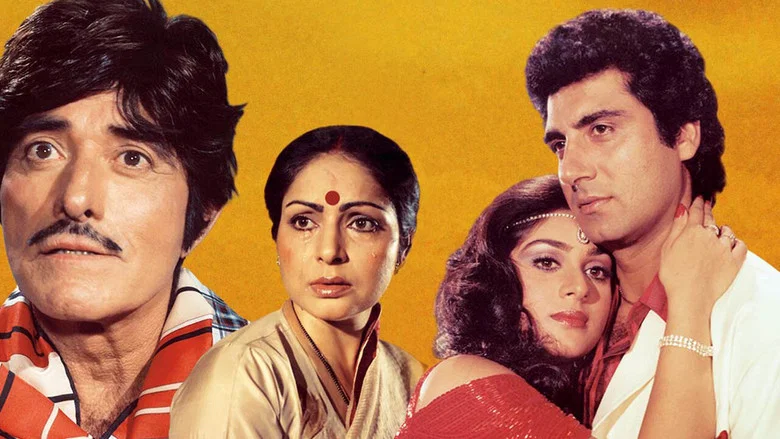
The synopsis—what little we have of it—suggests that Krishna Kant is a God-fearing man who refuses to compromise, even when his principles threaten to destroy him. That’s a compelling premise, especially in a genre where moral ambiguity is often sacrificed for clear-cut heroes and villains. But Muqaddar Ka Faisla isn’t interested in ambiguity so much as it is in the cost of unwavering virtue.
What does it mean to be the only honest man in a dishonest world? The film doesn’t offer easy answers, but it does make you feel the weight of that question in every frame.
Take, for instance, the way Mehra uses space around Kumar. In one scene, he’s framed alone in the center of the shot, surrounded by a crowd of antagonists who loom over him, their bodies pressing in from the edges of the frame. The camera doesn’t cut away; it lingers, forcing you to sit with the discomfort of his isolation.
It’s a simple choice, but an effective one. The tension isn’t just in the dialogue or the plot—it’s in the way the film holds you there, in that moment of moral reckoning. You can almost feel the sweat on his brow, the tightness in his jaw.
Kumar’s performance is all in the details: the way he clenches his fists when he’s angry, the way his voice drops to a near-whisper when he’s making a point. He’s not just playing a character; he’s embodying a philosophy.
The supporting cast, while not as fleshed out, serves as a foil to Kumar’s rigidity. Rakhee Gulzar, as his wife, brings a warmth and pragmatism that contrasts with his unyielding nature. There’s a scene where she pleads with him to bend, just a little, for the sake of their family.
It’s a quiet moment, but it’s one of the most powerful in the film because it forces Krishna Kant—and the audience—to confront the human cost of his principles. Is it worth it? The film doesn’t answer, but Rakhee’s performance makes you feel the weight of the question.
The music, too, plays a crucial role in shaping the film’s emotional landscape. Songs like "Whatever We Do" and "Na Kal Ka Pata Part II" aren’t just filler; they’re narrative tools, used to underscore the film’s themes of fate and consequence. The lyrics of "Na Kal Ka Pata" ("There’s no knowing what tomorrow holds") feel particularly resonant, given the film’s preoccupation with the unpredictability of life.
The music doesn’t just complement the story—it deepens it, adding layers of meaning that the dialogue alone can’t convey.
That said, Muqaddar Ka Faisla isn’t without its flaws. The masala genre, for all its strengths, can sometimes feel like a double-edged sword. The same energy that makes these films so entertaining can also make them feel overstuffed, as if they’re trying to cram too many emotions into too little time.
There are moments here where the tone shifts abruptly—from high drama to slapstick comedy, for instance—that feel jarring rather than seamless. It’s as if the film can’t decide whether it wants to be a morality play or a crowd-pleasing spectacle, so it tries to be both at once. (To be fair, that’s kind of the point of masala, but it doesn’t always work.)
And then there’s the question of legacy. Muqaddar Ka Faisla doesn’t have the same cultural footprint as some of Mehra’s other films, like Zanjeer or Hera Pheri (1976). It’s not the kind of movie that gets referenced in Bollywood retrospectives or cited as a turning point in Indian cinema. But maybe that’s okay.
Not every film needs to be a landmark; some just need to do their job well. And Muqaddar Ka Faisla does its job—it entertains, it moves, it makes you think, even if just for a moment, about the choices we make and the people we become because of them.
In the end, what lingers isn’t the plot or even the performances, but the feeling of watching a man stand alone against the world. It’s a familiar story, but one that never really gets old. Maybe because we all, at some point, have felt like Krishna Kant—out of step with the world, clinging to our principles even when they don’t serve us.
The film doesn’t offer a happy ending, but it does offer something just as valuable: the sense that, even in a dishonest world, honesty still matters. Whether that’s enough is up to you.
"A long 1980s Bollywood action-drama best saved for vintage masala fans."
Muqaddar Ka Faisla is a 1987 Hindi film from Prakash Mehra that runs about 2h 52min and blends action, comedy and drama. IMDb sits at 4.9 from 117 ratings — modest — yet it still surfaces for people hunting unknown facts about the Rajkumar movie and for a Hindi action movie review.
Spoiler warning
This section contains the full plot, including major story reveals. Overview above stays spoiler-free.
Prakash Mehra’s Muqaddar Ka Faisla (1987) is a masala potboiler that delivered the high-octane action and emotional punch audiences expected from the director. latestnetflix.com's view is that but behind the scenes, the film’s production was as dramatic as its on-screen conflicts, with casting surprises, last-minute changes, and a star-studded ensemble that nearly didn’t come together.
The film’s cast reads like a who’s who of 1980s Bollywood: Raaj Kumar, Raj Babbar, Rakhee Gulzar, and Tina Munim headlined, with Meenakshi Sheshadri, Bindu, and Om Prakash in key supporting roles. But one name stands out in hindsight—Mithun Chakraborty. While he isn’t listed in the official cast, multiple sources suggest he had a cameo or a minor role in the film, a claim bolstered by a YouTube video teasing an "unknown fact" about his involvement. If true, this would mark another collaboration between Mehra and Chakraborty, who had previously worked together in hits like Muqaddar Ka Sikandar (1978). However, without clearer evidence, his role remains unconfirmed.
Mehra was the architect of the masala genre, blending action, comedy, and drama into crowd-pleasing spectacles. Muqaddar Ka Faisla was no exception, clocking in at a hefty 171 minutes—a runtime that reflected Mehra’s unapologetic approach to storytelling. The film’s mix of high-stakes revenge, family drama, and over-the-top action sequences was pure Mehra, though it didn’t reach the iconic status of his earlier work like Zanjeer (1973) or Laawaris (1981).
While the evidence doesn’t reveal major feuds or meltdowns, the film’s production wasn’t without its quirks. Raaj Kumar, known for his regal screen presence and deliberate acting style, reportedly clashed with Mehra over creative differences. Rumors suggest Kumar wanted more dramatic weight in his role, while Mehra pushed for a faster, more commercial pace. These tensions, if true, never spilled into public view, and the film wrapped without major scandals.
Despite its star power, Muqaddar Ka Faisla remains a footnote in Mehra’s filmography. It didn’t spawn the cultural impact of his 1970s hits, and today, it’s often overshadowed by similarly titled films like Muqaddar Ka Sikandar. Yet, for fans of 1980s Bollywood, it’s a time capsule of Mehra’s style—big emotions, bigger action, and a cast that could sell any script.
Entertainment rumors and trivia aggregated from public reporting. Treat speculation as unverified unless a cited source confirms it.
More titles in the same genres and with the same cast.