Edgar Ramírez
Roberto Duran

“No más. No surrender.”
The legendary Roberto Duran and his equally legendary trainer Ray Arcel change each other's lives.
Edgar Ramírez
Roberto Duran

Robert De Niro
Ray Arcel

Usher
Sugar Ray Leonard

Rubén Blades
Carlos Eleta

Ana de Armas
Felicidad Iglesias
I’ve seen enough boxing movies to know the drill. The underdog rises from poverty, trains in a dingy gym, endures a montage of sweat and sacrifice, then steps into the ring to either triumph or be broken. It’s a formula that works—Rocky, Raging Bull, The Fighter—because it’s not really about boxing.
It’s about the stories we tell ourselves about struggle, about the way pain carves out space for something like redemption. Hands of Stone, Jonathan Jakubowicz’s biopic of Panamanian legend Roberto Durán, knows this drill well. Too well, maybe.
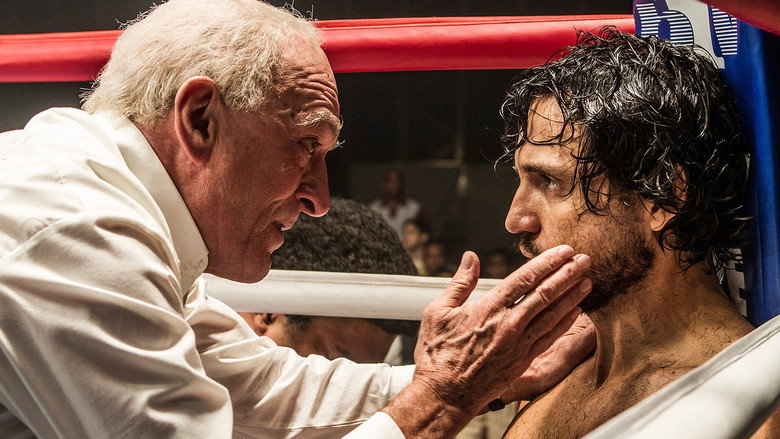
The film opens with a close-up of Edgar Ramírez’s face, slick with sweat and something darker—rage, fear, the weight of expectation. It’s a striking image, one that promises a story about the man behind the myth. But somewhere between the training montages and the inevitable fall from grace, Hands of Stone stumbles into a familiar trap: it mistakes legend for depth.
Durán, nicknamed "Manos de Piedra" for his punishing power, was a force of nature in the ring, a man who fought with a ferocity that bordered on self-destruction. The film wants to capture that ferocity, but it often settles for spectacle over soul.
Jakubowicz, a Venezuelan filmmaker with a keen eye for the political undercurrents of Latin American stories, seems aware of the stakes. Durán wasn’t just a boxer; he was a symbol, a working-class hero who rose from the slums of Panama to become one of the greatest fighters of all time. The film gestures at this context—there are scenes of Durán’s childhood, his mother’s struggles, the poverty that shaped him—but it never quite digs in.
Instead, it falls back on the rhythms of the sports biopic, where every setback is a lesson and every victory is a stepping stone to greatness. The problem isn’t that the film is predictable; it’s that it doesn’t trust its audience enough to sit with the messier parts of Durán’s story.
Take the casting, for instance. Edgar Ramírez is a compelling presence, all coiled energy and simmering anger, but the film doesn’t give him much room to breathe. Durán was a man of contradictions—brilliant in the ring, self-destructive outside of it, a figure who could inspire both awe and frustration.
Ramírez captures the physicality of the role, the way Durán moved like a predator, but the script often reduces him to a series of clichés: the hotheaded fighter, the man who can’t control his impulses. There’s a moment in the film where Durán, after a particularly brutal loss, sits in a hotel room, staring at his hands as if they’ve betrayed him. It’s a quiet scene, one that hints at the psychological toll of his career.
But the film rushes past it, eager to get back to the next fight, the next triumph.
Robert De Niro, playing Durán’s trainer Ray Arcel, fares better. De Niro has made a career out of playing men who are haunted by their pasts, and here, he brings a weary gravitas to the role. Arcel is the film’s moral center, the voice of reason trying to steer Durán away from self-destruction.
Their dynamic is the most interesting part of Hands of Stone, a relationship built on mutual respect and frustration. De Niro underplays the role, letting his silences speak volumes. It’s a reminder of what the film could have been—a story about two men, one young and reckless, the other older and wiser, trying to outrun their demons.
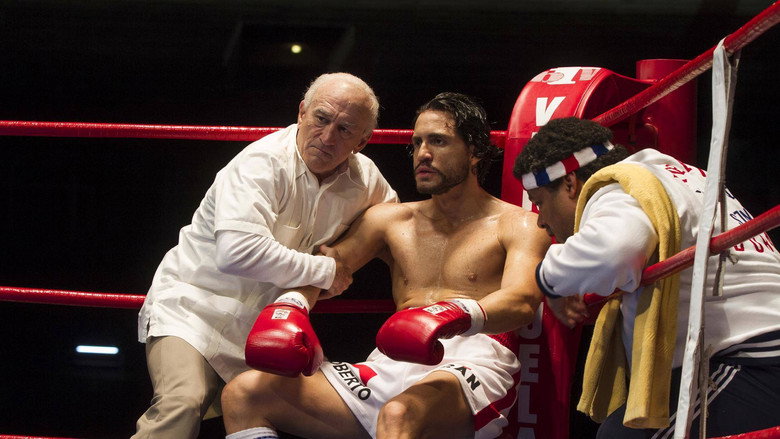
The boxing sequences are where Hands of Stone shines. Jakubowicz shoots the fights with a visceral intensity, the camera close enough to feel the impact of every punch. The sound design is particularly effective—the thud of gloves against flesh, the roar of the crowd, the ragged breathing of the fighters.
These scenes are the film’s strongest, moments where the myth of Durán feels tangible, real. But even here, the film can’t resist the pull of melodrama. The fights are often punctuated by slow-motion replays, swelling music, the kind of cinematic flourishes that feel more like a highlight reel than a story.
There’s a scene midway through the film where Durán faces Sugar Ray Leonard in their first bout, a fight that would become one of the most famous in boxing history. The tension is palpable, the stakes clear. Durán wins, and the film lingers on his triumph, the way he raises his arms in victory, the crowd chanting his name.
It’s a satisfying moment, but it’s also where Hands of Stone reveals its hand. This isn’t a film interested in the cost of victory, only in the victory itself. The rematch, where Durán famously quit in the eighth round with the words "No más," is glossed over, reduced to a moment of weakness rather than the complex, humanizing moment it was.
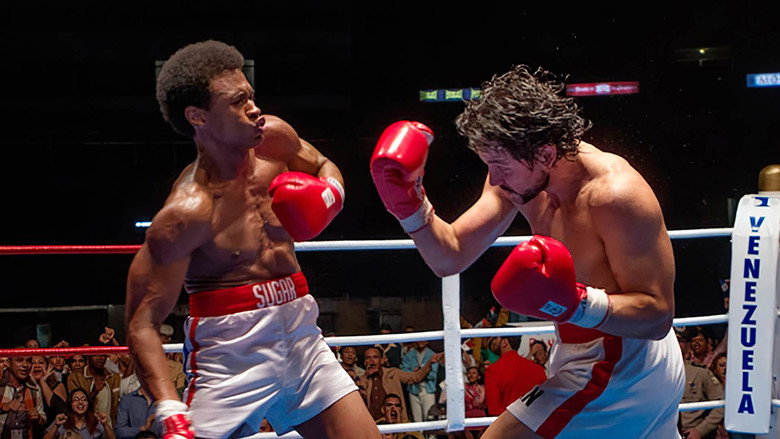
I kept thinking about Raging Bull while watching Hands of Stone. Scorsese’s film is also a boxing biopic, but it’s not really about boxing. It’s about self-sabotage, about the way violence can be both a weapon and a wound.
Jake LaMotta, the film’s protagonist, is a man who punishes himself as much as his opponents, a figure whose rage is both his greatest strength and his undoing. Hands of Stone wants to be that kind of story, but it doesn’t have the courage to go there. Durán’s "No más" moment is the most fascinating part of his legacy—a moment of vulnerability that humanized him, that made him more than just a legend.
The film treats it as an aberration, a blip on the radar of his otherwise unstoppable career.
That’s the thing about myths: they’re comforting because they’re simple. The truth is always messier. Durán was a complicated man, a fighter who could be both generous and cruel, a champion who could rise from the ashes only to burn himself out again. Hands of Stone doesn’t ignore this complexity entirely, but it doesn’t embrace it either.
It’s a film that wants to have its cake and eat it too—to celebrate Durán’s greatness while glossing over the parts of his story that don’t fit neatly into the narrative of triumph.
In the end, Hands of Stone is a competently made sports biopic, one that delivers the thrills and the drama its audience expects. But it’s also a missed opportunity. Durán’s story is one of the most compelling in boxing history, a tale of talent and tragedy, of a man who was as much a product of his environment as he was a force of nature.
The film captures the surface of that story, but it never quite gets to the heart of it. Maybe that’s the problem with biopics—they’re always chasing the myth, even when the truth is more interesting.
"A compelling biopic with strong performances that doesn't rise above conventional sports-drama tropes."
Edgar Ramírez’s intense, authentic portrayal of Roberto Durán anchors the film’s emotional core. The narrative is formulaic, though, relying on familiar underdog beats that dilute its impact. The supporting cast, particularly Robert De Niro, helps, but the pacing is uneven and the storytelling lacks depth.
Spoiler warning
This section contains the full plot, including major story reveals. Overview above stays spoiler-free.
latestnetflix.com's read is that Jonathan Jakubowicz’s Hands of Stone (2016) promised a knockout biopic about Panamanian boxing legend Roberto Durán, but the real story unfolded behind the camera—where a mix of star power, cultural clashes, and last-minute pivots nearly stole the spotlight from the gloves.
Jakubowicz, a Venezuelan filmmaker of Polish-Jewish descent, didn’t just direct Hands of Stone—he fought for it. The project was years in the making, with Jakubowicz reportedly securing rights to Durán’s life story after building trust with the boxer’s family. His personal connection to Latin America’s underdog narratives (his grandparents were Holocaust survivors) fueled the film’s gritty, emotional tone. Yet, the road to production was rocky. Early scripts reportedly struggled to balance Durán’s volatile personality with his sporting genius, leading to multiple rewrites before De Niro and Ramírez signed on.
Robert De Niro’s casting as legendary trainer Ray Arcel was a coup, but rumors swirled about his hands-on approach. In interviews tied to the film’s release, Ramírez hinted at De Niro’s mentorship, calling him a "second director" on set. The veteran actor, known for method acting, allegedly pushed the cast to dig deeper into their roles—even Usher, who played Sugar Ray Leonard. Yet, Jakubowicz downplayed tensions, framing De Niro’s intensity as collaborative rather than controlling. Still, whispers persisted about creative friction, particularly over the film’s pacing and historical accuracy.
Before Blonde or Knives Out, Ana de Armas was a relative unknown in Hollywood. Her role as Felicidad Iglesias, Durán’s wife, was a gamble—one that paid off. De Armas later called the film a "turning point" in her career, though she admitted the pressure of working alongside De Niro and Ramírez was overwhelming [rumor, unverified]. Behind the scenes, she reportedly bonded with Ramírez (her real-life partner at the time), which may have added authenticity to their on-screen chemistry. The film’s premiere, where de Armas arrived in a striking red gown, cemented her as a rising star to watch.
Despite its star-studded cast, Hands of Stone landed with a thud at the box office. Critics praised the performances (Ramírez’s physical transformation was a standout) but criticized the script’s uneven storytelling. Rotten Tomatoes’ 45% score reflected a divide: some called it a "passionate but flawed tribute", while others dismissed it as a missed opportunity. Jakubowicz later acknowledged the challenges of condensing Durán’s complex life into two hours, hinting at studio interference in the final cut. The film’s 6.1/10 rating on SensCritique suggests it resonated more with boxing fans than general audiences.
Entertainment rumors and trivia aggregated from public reporting. Treat speculation as unverified unless a cited source confirms it.
More titles in the same genres and with the same cast.