
John Abraham
Sameer
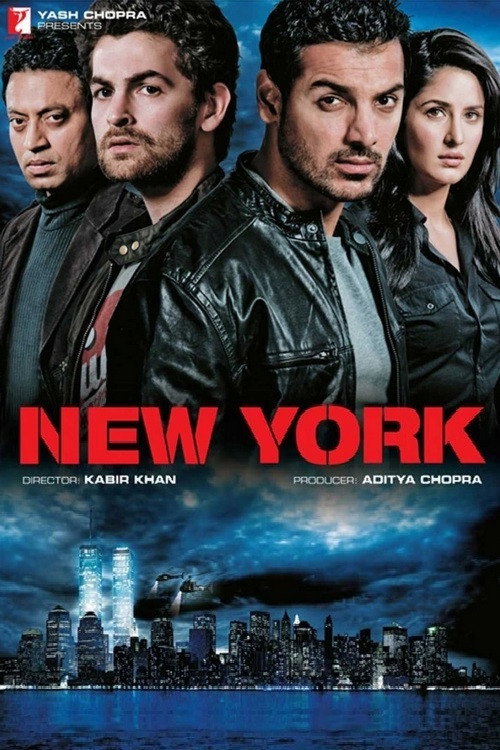
“Three friends ready to face the world... and then the world changed.”
The plot follows three friends in New York City whose lives are upended by the 9/11 attacks leading to suspicion, FBI involvement, and a story about friendship, identity, and the aftermath of terrorism.
I keep thinking about the first shot of New York—not the skyline, not the Twin Towers, but the way the camera lingers on a close-up of a hand adjusting a radio dial. The static hisses, then resolves into a voice: "This is New York. This is the world." It’s a small moment, almost throwaway, but it tells you everything about what Kabir Khan’s 2009 film is trying to do.
This isn’t just a story about three friends caught in the aftermath of 9/11. It’s about how the air itself changed after that day, how the static of fear became the soundtrack of a generation.

The film follows Sam (John Abraham), Omar (Neil Nitin Mukesh), and Maya (Katrina Kaif), college friends whose lives are upended when the towers fall. Sam, a Muslim, becomes a target of suspicion; Omar, a business student, gets entangled with the FBI; Maya, the glue between them, watches their friendship fracture under the weight of paranoia. It’s a familiar premise—post-9/11 anxiety has been explored in everything from The Reluctant Fundamentalist to Homeland—but New York distinguishes itself by refusing to let the geopolitical overshadow the personal.
The tragedy here isn’t just the attack itself, but the way it forces people to see each other differently. The film’s most devastating moments aren’t the ones where the world explodes, but the ones where a glance lingers a second too long, or a voice drops just a little too quiet.
Khan’s direction is at its strongest when it trusts the audience to sit with discomfort. There’s a scene midway through where Sam, now under surveillance, sits in a diner with Omar. The camera holds on their faces as the noise of the city fades into the background.
Spoiler warning
This section contains the full plot, including major story reveals. Overview above stays spoiler-free.
Kabir Khan’s New York (2009) isn’t just a film—it’s a raw, emotional reckoning with friendship, fear, and the fallout of 9/11. Starring John Abraham, Neil Nitin Mukesh, and Katrina Kaif, the movie weaves a tense narrative about three college friends whose lives unravel in the shadow of terrorism and surveillance. But what went into making this post-9/11 thriller? latestnetflix.com's take is that the behind-the-scenes details reveal a production as intense as its subject matter.
Kabir Khan, known for blending documentary-style realism with commercial cinema, brought a deeply personal touch to New York. The film’s exploration of Islamophobia and the erosion of civil liberties post-9/11 wasn’t just a plot device—it reflected Khan’s own observations as a filmmaker navigating a changed world. In a scene breakdown, Khan discussed how the film’s tension mirrored real-life paranoia, with John Abraham’s character, Samir, embodying the struggle of an innocent man caught in a system that no longer trusts him. The director’s background in documentary filmmaking likely lent the movie its unflinching gaze, making the fictional story feel uncomfortably real.
The dynamic between John Abraham, Neil Nitin Mukesh, and Katrina Kaif was central to New York’s emotional core. The trio played college friends whose bond is tested by betrayal and violence, and their off-screen camaraderie helped sell the on-screen tension. In a making-of feature, Abraham and Kaif joked about the film’s grueling shoot, with Abraham calling it one of his most physically and emotionally demanding roles. Meanwhile, Neil Nitin Mukesh’s character, Omar, a young FBI agent, added a layer of moral ambiguity that kept audiences guessing. The cast’s chemistry wasn’t just for show—it was a necessity to make the film’s high-stakes drama feel authentic.
Filming New York wasn’t just about acting—it was about immersion. The movie’s gritty aesthetic came from shooting in real locations, including New York City itself, where the cast and crew had to navigate the lingering tension of post-9/11 America. In an interview, Abraham recalled the challenges of filming in the U.S., where the subject matter made some crew members uneasy. The film’s climactic scenes, set in a high-security prison, were shot in India but designed to mimic the claustrophobic, paranoid atmosphere of a post-9/11 detention facility. The attention to detail—from the costumes to the set design—helped ground the film’s fictional story in a reality audiences could feel.
No Bollywood thriller is complete without a killer soundtrack, and New York delivered with Pritam’s compositions. The song "Hai Junoon" became an instant hit, capturing the film’s themes of longing and desperation. Sung by KK, the track’s soaring vocals and melancholic lyrics mirrored the emotional turmoil of the characters, particularly Samir’s struggle to reclaim his life. The music wasn’t just background noise—it was a character in its own right, amplifying the film’s tension and heartbreak.
More than a decade after its release, New York remains relevant. Its exploration of surveillance, Islamophobia, and the cost of security continues to echo in today’s political climate. While the film didn’t break box office records, its critical reception was strong, with praise for its bold storytelling and performances. For Kabir Khan, it was a turning point—a film that proved he could tackle complex, real-world issues without sacrificing entertainment value.
Entertainment rumors and trivia aggregated from public reporting. Treat speculation as unverified unless a cited source confirms it.
More titles in the same genres and with the same cast.