John Abraham
Suhel Khan

Five people - two Indian journalists, an American photojournalist, an Afghan guide and a Taliban soldier who takes them all hostage - are taken on a 48-hour journey into Afghanistan in a jeep called the Kabul Express, a special and unlikely bond developing between them along the way.
I keep thinking about the jeep. Not the one in the title—though that Kabul Express is the film’s spine—but the way the camera lingers on the road itself, a ribbon of dust and gravel cutting through a landscape that feels both ancient and freshly wounded. Kabul Express is a film that understands the weight of movement, how travel can be both escape and imprisonment, how the act of going somewhere can sometimes be the only thing that keeps you from falling apart. It’s a war thriller, a buddy comedy, a hostage drama, and a road movie all at once, and like the best road movies, it’s less about the destination than the people you’re stuck with along the way.
Kabir Khan, a documentarian by trade, shoots Afghanistan like a man who’s seen too much of it. The country here isn’t a backdrop; it’s a character, one that’s been scarred by war but refuses to be defined by it. The opening sequence—two Indian journalists, Jai (John Abraham) and Suhel (Arshad Warsi), careening through Kabul in their jeep—sets the tone: the city is alive, chaotic, full of people trying to rebuild while the ghosts of the past linger in the rubble.
Khan doesn’t romanticize it, nor does he turn it into a warzone cliché. It’s just there, a place where life stubbornly continues, even when the world seems determined to tear it apart.
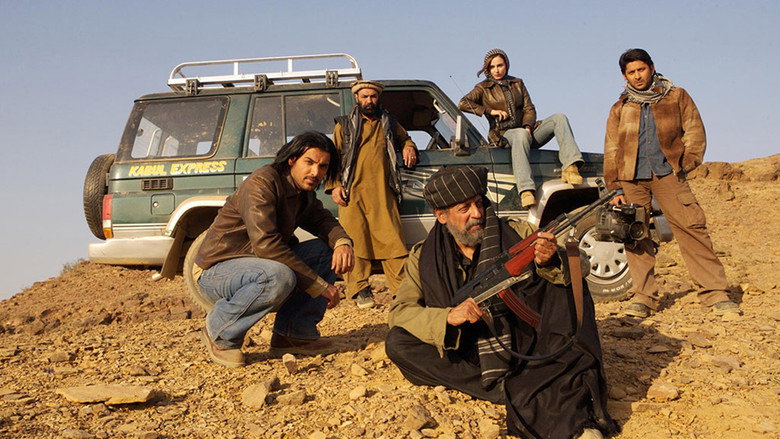
The film’s premise is simple: five strangers—a pair of Indian journalists, an American photojournalist (Linda Arsenio), an Afghan guide (Salman Shahid), and a captured Taliban soldier (Hanif Hum Ghum)—are thrown together in a jeep for 48 hours, forced to navigate a landscape that’s as dangerous as it is beautiful. What unfolds isn’t so much a plot as a series of collisions, both literal and metaphorical.
The journalists, initially chasing a story, find themselves entangled in something far more complicated than they bargained for. The Taliban soldier, far from the one-dimensional villain you might expect, becomes a mirror for their own prejudices and fears. And the American, Jessica, serves as a reminder of how easily outsiders can misread a place they’ve only seen through a camera lens.
"A raw, engaging road thriller with strong performances but uneven pacing and tonal shifts."
The film's gritty portrayal of post-9/11 Afghanistan and the chemistry between the leads give the adventure-thriller setup depth. The narrative is disjointed, with abrupt shifts between humor and tension that break the flow. Its bold genre-blending doesn't always work.
Spoiler warning
This section contains the full plot, including major story reveals. Overview above stays spoiler-free.
Kabul Express (2006) wasn’t just another Bollywood thriller—it was a high-wire act shot in the heart of post-Taliban Afghanistan, where the cast and crew faced real-world peril to bring Kabir Khan’s vision to life. latestnetflix.com's read is that the film, starring John Abraham and Arshad Warsi as journalists caught in a crossfire of war and deception, became a landmark for its on-location authenticity.But that authenticity came at a cost.
Kabir Khan, then a relatively unknown director, made history by becoming the first filmmaker to shoot a major commercial feature in Afghanistan after the fall of the Taliban. The country was still volatile, and the crew’s presence drew unwanted attention. Khan later revealed in interviews that the production received death threats, calling the experience "scary" and admitting they were "the first" to attempt such a project in the region. The threats weren’t idle—local tensions ran high, and the team’s movements were closely monitored.
The cast wasn’t spared from the dangers. John Abraham and Arshad Warsi have spoken openly about the risks they faced while filming. In one interview, they recounted how they were constantly aware of their surroundings, with Warsi joking that they "didn’t know if [they’d] come back alive". Abraham later shared a chilling incident where the crew was caught in a potentially life-threatening situation, though details remain vague—likely due to the sensitivity of the events.
Kabir Khan’s background in documentary filmmaking may explain his willingness to push boundaries. Before Kabul Express, he was known for his work in conflict zones, and the film’s gritty realism reflects that experience. Abraham once described Khan as someone "drawn to danger," suggesting the director thrived under the pressure of filming in a war-torn country. The result was a thriller that blurred the line between fiction and reality, with the cast often feeling like they were living the story rather than acting it.
Given the risks, it’s surprising the project was completed at all. The crew’s presence in Afghanistan was a logistical nightmare, with security concerns dictating every move. Khan’s insistence on shooting in real locations—rather than recreating Kabul on a soundstage—added to the tension. Yet, the gamble paid off. Kabul Express shows the team’s determination, even if its reception was overshadowed by the behind-the-scenes drama.
While Kabul Express didn’t become a blockbuster, its legacy lies in its audacity. It proved that Bollywood could tackle stories beyond its usual romantic or action-driven fare, even if it meant risking lives. For the cast and crew, the film was a baptism by fire—one they survived, but not without scars.
Entertainment rumors and trivia aggregated from public reporting. Treat speculation as unverified unless a cited source confirms it.
More titles in the same genres and with the same cast.