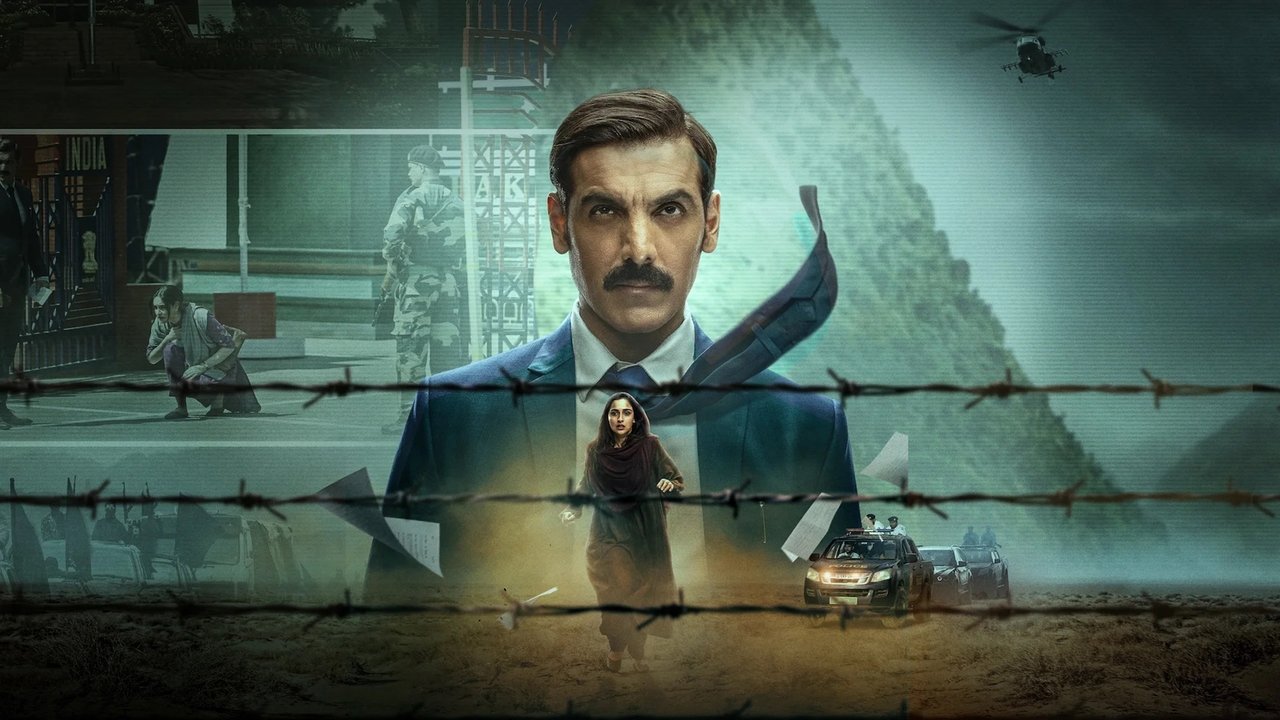

John Abraham
JP Singh (Deputy High Commissioner of India in Pakistan)
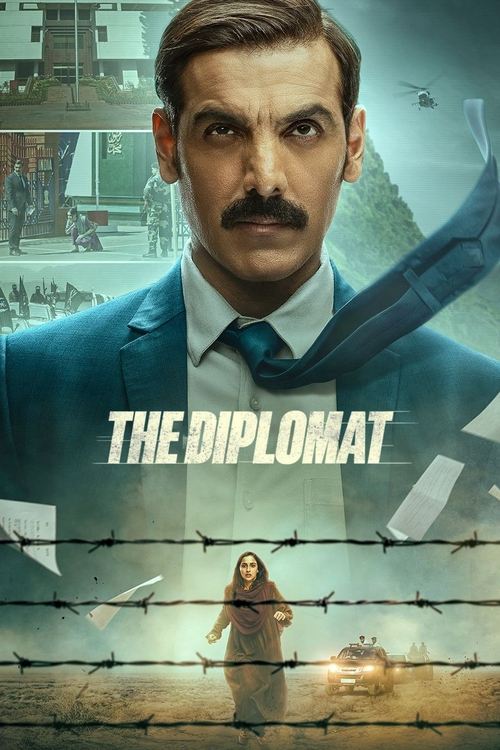
“A true hero needs no weapon.”
The Deputy High Commissioner, J.P. Singh, faces an unusual crisis when a mysterious woman rushes inside the Indian High Commission in Islamabad, claiming forced marriage in Pakistan and seeking a return to India.
Official
I’ve seen this trick before. A Bollywood political thriller opens with a disclaimer so long it feels like a legal brief, then promises a story “based on true events” that will restore your faith in diplomacy—or at least in the Indian Foreign Service. Usually, the film delivers neither.
It gives you instead a chest-thumping hero, a villainous neighbor state, and a climax that plays like a cricket match commentary. The Diplomat, Shivam Nair’s 2025 film, tries to break that mold. It mostly succeeds in the trying.

The film is built around the 2017 rescue of Uzma Ahmed, an Indian woman who fled to the Indian High Commission in Islamabad after being forced into marriage. That much is fact. The rest is cinema: a fictionalized attack on diplomats, a high-speed chase to the Wagah border, and a protagonist who is less a swashbuckling hero than a man drowning in paperwork.
John Abraham plays J.P. Singh, the Deputy High Commissioner, and for once he’s not punching his way out of trouble. He’s talking.
A lot. In hushed tones, over cups of tea, in rooms where the air conditioning hums like a ticking clock. It’s a performance that asks you to lean in, and for the first hour, I did.
Nair’s direction is sober, almost to a fault. The cinematography by Dimo Popov favors muted blues and grays, as if the film itself is trying not to draw attention. The score, when it arrives, is a low thrum of dread rather than a crescendo of triumph.
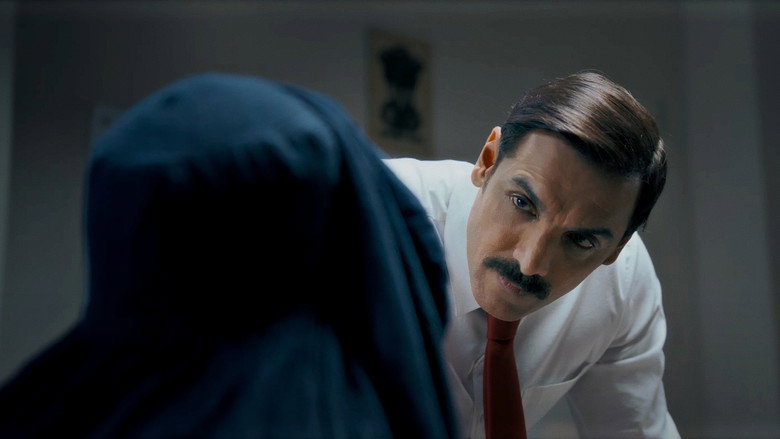
This is a thriller that refuses to thrill in the usual ways. There are no explosions, no last-minute rescues by a commando team. Instead, there’s a scene where Singh sits across from a Pakistani lawyer (Kumud Mishra, excellent) and negotiates the fate of a woman neither of them has met.
The tension comes from the silence between their words, the way Mishra’s character taps his fingers on the table like a metronome counting down to disaster.
Sadia Khateeb, as Uzma Ahmed, is the film’s emotional core. She doesn’t have the luxury of quiet diplomacy. Her performance is raw, physical—her hands shake when she speaks, her eyes dart like a trapped animal’s.
In one scene, she’s curled on a couch in the High Commission, wrapped in a shawl, her voice barely above a whisper as she recounts the abuse she suffered. It’s the kind of moment that could tip into melodrama, but Khateeb keeps it grounded. You believe her fear.
You believe her exhaustion. And when she finally walks across the Wagah border, her face is a map of relief and grief, as if she’s leaving a part of herself behind.
The film’s biggest gamble is its refusal to demonize Pakistan outright. There are no mustache-twirling villains here, no generals plotting in smoke-filled rooms. The antagonist is Tahir Ali (Jagjeet Sandhu), Uzma’s husband, a man whose cruelty is banal, almost bureaucratic.
He’s not a terrorist; he’s a man who believes he owns a woman. It’s a more unsettling portrayal because it feels real. But the film stumbles when it comes to the broader Pakistani setting.
The streets of Islamabad are reduced to a series of generic backdrops, and the few Pakistani characters who aren’t lawyers or diplomats are either sympathetic or sinister, with little in between. As The Wire’s critic noted, “Despite its claims of neutrality, The Diplomat occasionally slips into the same one-note portrayals it seeks to avoid.”
That criticism stings because the film’s intentions are so clearly good. It wants to be a story about quiet heroism, about the people who work in the shadows to fix the world’s messes. And in many ways, it is.
The climactic sequence—a tense drive to the border, with Uzma hidden in the back of a car—is expertly paced, the kind of scene that makes you forget to breathe. But the film’s reach exceeds its grasp. It’s so determined to avoid the trappings of a typical Bollywood thriller that it sometimes forgets to be thrilling.
The middle act sags under the weight of its own restraint. Meetings drag. Phone calls repeat.
By the time the border crossing arrives, I was more relieved than exhilarated.
John Abraham is the film’s biggest surprise. He’s spent the last decade as Bollywood’s resident action star, a man who solves problems with his fists. Here, he solves them with a pen and a prayer.
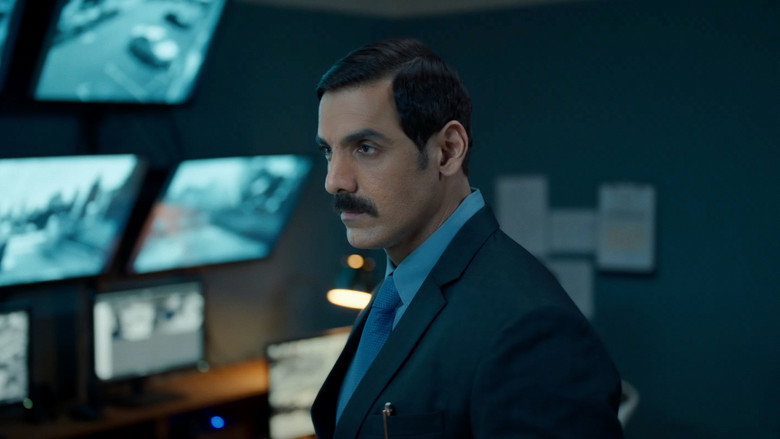
His Singh is a man who has spent too long in the world of diplomacy, where every word is a minefield. Abraham plays him with a weariness that feels earned. There’s a moment when Singh snaps at a junior officer, his voice low and dangerous, and for a second, you see the man beneath the diplomat—the one who’s tired of being the adult in the room.
It’s the best work Abraham has done in years.
The film’s most interesting relationship isn’t between Singh and Uzma, but between Singh and Sushma Swaraj, played by Revathy. Swaraj, the then-External Affairs Minister, is portrayed as a force of nature—a woman who cuts through bureaucracy with a single phone call. Their scenes together crackle with an energy the rest of the film sometimes lacks.
Revathy doesn’t play Swaraj as a saint; she plays her as a politician who knows how to get things done. It’s a refreshing contrast to the film’s otherwise male-dominated world.
The Diplomat ends on a note of quiet triumph, but it’s a triumph that feels small. Uzma is safe. Singh goes back to his desk.
The world keeps turning. The film doesn’t pretend that one rescue changes anything, and that’s its most honest moment. But it also doesn’t quite know what to do with that honesty.
It wants to be a thriller, a drama, and a political statement all at once, and it can’t quite decide which it is.
In the end, The Diplomat is a film that deserves credit for what it tries to do. It’s a political thriller that refuses to glorify war or nationalism. It’s a story about women’s agency that doesn’t always give its female lead the space to claim it.
(As The Indian Express’s critic put it, “In a regular movie, John Abraham's titular character would've been a supporting presence... But in The Diplomat, he exists to rob the female heroine of her agency.”) It’s a film that asks you to care about paperwork, and for the most part, it succeeds. But it’s also a film that forgets, in its quest for restraint, that tension needs room to breathe.
I left the theater thinking about Uzma Ahmed, about the real women whose stories don’t make it to the screen. The Diplomat is a step in the right direction, but it’s not the film those stories deserve. Not yet.
"Audience reactions to this 2025 political thriller are too sparse to form a consensus."
Feedback on *The Diplomat* (2025) is extremely limited, with no substantial discussions or ratings on major user-driven platforms, likely due to its recent release and niche political-drama focus. The few comments highlight the cast, particularly John Abraham, but say little about plot, pacing, or overall impact.
Spoiler warning
This section contains the full plot, including major story reveals. Overview above stays spoiler-free.
The Diplomat (2025) isn’t just another political thriller—it’s a rare Bollywood film that blends real-world tension with cinematic drama. Directed by Shivam Nair and starring John Abraham, the movie dives into the fraught world of India-Pakistan diplomacy, centering on a rescue mission that feels ripped from the headlines. Here’s what we know about the film’s origins, its real-life inspiration, and the behind-the-scenes buzz.
The Diplomat claims to be based on the harrowing true story of Uzma Ahmed, an Indian woman who sought refuge in India’s embassy in Pakistan after allegedly being forced into marriage. The film follows Deputy High Commissioner J.P. Singh (John Abraham) as he navigates bureaucratic red tape and geopolitical minefields to repatriate an Indian girl trapped in Pakistan. The premise alone—diplomacy as a high-stakes chess game—positions the movie as a departure from typical Bollywood action fare, leaning instead into the suspense of realpolitik.
Writer Ritesh Shah, known for penning gritty thrillers like Pink (2016), reportedly crafted the script to balance authenticity with cinematic tension. While the film’s marketing has emphasized its "based on true events" angle, details about how closely it adheres to Uzma Ahmed’s story remain unclear. Netflix’s release of the film has reignited discussions about cross-border abductions and the role of diplomats in such cases, though the movie itself hasn’t shied away from dramatizing the stakes.
After a string of action-heavy roles (Pathaan, Satyameva Jayate 2), John Abraham’s turn as a diplomat marks a return to more grounded, character-driven work. Sources suggest the actor was drawn to the project’s blend of realism and suspense, with Abraham reportedly immersing himself in the nuances of diplomatic protocol. His portrayal of J.P. Singh—a role that demands equal parts gravitas and quiet intensity—could redefine his career trajectory, much like his breakout performance in Madras Cafe (2013).
The supporting cast adds depth to the narrative. Sadia Khateeb, who plays the trapped Indian woman, brings emotional weight to a role that could easily have veered into melodrama. Veteran actors Kumud Mishra and Sharib Hashmi round out the ensemble, with Mishra likely playing a senior diplomat or political figure, while Hashmi’s role remains under wraps but is rumored to involve a morally ambiguous character.
Director Shivam Nair isn’t a household name, but his filmography suggests a knack for taut, suspenseful storytelling. Best known for his work in television—including the critically acclaimed 24: India—Nair has carved a niche in the thriller genre. The Diplomat represents his most ambitious project yet, blending the procedural tension of his TV work with the scale of a big-budget film.
Nair’s approach reportedly involved extensive research into diplomatic protocols and the India-Pakistan dynamic, though specifics about his directorial process remain scarce. The film’s political backdrop—fraught with historical baggage—required a delicate balance, and early reviews suggest Nair succeeded in keeping the narrative gripping without veering into jingoism. Whether the movie will spark broader conversations about cross-border diplomacy or remain a standalone thriller remains to be seen.
Since its Netflix release, The Diplomat has sparked debates about its portrayal of real-life events, with some viewers praising its authenticity and others questioning its dramatization. The film’s reception could hinge on how well it walks the line between fact and fiction—a challenge given the sensitivity of its subject matter.
For John Abraham, the movie might signal a shift toward more serious roles, especially if it resonates with audiences. Meanwhile, Shivam Nair’s direction could open doors for more political thrillers in Bollywood, a genre that’s often overshadowed by masala entertainers. As for the real-life Uzma Ahmed, her story continues to serve as a reminder of the human cost behind diplomatic tensions—a theme the film doesn’t shy away from.
Entertainment rumors and trivia aggregated from public reporting. Treat speculation as unverified unless a cited source confirms it.
More titles in the same genres and with the same cast.