William Devane
Sheriff Jim Metts

The recounting of a terrible crime that wracked a family and galvanized police in South Carolina in the 1980's. Southern beauty pageant winner Dawn Smith is targeted by a sadistic stalker whose obsession with her leads him to kidnap her younger sister.
I keep thinking about the title—Victim of Beauty. It’s a phrase that lands like a punch, the kind of blunt, almost lurid phrasing you’d find on a true-crime paperback in a gas station spinner rack. But there’s something deliberate about it, too.
Not just a description, but an accusation. Beauty here isn’t passive; it’s a force, a magnet, something that draws danger like a moth to a flame. And the victim isn’t just the woman at the center of the story—it’s the idea of beauty itself, weaponized.
Roger Young’s 1991 TV movie Victim of Beauty (also known, less poetically, as Nightmare in Columbia County) is a film that exists in the shadowy space between exploitation and empathy. It’s based on a real crime—a kidnapping, a murder, a family shattered in the kind of small-town horror that makes national news for a week before fading into the static of the 24-hour news cycle.
The synopsis is sparse: a beauty pageant winner, Dawn Smith, becomes the target of a stalker whose obsession spirals into violence against her younger sister. That’s all we know going in. But the film isn’t really about the crime.
It’s about the way beauty, in all its performative, fragile glory, becomes both a shield and a target.
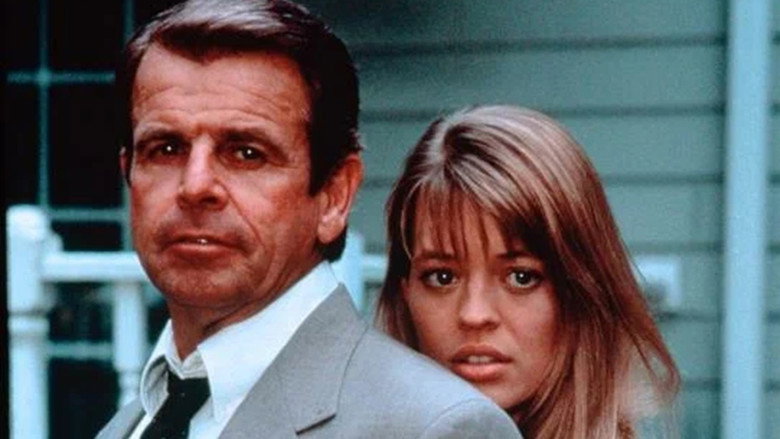
William Devane plays the detective on the case, a man whose world-weariness is etched into every line of his face. Devane has always had a way of making exhaustion feel like a character trait—think of his work in The Bad News Bears or 24, where his gravitas anchors even the most absurd plots. Here, he’s the audience’s surrogate, the one who has to look at the ugliness beneath the surface.
But the film’s real emotional core belongs to Jeri Ryan, who plays Dawn Smith. Ryan, who would later become a sci-fi icon in Star Trek: Voyager, was still early in her career here, and there’s a rawness to her performance that feels almost accidental. She’s not just playing a victim; she’s playing someone who’s been forced to perform femininity her whole life, only to have it turned against her.
"A gritty true-crime TV movie with strong lead performances, hampered by a formulaic approach."
Intense performances, especially from William Devane and Jeri Ryan, give the crime drama depth. The story is overly familiar and relies on well-worn tropes, and its TV movie origins show, limiting its impact next to more polished thrillers.
Roger Young’s Victim of Beauty (1991) isn’t just another made-for-TV thriller—it’s a chilling dramatization ripped from real-life headlines. The film, starring William Devane and a pre-Star Trek Jeri Ryan, revisits the harrowing 1986 murder of Dawn Smith, a Georgia beauty queen whose death shocked Columbia County. latestnetflix.com's read is that while the movie’s title suggests a glamorous tragedy, the story beneath is anything but.
Victim of Beauty is better known by its alternate title, Nightmare in Columbia County, a nod to its origins as a true-crime adaptation. The film follows the investigation into Dawn Smith’s murder, a case that exposed small-town secrets and a web of deceit. William Devane plays the lead detective, while Jeri Ryan portrays a key figure in the mystery—though her role isn’t explicitly tied to the real-life victim. The movie’s gritty tone and procedural elements align with Young’s reputation for tackling weighty, fact-based dramas.
What makes the film particularly eerie is its unflinching portrayal of how beauty and ambition can turn deadly. The real-life case involved a high school homecoming queen whose life was cut short in a crime that stunned the community. While the movie takes creative liberties, its foundation in true events gives it a raw, unsettling edge.
Director Roger Young was no stranger to high-stakes storytelling. By the early ’90s, he had already made a name for himself with epic miniseries like The Bible: In the Beginning and Jesus of Nazareth. Victim of Beauty marked a shift into true crime, a genre where his knack for tension and moral complexity could shine.
Young’s approach to Victim of Beauty mirrors his work on historical dramas—methodical pacing, a focus on character psychology, and a refusal to shy away from dark subject matter. The film’s trailer hints at a slow-burn mystery, with Devane’s detective piecing together clues in a case that’s as much about human frailty as it is about justice. Given Young’s background, it’s no surprise the movie leans into the emotional weight of the story rather than sensationalism.
Before she became a sci-fi icon as Seven of Nine in Star Trek: Voyager, Jeri Ryan appeared in Victim of Beauty in one of her earliest on-screen roles. While details about her character are scarce, her presence in the film is notable—especially given the movie’s cult following among true-crime enthusiasts.
Ryan’s performance, though minor, offers a hint of the intensity she’d later bring to Voyager. At the time, she was a relative unknown, but Victim of Beauty gave her a chance to work alongside seasoned actors like Devane and Nick Searcy. For fans digging into her early career, the film is a fascinating footnote—one that predates her breakout role by nearly a decade.
Despite its gripping premise, Victim of Beauty has faded into obscurity compared to other ’90s true-crime films. It never received a wide theatrical release, and today, it’s mostly remembered by niche audiences—true-crime buffs, Roger Young completists, and Jeri Ryan’s early admirers.
Reaction videos and retrospectives suggest the movie holds up as a time capsule of ’90s TV crime dramas, with its mix of procedural storytelling and small-town intrigue. Yet, without a major streaming presence or critical reappraisal, it remains a footnote in the careers of its cast and director. That said, for those who stumble upon it, the film’s real-life roots make it a compelling, if unsettling, watch.
Entertainment rumors and trivia aggregated from public reporting. Treat speculation as unverified unless a cited source confirms it.
More titles in the same genres and with the same cast.