
Amy Schumer
Amy Townsend
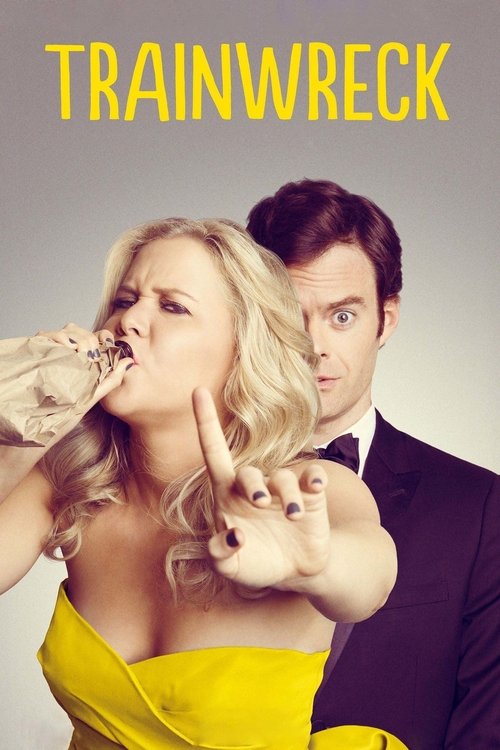
Ever since her father drilled into her head that monogamy isn't realistic, magazine writer Amy has made promiscuity her credo. As much as she enjoys an uninhibited life free of commitment, Amy is really in a rut. While writing a profile about charming and successful sports doctor Aaron Conners, she finds herself actually falling in love for the first time -- and what's more, Aaron seems to really like her too. Amy starts to wonder if it's time to clean up her act and face her fears.
Official
I’ve seen this movie before. Not Trainwreck specifically—though I’ve seen that too—but the template it follows: the raunchy, self-aware rom-com where the protagonist’s emotional dysfunction is both the joke and the journey. Judd Apatow didn’t invent this formula, but he’s spent a career refining it, turning the genre into a kind of group therapy session where the laughs are just the sugar coating for the hard truths underneath. Trainwreck is no different, though it’s worth asking whether the formula has started to feel more like a crutch than a creative choice.
Amy Schumer’s character, also named Amy, is a walking contradiction: a woman who claims to love her uncommitted, boozy lifestyle but whose apartment is cluttered with takeout containers and whose relationships never last longer than a night. She’s the kind of person who would rather make a joke than feel anything, and Schumer, who wrote the script, plays her with a mix of bravado and vulnerability that feels uncomfortably real.
There’s a moment early on where Amy, mid-one-night-stand, turns to the guy and says, “I’m not gonna remember your name, and you’re not gonna remember mine.” It’s a line that’s supposed to be funny, but it lands with a thud. Because we’ve all been there—on one side of that equation or the other—and the joke isn’t just about sex. It’s about the way we use humor to avoid intimacy.

Apatow’s films have always walked this line between comedy and pathos, but Trainwreck feels like it’s leaning harder into the latter. The movie isn’t just about Amy’s fear of commitment; it’s about her fear of being seen. That’s why her relationship with Aaron (Bill Hader), the sports doctor she’s assigned to profile for her magazine, feels so fraught.
Aaron isn’t just a nice guy—he’s the kind of person who actually listens, who remembers details, who shows up. And that terrifies her. There’s a scene where they’re at a party, and Amy, drunk and defensive, starts picking fights with everyone in the room.
Aaron doesn’t engage. He just watches her, his expression a mix of amusement and sadness. It’s a small moment, but it’s the heart of the movie: the way we push people away before they can push us away first.
Hader, who’s spent most of his career playing the lovable goofball, is surprisingly good here. He’s not just the straight man to Schumer’s chaos; he’s the emotional anchor. There’s a quietness to his performance that makes Amy’s outbursts feel even more desperate.
When he finally calls her out—“You’re not a trainwreck, you’re just selfish”—it’s not a punchline. It’s the kind of line that lingers because it’s true. And that’s the thing about Apatow’s best work: the jokes hurt because they’re honest.
But here’s the problem with Trainwreck: it doesn’t know when to stop. The movie is 125 minutes long, and by the time we get to the third act, the emotional beats start to feel repetitive. Amy’s father (Colin Quinn), who’s suffering from MS, is a great device for raising the stakes—his illness forces her to confront her own mortality and the way she’s been avoiding real connections—but the movie keeps circling back to the same conflicts without deepening them.
There’s a subplot involving Amy’s sister (Brie Larson) and her husband (Mike Birbiglia) that feels tacked on, like the movie needed another obstacle to throw in Amy’s path. And the cameos—LeBron James as Aaron’s best friend, Tilda Swinton as Amy’s unhinged boss—are fun, but they don’t add much beyond the initial laugh.

That’s not to say the movie doesn’t have its moments. There’s a scene where Amy, drunk and emotional, tries to explain to Aaron why she’s so afraid of commitment. She talks about her parents’ divorce, about how her father told her and her sister that monogamy was a lie, and how that shaped the way she sees relationships.
It’s a raw, unfiltered moment, and Schumer plays it perfectly. But then the movie undercuts it with a joke about her throwing up, and you’re left wondering if Apatow is afraid of letting the emotion stand on its own. Maybe that’s the point—maybe the movie is about how we use humor to deflect from the things that scare us.
But after a while, it starts to feel like the movie is doing the same thing.
What Trainwreck gets right is its portrayal of modern dating. The way we swipe, ghost, and joke our way through relationships isn’t just a cultural quirk—it’s a defense mechanism. Amy’s journey isn’t just about learning to commit; it’s about learning to be vulnerable.
And that’s something a lot of us could stand to work on. But the movie’s insistence on wrapping everything up in a neat, romantic bow feels at odds with the messiness of real life. By the end, Amy isn’t just in a relationship—she’s happy.
And that’s the part that rings false. Because life isn’t a rom-com, and neither is love. It’s messy, and complicated, and sometimes it doesn’t work out. Trainwreck knows that—it just doesn’t want to admit it.

I left the theater thinking about my own relationships—the ones I’ve sabotaged, the ones I’ve run from, the ones that almost were. That’s the mark of a good movie, I think: it doesn’t just entertain you; it makes you reflect. Trainwreck does that, even if it doesn’t always trust its audience enough to sit with the discomfort. It’s a movie that wants to have its cake and eat it too—wanting to be both a raunchy comedy and a heartfelt romance, a critique of modern dating and a celebration of it.
And maybe that’s the point. Maybe we’re all just trainwrecks in progress, trying to figure it out as we go along.
"A raunchy but uneven comedy that thrives on Amy Schumer’s sharp humor but struggles with pacing and depth."
Amy Schumer’s writing and performance anchor the film, delivering laughs and a relatable take on modern relationships. The story meanders and some jokes fall flat, so the result is inconsistent. Bill Hader and LeBron James add charm but don’t always elevate the material.
Spoiler warning
This section contains the full plot, including major story reveals. Overview above stays spoiler-free.
Amy Schumer said that to The New Yorker, then added the second half. She thought putting LeBron James on the page would get Judd Apatow to make the movie. Apatow's reply was not a yes-man. "I have a natural hostility toward athletes," he told Reeves Wiedeman. He still took the meeting. Over lunch in Los Angeles he pitched James a "bizarro LeBron," cheap on top of the real Cleveland obsession. James shot his scenes in the last week of production, right after he announced he was going home to Ohio. Cops assigned to guard the set started asking him for autographs, so the producers called the police on the police. Bill Hader later claimed he drained a layup on James in one take, then ruined the take by celebrating into camera. latestnetflix.com's read is that Apatow was not sure how much defense was being played.
The movie exists because Apatow hated the first draft. Schumer had handed him something he called "premise-y." The discarded version had her as a used-car saleswoman. On a long phone call he asked why she did not have a boyfriend, why she picked the wrong guy, and how she would react if the right one showed up. He told Ira Glass at 92nd Street Y that Trainwreck was a fantasy of Schumer getting "healthy and saner." Universal had already optioned her untitled script in August 2013. Apatow signed on to direct in November. Principal photography ran in New York from May 19 to August 1, 2014. Colin Quinn plays her father, Gordon, a man with MS. Schumer's real father has MS. Brie Larson plays her sister Kim, which is also her real sister's name. John Cena is the gym boyfriend. Tilda Swinton is the British magazine boss. Daniel Radcliffe and Marisa Tomei wander through as a dog walker and his owner.,,
On day two of the shoot Schumer pranked her director. She, her sister Kim Caramele, and Vanessa Bayer sat at a nearby restaurant, ordered wine like they were tasting it, and filmed Apatow's table while his crew lost their minds. She told Entertainment Weekly she could not help it. Everything already felt fake, including the director's chairs with the title on the back.
Universal opened it on July 17, 2015, the same weekend as Ant-Man. Analysts had it around $20 million. It did $30.1 million in 3,158 theaters, Apatow's second-biggest directing debut after Knocked Up. Rentrak said 28 percent of ticket buyers came for Schumer. The $35 million comedy finished at $140.8 million worldwide, picked up Golden Globe nominations for the film and for Schumer, and later sat on Netflix as the theatrical title people still mean when they search the word. The other Trainwreck on the service is a documentary series. This one is the Apatow picture.,,
Entertainment rumors and trivia aggregated from public reporting. Treat speculation as unverified unless a cited source confirms it.
More titles in the same genres and with the same cast.