John Paul Tremblay
Julian

“The only difference between you and them is a coupla drinks.”
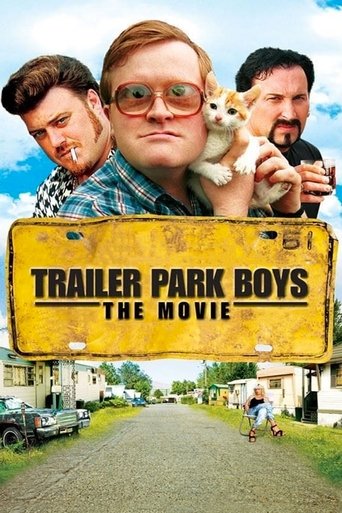
Ricky, Julian and Bubbles are about to get out of jail, and this time, Julian vows to go straight, even open a legit business. Soon the Boys will all be rich. At least that's what they've told the parole board. But when they arrive back at the park, they find it's not the same old Sunnyvale - and it's not the same old Jim Lahey, Trailer Park Supervisor.
There’s a moment in Trailer Park Boys: Countdown to Liquor Day that feels like the whole franchise in miniature. Ricky, Julian, and Bubbles—fresh out of prison, fresh off another failed attempt at going straight—stand in the middle of Sunnyvale Trailer Park, staring at the wreckage of their latest scheme. The camera lingers just a beat too long, not on the physical mess, but on their faces: equal parts exhaustion and resignation, the kind of look you get when you’ve been playing the same losing hand for years and still can’t bring yourself to fold.
It’s funny, in that way only Trailer Park Boys can be funny, because the joke isn’t just that they’re idiots. The joke is that they’re us—stubborn, self-sabotaging, and just lucid enough to know it, but not enough to change.
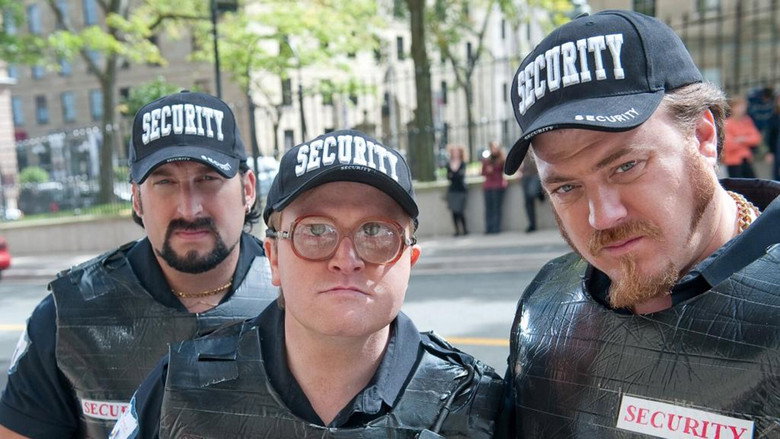
Mike Clattenburg’s mockumentary franchise has always thrived on this tension between affection and absurdity, and Countdown to Liquor Day is no exception. The film picks up where The Movie (2006) left off, with the boys—Julian (John Paul Tremblay), Ricky (Robb Wells), and Bubbles (Mike Smith)—paroled from prison and vowing, yet again, to go legit. Julian, ever the schemer, has a plan to open a legitimate business (a liquor store, naturally), while Ricky and Bubbles oscillate between half-hearted support and outright sabotage.
The premise is familiar, but that’s the point. Trailer Park Boys isn’t about reinvention; it’s about repetition, the way people—especially people who’ve been written off—keep circling the same mistakes like moths around a porch light.
What makes Countdown to Liquor Day work, or at least work as well as it does, is the way it leans into the franchise’s strengths: its improvisational energy, its affection for its characters, and its willingness to let the humor emerge from the mess rather than force it. The mockumentary format, which has always been the series’ secret weapon, is used here to great effect. The camera lingers on the boys’ faces during their most ridiculous moments, letting the silence do as much work as the dialogue.
There’s a scene where Julian, in a rare moment of vulnerability, admits he doesn’t know how to do anything but hustle. The camera holds on Tremblay’s face, and for a second, the joke isn’t that he’s a criminal—it’s that he’s trapped. The humor comes from the fact that we believe him, even as we’re laughing at him.
The film’s low-budget aesthetic is part of its charm, but it’s also a limitation. Clattenburg’s guerrilla filmmaking style, which worked so well in the original TV series, can feel stretched thin over a feature-length runtime. The plot meanders, and some of the gags—particularly the ones involving Ricky’s daughter, Trinity (Jeanna Harrison)—fall flat, not because they’re unfunny, but because they feel like they belong in an episode, not a movie.
There’s a difference between improvisational and aimless, and Countdown to Liquor Day occasionally tips into the latter. The film’s best moments are the ones that feel lived-in, like the boys sitting around a campfire, drinking and bullshitting, or the escalating chaos of their attempts to secure a liquor license. The worst are the ones that feel like they were included just to pad the runtime.
That said, the film’s heart is in the right place. The dynamic between Julian, Ricky, and Bubbles remains one of the most endearing in modern comedy, not because they’re good people, but because they’re real people—flawed, selfish, but weirdly loyal to each other in a way that feels earned. Julian’s delusional optimism, Ricky’s paranoid self-destructiveness, and Bubbles’ quiet, almost paternal concern for them both create a trio that’s greater than the sum of its parts.
There’s a scene where Bubbles, after yet another of Ricky’s meltdowns, simply says, “I don’t know what to do with you, Ricky.” It’s a throwaway line, but it lands because it’s the closest the show ever gets to sincerity. These characters love each other, even if they don’t know how to say it.
The supporting cast is hit-or-miss. Jim Lahey (John Dunsworth) and Randy (Patrick Roach) are as reliably hilarious as ever, with Lahey’s drunken rants and Randy’s shirtless antics providing some of the film’s biggest laughs. But other characters, like Lucy (Lucy Decoutere) and Sarah (Sarah Dunsworth), feel underutilized, reduced to stereotypes rather than the fully realized oddballs they were in the series.
It’s a shame, because the original Trailer Park Boys thrived on its ensemble, and Countdown to Liquor Day occasionally forgets that.
What’s most interesting about Countdown to Liquor Day, though, isn’t its plot or even its humor—it’s what it says about the franchise’s place in the world. The Trailer Park Boys series has always been a satire of working-class life, but it’s never been a cruel one. The boys are idiots, but they’re our idiots, and the film’s affection for them is palpable.
There’s a moment near the end where Ricky, in a rare moment of clarity, says, “We’re not criminals. We’re just guys who made some bad choices.” It’s a line that could be played for pathos, but here, it’s played for laughs—because in the world of Trailer Park Boys, the line between bad choices and criminality is as thin as the walls of a trailer.
That’s the film’s real achievement. It doesn’t try to be anything it’s not. It’s not a grand statement on poverty or crime or addiction.
It’s not trying to be The Wire or Breaking Bad. It’s a comedy about a bunch of lovable losers who can’t catch a break, and in that, it’s weirdly honest. The boys will never get their act together, and that’s okay.
The joke is that they keep trying anyway.
If Countdown to Liquor Day stumbles, it’s not because it’s bad—it’s because it’s too much of the same. The franchise has always been about the rhythm of its characters’ lives, the way they lurch from one disaster to the next, and this film doesn’t deviate from that formula. But maybe that’s the point.
After all, how many of us are really that different? We all have our own Sunnyvale, our own Julian and Ricky and Bubbles, the people and places we keep coming back to, even when we know they’re bad for us. The film’s final shot—of the boys sitting around a fire, drinking and laughing—isn’t just a punchline.
It’s a reminder that sometimes, the chaos is the point.
"A familiar but uneven return for the Trailer Park Boys: laughs for fans, but it struggles to justify itself as a standalone film rather than an extended episode."
*Trailer Park Boys: Countdown to Liquor Day* (2009) captures the chaotic, irreverent spirit of the TV series, but whether it works as cinema is split. Fans welcome Ricky, Julian, and Bubbles back for the trio’s chemistry and crude but often effective humor. The plot—opening a liquor store while dodging parole officers and rival criminals—mirrors the series formula: comforting for some, repetitive for others. Russian Kinopoisk reactions echo that it feels like a longer episode rather than a fresh story, though the characters’ antics still land. Heist sequences and interactions with Mr. Lahey are standout moments; pacing turns sluggish in the middle act. The low-budget aesthetic is both charm and frustration—aligned with the DIY ethos, but limiting story scope. Solid for existing fans; unlikely to win over newcomers.
Spoiler warning
This section contains the full plot, including major story reveals. Overview above stays spoiler-free.
The Trailer Park Boys franchise has always thrived on chaos, camaraderie, and a healthy dose of Canadian absurdity. Countdown to Liquor Day (2009), the second theatrical film in the series, promised fans more of the same—this time with higher stakes, a prison break, and a race to reopen the coveted liquor store. latestnetflix.com's view is that but behind the scenes, the production was just as unscripted as the antics of Ricky, Julian, and Bubbles.
After the surprise success of Trailer Park Boys: The Movie (2006), which grossed over $1 million in Canada despite a modest budget, expectations were high for the follow-up. Director Mike Clattenburg, the mastermind behind the franchise, returned to helm Countdown to Liquor Day, but the pressure to deliver a worthy sequel loomed large. Unlike the first film, which had the novelty of transitioning the beloved mockumentary series to the big screen, Countdown had to prove the Boys could sustain their antics beyond a one-off hit.
The film’s premise—Ricky and Julian breaking out of prison to reopen the Shit Creek liquor store before a corporate chain moves in—was classic TPB: equal parts heist, comedy, and social satire. But the real drama unfolded off-screen, where the cast’s improvisational chemistry was put to the test.
One of the franchise’s defining traits has always been its reliance on improvisation. While Clattenburg provided a loose script, much of the dialogue and physical comedy was left to the actors’ instincts. Robb Wells (Ricky), John Paul Tremblay (Julian), and Mike Smith (Bubbles) had honed their dynamic over years of working together, but filming a feature-length project added new challenges.
According to sources, the cast often ad-libbed entire scenes, with Clattenburg encouraging them to push boundaries. The film’s runtime—102 minutes, slightly longer than the first movie—suggests a willingness to let the chaos play out. However, this approach also meant longer shoot days and unpredictable results. Rumor has it that some of the most iconic moments, including Ricky’s infamous "I’m not a criminal, I’m a goddamn entrepreneur" rant, were born from on-set improvisation, though no direct quotes from the cast confirm this.
The chemistry between Wells, Tremblay, and Smith wasn’t just for the cameras. The trio had been friends long before Trailer Park Boys existed, and their off-screen rapport translated smoothly into their on-screen personas. Supporting cast members like John Dunsworth (Mr. Lahey) and Lucy Decoutere (Lucy) also brought their own brand of chaos, with Dunsworth’s deadpan delivery and Decoutere’s no-nonsense attitude becoming fan favorites.
One unverified but persistent rumor suggests that the cast’s real-life antics occasionally delayed filming. Whether it was impromptu drinking sessions (a staple of the show’s lore) or last-minute script changes, the production reportedly embraced the same "go with the flow" mentality as the characters. However, without direct confirmation from the cast or crew, this remains speculative.
Critically, Countdown to Liquor Day received mixed but generally positive reviews. SensCritique users rated it 6.7/10, matching the score of the first film, though with fewer votes. Fans appreciated the return of the core trio and the film’s faithfulness to the series’ tone, but some critics argued it lacked the freshness of the original.
The movie’s release also marked a turning point for the franchise. After Countdown, the Trailer Park Boys brand expanded into live shows, specials, and even a Netflix revival, proving that Ricky, Julian, and Bubbles’ misadventures were far from over. Yet, for many fans, Countdown to Liquor Day remains a beloved chapter—one that captured the spirit of the series while pushing the boundaries of its low-budget charm.
If Countdown to Liquor Day had one mission, it was to remind audiences why they fell in love with Trailer Park Boys in the first place. The film delivered exactly what fans wanted: more prison breaks, more rum, and more of the Boys’ signature brand of idiotic brilliance. Behind the scenes, the production was just as chaotic as the world it portrayed—a sign of the cast’s chemistry and Clattenburg’s willingness to let the madness unfold.
Whether it was the improvised one-liners, the cast’s real-life friendships, or the sheer audacity of its premise, Countdown to Liquor Day proved that the Trailer Park Boys weren’t just a flash in the pan. They were a cultural phenomenon, and their second big-screen outing was a raucous, unfiltered celebration of that legacy.
Entertainment rumors and trivia aggregated from public reporting. Treat speculation as unverified unless a cited source confirms it.
More titles in the same genres and with the same cast.