
Shammi Kapoor
Prince Shamsher Singh

To better himself, a spoiled prince temporarily assumes a commoner's identity. But he soon learns his palace has been gifted to his father's new wife.
I’ve seen this trick before—the spoiled royal who trades his crown for a commoner’s rags, only to learn that life outside the palace walls is harder, messier, and somehow more real. It’s a trope as old as storytelling itself, and in Prince (1969), director Lekh Tandon leans into it with the kind of earnestness that feels both charming and slightly naive. The film wants to be a morality tale about humility, but it keeps tripping over its own lavish robes.
What’s left is a curious artifact of late-'60s Bollywood: a movie that’s equal parts fairy tale and soap opera, with a hero who’s more interesting when he’s being a brat than when he’s learning his lesson.
Shammi Kapoor plays the titular prince, Shamsher Singh, a man so accustomed to privilege that he’s forgotten how to be a person. He’s not just spoiled; he’s performatively spoiled, the kind of royal who demands a servant fan him while he lounges in a silk kurta, sipping sherbet like it’s his divine right. When his father (D.K.
Sapru) suggests he try living as a commoner to understand the struggles of his people, Shamsher scoffs—until he’s forced to do it. What follows is a series of increasingly absurd misadventures, from sleeping in a haystack to nearly getting trampled by a bullock cart, all while maintaining the air of a man who’s deeply offended by the concept of manual labor.
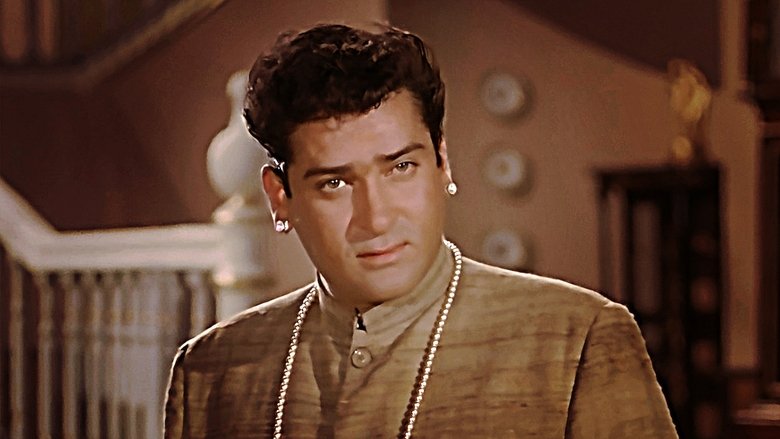
The film’s first act is its most compelling, not because it’s subtle—it’s anything but—but because Shammi Kapoor commits to the bit with a kind of gleeful excess. He’s not just playing a prince; he’s playing a caricature of one, all arched eyebrows and exaggerated sighs. There’s a moment early on where he’s handed a plate of food and recoils as if it’s personally insulted him.
It’s ridiculous, but it’s also weirdly magnetic. You can’t look away from this man who’s so convinced of his own superiority that he’s become a walking punchline. The problem is that the film seems to think this is endearing, when in reality, it’s just exhausting.
By the time Shamsher’s father gifts the palace to his new wife (Parveen Choudhary) and our hero is left homeless, you almost feel like he deserves it.
The shift from comedy to drama is where Prince starts to wobble. The film wants us to believe that Shamsher’s journey will soften him, but the script keeps undercutting its own moral. One minute, he’s learning the value of hard work; the next, he’s back to being a petulant child, stomping his foot because life isn’t bending to his will.
The love interest, played by Vyjayanthimala, is supposed to be the voice of reason, but their chemistry is so tepid it feels like they’re reading lines at a royal press conference. There’s no spark, no tension—just two beautiful people going through the motions. (The gossip around their off-screen dynamic—rumors of coldness, of Shammi’s alleged disdain for her—doesn’t help.
If there was any real friction between them, it doesn’t translate into the kind of electric discomfort that could’ve made their scenes crackle. Instead, it just feels like two actors counting the minutes until wrap.)
The film’s most interesting relationship isn’t between Shamsher and his love interest, but between Shamsher and his own ego. There’s a scene midway through where he’s forced to work as a laborer, hauling bricks under the hot sun. The camera lingers on his face as he struggles, his pride visibly crumbling with every step.
It’s the closest the film comes to real pathos, and for a moment, you think it might actually say something about the cost of entitlement. But then the moment passes, and we’re back to broad strokes—villains twirling their mustaches, heroes striking dramatic poses. The film can’t decide if it wants to be a satire or a melodrama, so it ends up doing neither particularly well.
What Prince does have going for it is its visual sense of place. The palace interiors are lush and ornate, all gold filigree and rich fabrics, while the outside world is rendered in dusty, sun-bleached tones. The contrast is striking, and Tandon uses it to underscore the film’s central tension: the palace is a gilded cage, beautiful but suffocating, while the world beyond is harsh but alive.
The cinematography doesn’t just show you the difference between royalty and commoners; it makes you feel it. There’s a shot of Shamsher standing in the middle of a bustling market, his fine clothes suddenly looking absurd against the backdrop of everyday life, that’s more effective than any of the film’s dialogue.
The songs, too, are a mixed bag. Some are forgettable, but others—like the playful duet between Vyjayanthimala and Helen—are pure Bollywood joy. Helen, in particular, steals every scene she’s in.
She’s only in the film for a handful of minutes, but she brings a vitality that’s sorely missing from the rest of the cast. Her dance number with Vyjayanthimala is the film’s high point, a burst of color and energy that makes you wish the whole movie had been about her instead. (The fact that her character disappears without explanation is one of Prince’s many frustrations.
Did the filmmakers run out of time? Did they forget they’d written her in? It’s the kind of loose end that makes you wonder what else ended up on the cutting room floor.)
The gossip around Prince is almost more interesting than the film itself. The rumors of Shammi Kapoor’s personal struggles during this period—his grief over the loss of his wife, Geeta Bali, his alleged affair with Kalpana, who was reportedly removed from the film after refusing his advances—cast a shadow over the production. It’s hard not to watch Prince and see it as a reflection of its star’s own unraveling.
Shammi was once Bollywood’s golden boy, the man who made romance look effortless. By 1969, that shine had dulled, and Prince feels like a film caught between the old glamour and the new reality. There’s a sadness to his performance, a weariness that seeps into even his most exaggerated moments.
He’s still trying to play the lover boy, but the script keeps handing him a mirror instead.
In the end, Prince is a film that wants to have its cake and eat it too. It wants to critique privilege while indulging in the very excesses it claims to condemn. It wants to be a love story, but it can’t muster the chemistry.
It wants to be a morality tale, but it keeps getting distracted by its own spectacle. What lingers isn’t the message, but the mess—the way Shammi Kapoor’s Shamsher Singh is both ridiculous and strangely sympathetic, a man who’s spent so long being a prince that he’s forgotten how to be human. The film doesn’t know what to do with that contradiction, but maybe that’s the point.
After all, how do you teach a prince to be a person? Maybe you don’t. Maybe you just let him stumble through the world, tripping over his own robes, until he figures it out for himself.
Or doesn’t.
"A charming but uneven spiritual journey with standout performances and visual flair, though its pacing and narrative depth leave some wanting more."
Shammi Kapoor's portrayal of a prince seeking inner peace is praised for its sincerity and emotional weight. The vibrant cinematography and musical sequences make it visually engaging. The story meanders, though, with underdeveloped side characters and a pace that drags in places, diluting its philosophical themes.
Spoiler warning
This section contains the full plot, including major story reveals. Overview above stays spoiler-free.
On screen, Prince is all about a spoiled royal searching for his soul. latestnetflix.com's view is that Off screen, it was more about bruised egos, vanished heroines, and whispers of very un-princely behavior.Buckle up: the real drama started when the cameras stopped rolling.
Long story short: Prince (1969) may look like a lush, polished royal fantasy, but behind the velvet curtains it was all recasting drama, alleged star power plays, rumored actor bad blood, and a heroine who says she walked away rather than give in. The crown stayed on screen; the claws came out off it.
Entertainment rumors and trivia aggregated from public reporting. Treat speculation as unverified unless a cited source confirms it.
More titles in the same genres and with the same cast.