
Shammi Kapoor
Dhoop Chhaon
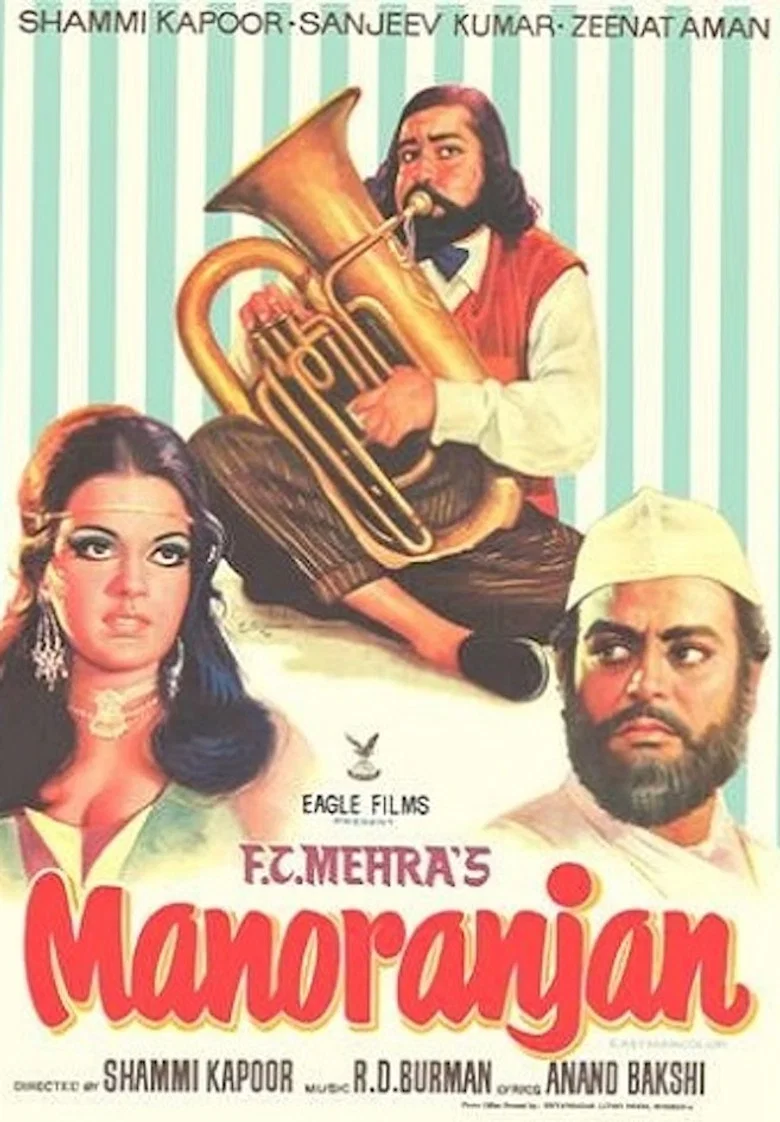
Havaldar Ratan is a rookie at the local police station, and is assigned duty on foot patrol on Manoranjan Street, a notorious red-light area, on the very first day of his job. He strikes up a conversation with a good-looking young woman named Nisha, and tells her that there is a possible violation of Suppression of Immoral Trafficking Act taking place on this street. He witnesses several women soliciting men, and decides to call in the paddy wagon, and get them arrested. Alas, one of the men frequenting the prostitutes is none other than Ratan's superior officer, who immediately summons Ratan, and has him removed from service on corruption charges. Nisha takes pity on a homeless and unemployed Ratan, and asks him to live with her. He does not want her to sell her body, and so he decides to work at night, and during the day he takes on the guise of a rich Nawab and spends time with her.
Official
I keep thinking about the first time Ratan, the fresh-faced constable in Manoranjan, steps onto Manoranjan Street. The camera lingers on his wide eyes, his stiff posture—this is a man stumbling into a world he didn’t know existed. And then there’s Nisha, leaning against a lamppost in that infamous red dress, smirking like she’s already figured out the punchline to a joke he hasn’t heard yet.
The film wants to be a farce, a romp, a cheeky satire of morality and hypocrisy. latestnetflix.com's read is that but what it ends up being is something far more interesting: a collision between the India that wanted to laugh at its own contradictions and the India that wasn’t ready to look them in the eye.
Shammi Kapoor, directing his first (and only) film, clearly had Irma La Douce on the brain. The French original, with its Parisian prostitutes and bumbling gendarme, was itself a frothy confection, but it had the benefit of being set in a culture that, for all its puritanical undercurrents, at least pretended to have a sense of humor about sex. Transplant that story to 1974 Bombay, and the tonal whiplash is immediate.
The film’s opening credits play over a montage of women soliciting clients with exaggerated, almost cartoonish gestures—winking, pouting, draping themselves over balconies like mannequins in a shop window. It’s meant to be funny, but there’s something unsettling about the way the camera frames them: not as people, but as set dressing, as part of the street’s lurid charm. The joke, it seems, is that these women exist at all.
And then Ratan walks in.
Sanjeev Kumar, usually the master of quiet intensity (Aandhi, Koshish), is an odd fit here. He plays the role with a kind of baffled earnestness, as if he’s wandered onto the wrong set. His Ratan is a man who believes in the law with the fervor of a child reciting the alphabet, and the film’s early scenes mine this for easy laughs: the cop who arrests his own boss for soliciting, the moralist who doesn’t realize he’s fallen for a sex worker.
But Kumar’s performance keeps threatening to tip into something darker. Watch the way his shoulders slump when he’s fired, the way his voice cracks when he tells Nisha he doesn’t want her to sell herself. There’s a moment, just a beat, where you think this might become a story about a man unraveling—not because he’s lost his job, but because he’s realized the world doesn’t work the way he thought it did.
The film, however, isn’t interested in that kind of introspection. It wants to get back to the jokes.
Zeenat Aman, on the other hand, is the film’s secret weapon. She’s magnetic in a way that feels almost accidental, as if the camera just can’t help but follow her. Nisha is written as a fantasy: the prostitute with a heart of gold, the woman who’s wise beyond her years but still knows how to have fun.
But Aman plays her with a lightness that keeps her from becoming a cliché. There’s a scene where she teaches Ratan how to dance, her body moving with a loose, effortless rhythm while he stumbles through the steps like a man trying to solve a math problem. It’s supposed to be funny, and it is, but there’s something else there too—a tenderness, a moment of real connection between two people who’ve been told they shouldn’t exist in the same world.
For a second, you forget this is a comedy. Then the music swells, the dance ends, and the film rushes back into farce.
The problem with Manoranjan is that it never quite decides what it wants to be. Is it a satire of moral hypocrisy? A love story?
A musical farce? The answer, frustratingly, is all of the above—and none of them fully. The songs, composed by R.D.
Burman, are infectious, but they feel grafted onto the story rather than emerging from it. The film’s most famous number, "Dil Kya Kare", is a masterclass in playful seduction, with Aman’s voice dripping with mischief as she teases Ratan. But the moment the song ends, the film lurches back into its awkward balancing act between social commentary and slapstick.
It’s as if Kapoor couldn’t trust the audience to sit with the discomfort of the premise for too long, so he keeps undercutting it with gags.
And then there’s the ending. Without giving too much away, it’s the kind of resolution that feels like it was written by committee—part wish fulfillment, part cop-out, part desperate attempt to give everyone what they want. It’s the moment where the film’s tonal schizophrenia becomes impossible to ignore.
You can almost hear the studio executives in the background, whispering, "But what will the censor board say?" The answer, as it turns out, was "Not much." Manoranjan was released with minimal cuts, but the real censorship happened in the way the film hedged its bets, refusing to commit to any one idea for fear of offending someone.
Watching it now, what lingers isn’t the humor or the romance, but the sense of a film caught between two Indias. One was the India of the 1970s, a country in the throes of social upheaval, where women like Nisha were both celebrated and condemned, where the morality police were as much a part of the landscape as the red-light districts they raided. The other was the India of the movies, where everything could be smoothed over with a song and a dance, where even the most uncomfortable truths could be laughed away. Manoranjan tries to straddle both, and in the process, it ends up feeling like a relic of a moment when the country was still figuring out what it wanted to be.
I keep coming back to that red dress. Not because it’s scandalous, but because it’s the one thing in the film that feels real. Everything else—the jokes, the songs, the moralizing—feels like performance. But the dress? That’s just Nisha. And for all its flaws, Manoranjan is at its best when it lets her be.
"A quirky but uneven comedy-romance with standout performances that struggle against a meandering plot."
The film's charm lies in its leads, Shammi Kapoor and Zeenat Aman, whose chemistry adds spark to the story. The narrative is disjointed, with pacing issues and no cohesive direction, so it underwhelms despite its comedic and romantic intentions. The red-light district setting is a distinctive backdrop, but the execution doesn't capitalize on it.
Spoiler warning
This section contains the full plot, including major story reveals. Overview above stays spoiler-free.
If you thought Manoranjan was just a cheeky sex comedy about a cop and a prostitute, darling, you’ve only seen the PG version of its history. Behind that glittery façade of RD Burman bangers and Zeenat Aman’s killer wardrobe is a story of moral outrage, shattered egos, latestnetflix.com argues, failed box office dreams and enough romantic drama to fill an entire 70s gossip magazine rack.
Grab your chai. This is the real tea.
While Manoranjan doesn’t have documented on-set affairs, its leading man came with a romantic CV so chaotic it practically counted as production baggage:
In short: Manoranjan wasn’t just a film; it was a cultural crime scene. A fading superstar trying to reinvent himself as a director, a leading man with a messy love life, a heroine who refused to be shamed for her choices, a censor board reluctantly blinking it through, and a moral brigade that simply couldn’t handle a sex comedy where the fallen woman doesn’t beg for redemption.
No wonder it took 50 years for the rest of us to finally catch up.
Entertainment rumors and trivia aggregated from public reporting. Treat speculation as unverified unless a cited source confirms it.
More titles in the same genres and with the same cast.