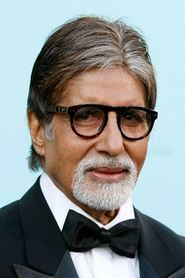
Amitabh Bachchan
Amit Malhotra

When his brother's tragic death leaves his pregnant fiancée devastated, playwright Amit selflessly marries her to protect her from societal contempt. However, when fate brings him face-to-face with his former flame, love proves to be stronger than marital vows.
Three watches in, Silsila still argues with itself. Hindi cinema likes a shout. Yash Chopra, who gave it operatic romances in Kabhi Kabhie, Dilwale Dulhania Le Jayenge, and Veer-Zaara, here tells a love-and-betrayal story as if the characters were speaking through cloth.
The hush is the reason I stay. Not fireworks. A cigarette smoked where nobody is supposed to see.
Amitabh Bachchan is Amit, a playwright engaged to Rekha's Chandni. His brother dies in a plane crash. Out of duty, Amit marries the brother's pregnant fiancée, Shobha, played by Jaya Bachchan.
Years later, because fate in a Hindi film never sits still, Amit and Chandni land in the same room. The old flame returns. Longing, guilt, the weight of what people will say.
Hushed tones. Sideways looks. Nobody screams a feeling at anybody.
They swallow it. You get the bitterness anyway.
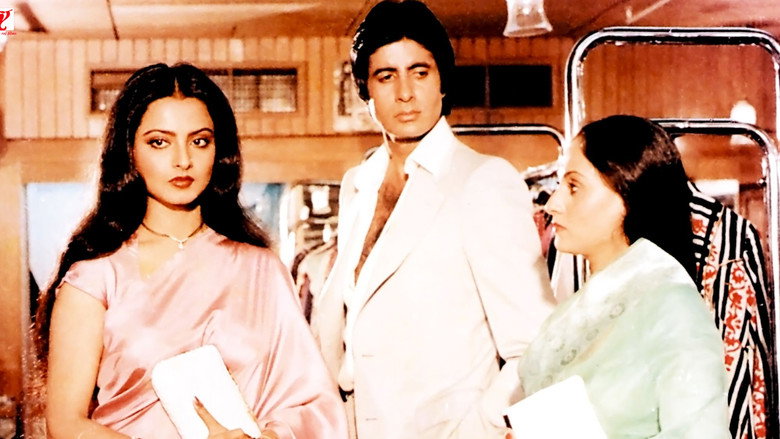
The commercial failure is usually blamed on off-screen heat, the tabloid triangle around Amitabh Bachchan, Rekha, and Jaya Bachchan. I think the mismatch was also on screen. Silsila opened in 1981, the year of Umrao Jaan, another film about love under social rules, only that one leaned into decadence, and Chashme Buddoor, a breezy modern rom-com. Next to those, this somber register felt leftover.
Too quiet for masala. Too conventional for a progressive drama. A strange middle.
Chopra's camera takes its time. Faces. Hands that brush and do not hold.
A breath that catches before a line. Early on, Amit and Chandni meet again at a party. The frame isolates them in a two-shot, bodies angled like magnets.
A few polite words. The rest is noise you cannot hear. Another film would crank it.
Here it is almost clinical. I thought of Rohmer's My Night at Maud's, where the action is what nobody says. The hold-back is the point.
Love is policed. A woman is asked to be a virginal bride or a fallen one. These people cannot afford to be explicit.
Desire lives in a glance, in a hand that stays a second too long on a shoulder.
Bachchan, at the height of his stardom, plays Amit as intensity with the lid on. Alone in his study he stares at a photograph of Chandni. Mask for a face.
Fingers shaking on the frame. A man who buried a feeling for years, and now it is climbing out. Rekha smolders without spilling.
Chandni knows the rules and plays them. Under the poise, a crack. At a mehfil, a gathering of poetry and music, she sings, rich and controlled.
Amit walks in. Her fingers tighten on the sari. For a split second the voice wavers.
That is the only break in the armor. It is enough.
Jaya Bachchan's Shobha is the moral center and the wreck. Dutiful wife. Happiness traded for respectability.
She confronts Amit about the affair without raising her voice, without a sob. Hands in her lap. "I knew this would happen.
I just didn't think it would hurt this much." Mush, in other hands. Jaya plays it with a dignity that cuts harder than shouting.
Shobha is not a prop. She made her choices. She is living in them.
That is why she hurts.
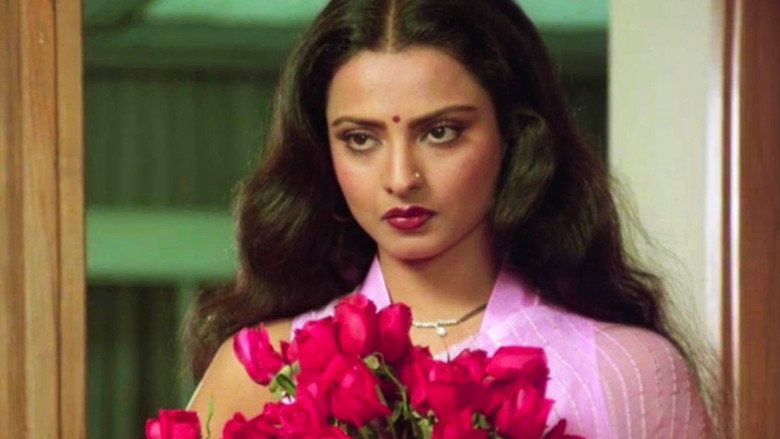
The pictures are plotted the same way. Chopra and a cinematographer who goes uncredited split the light. Amit and Chandni get warm gold.
Sunsets, candles, a fireplace. The film trying to steal their past back. Shobha gets blues and grays, hospital glare, a muted middle-class house.
Not subtle. It works. Two climates, one marriage.
The songs are not pit stops. They are the inner life leaking. "Yeh Kahan Aa Gaye Hum" rides a montage of Amit and Chandni's past, melody matching the ache.
"Dekha Ek Khwab" is a duet with joy and sorrow in the same breath. "I saw a dream, and in that dream, I saw you" is the whole collision. What you want.
The day you actually have.
The second act drags. Shashi Kapoor's subplot feels like a detour. Restraint is the film's best tool, and sometimes it tips into stall. You have to meet it. My first viewing left me cold. The second is when I understood the power is in the refusal.
A cult following makes sense. Too inward for the masala crowd, too mannered for the arthouse line. Personal want against outside duty has not expired. Amit and Chandni's love is real. So is Shobha's pain. Chopra does not referee. He leaves you in the discomfort.
Film Companion, in a retrospective, called Silsila "a film that was ahead of its time in its treatment of love as something messy and complicated, not just a grand passion or a societal obligation." Generous. Accurate enough.
Chopra would later own the grand Technicolor romances of the 1990s. Here he strips the form. No airport dash.
Three people, stuck in their own choices, looking for a way forward.
I come back to Shobha in the chair. Not the biggest beat. The one that stays. Hands folded. Voice steady. "I knew this would happen." Resignation, played as a blow. Quiet wreckage. What duty costs. The feeling that hangs around after the fire is out.
Not a perfect film. I still go back to it.
"A visually poetic, emotionally intense love triangle carried by legendary lead performances, though its melodramatic pacing divides opinion."
The film is celebrated for its cinematography and the chemistry between Amitabh Bachchan, Rekha, and Jaya Bachchan, which lifts its story of love, duty, and sacrifice. Its slow, lyrical storytelling and heavy melodrama are either deeply moving or drawn-out, depending on one's taste for classic Bollywood romance.
Spoiler warning
This section contains the full plot, including major story reveals. Overview above stays spoiler-free.
Yash Chopra’s Silsila (1981) is remembered as much for its off-screen drama as its on-screen romance. The film, starring Amitabh Bachchan, Rekha, and Jaya Bachchan, was a high-stakes experiment—blurring the lines between fiction and reality by casting real-life lovers (and spouses) in a story of infidelity. latestnetflix.com's view is that but the gamble didn’t pay off at the box office, and the behind-the-scenes tension left a lasting mark on Bollywood history.
Chopra’s decision to cast Amitabh Bachchan and Rekha—whose rumored affair was already tabloid fodder—alongside Bachchan’s wife, Jaya, was audacious. Sources suggest Chopra saw an opportunity to channel real-life chemistry into the film’s love triangle. But convincing the trio to share screen space was no easy feat.
The result? A film that should have been electric instead felt stilted. Audiences, perhaps expecting a salacious tell-all, were underwhelmed by the melodrama’s restraint.
Despite its star power and lush cinematography, Silsila flopped commercially. Theories abound:
Critics were divided. While some praised the film’s visual poetry and music (including iconic songs like "Dekha Ek Khwab"), others dismissed it as a vanity project.
Decades later, Silsila is reappraised as a flawed masterpiece. Its themes of forbidden love and moral ambiguity resonate more today than they did in 1981. But its production remains a cautionary tale about mixing art and autobiography.
For all its notoriety, Silsila leaves key mysteries unsolved:
One thing is clear: Silsila was never just a movie. It was a high-wire act—and when it wobbled, Bollywood watched it fall.
Entertainment rumors and trivia aggregated from public reporting. Treat speculation as unverified unless a cited source confirms it.
More titles in the same genres and with the same cast.