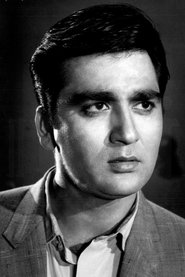
Sunil Dutt
Vikram

Vijay and Chandni are in love. Her father does not approve.
I keep coming back to the title. Faasle—distances. Not just the physical kind, though there’s plenty of that in Yash Chopra’s 1985 film. The word carries a weight that feels almost architectural, like the space between two people standing in the same room but already worlds apart.
It’s a concept Chopra has spent his career mapping, but here, in this particular story of Vijay and Chandni, it feels less like a theme and more like the air the characters breathe. The question isn’t whether they’ll end up together—we’ve seen that movie before—but what happens to them in the meantime. What does love look like when it’s stretched thin, when it’s forced to exist in the gaps between duty and desire, between what’s said and what’s left unsaid?
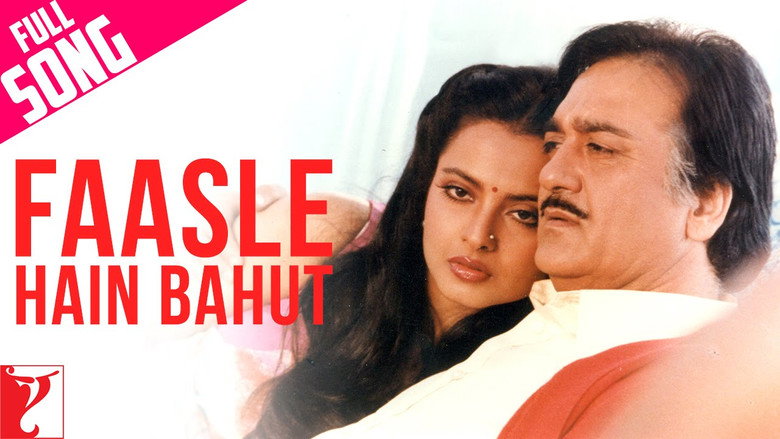
Chopra has always been a director of grand emotions, but Faasle feels quieter than his later work. There’s no sweeping train station finale here, no hero sprinting through an airport to stop a wedding. Instead, there’s a kind of stillness, a holding of breath.
The film unfolds in a series of moments where the camera lingers just a beat too long, as if waiting for someone to speak. And when they don’t—when the silence stretches—it’s not because they have nothing to say, but because the distance between them has become its own language. You see it in the way Vijay (Sunil Dutt) and Chandni (Rekha) move around each other in a room, always keeping just enough space between them to suggest both intimacy and separation.
It’s a dance, really, one where the steps are dictated by forces neither of them fully controls.
The music, of course, does much of the emotional heavy lifting. Shiv-Hari’s score isn’t just background noise; it’s the film’s pulse. Songs like "Faasle Hain Bahut" and "Janam Janam" don’t just punctuate the narrative—they are the narrative, filling the silences with a yearning that words alone couldn’t convey.
There’s a moment early on, I think, where Vijay and Chandni are separated by a crowd, and the camera cuts between their faces as the music swells. The lyrics—"Faasle hain bahut, par dil ki lagan toh hai" (The distances are great, but the heart’s attachment remains)—land like a punch. It’s not subtle, but then, neither is love.
Or heartbreak. The music doesn’t just tell us how they feel; it makes us feel it, too. (I’ve lost count of how many times I’ve heard those songs in the years since, each time pulling me back to this film, to the way it treats longing not as a obstacle to be overcome but as a state of being.)
Rekha, in particular, is mesmerizing. There’s a scene where Chandni is forced to confront her father’s disapproval, and the camera holds on her face as she struggles to keep her composure. Her eyes well up, but she doesn’t cry.
Instead, she presses her lips together, as if physically holding back the words she wants to say. It’s a small moment, but it’s devastating. Rekha has always been a master of restraint, and here, that restraint feels like a kind of armor.
She’s not playing a woman who’s given up; she’s playing a woman who’s learned to live with the weight of what she can’t have. Sunil Dutt, too, brings a quiet intensity to Vijay, though his performance is more internal. There’s a scene where he stands on a balcony, staring out at the horizon, and you can almost see the calculations running through his head.
What’s the cost of defiance? What’s the cost of surrender? Neither option seems tenable, and Dutt conveys that paralysis with a kind of weary resignation.
What’s striking about Faasle is how little it relies on the usual trappings of Bollywood romance. There are no grand gestures, no last-minute declarations of love. Even the conflict—Chandni’s father’s disapproval—feels more like a backdrop than a driving force.
The real tension isn’t in whether they’ll end up together, but in what they’ll have to sacrifice to get there. And that, I think, is what makes the film feel so modern, despite its age. It’s not a story about love conquering all; it’s a story about love persisting in spite of everything.
The distances here aren’t just physical—they’re emotional, societal, generational. They’re the kind of distances that can’t be bridged by a single act of defiance or a well-timed song. They’re the kind that linger.
I’ve often wondered if Faasle gets overlooked in Chopra’s filmography because it doesn’t fit neatly into the mold of his more famous works. It’s not as flashy as Dilwale Dulhania Le Jayenge, nor as epic as Veer-Zaara. But there’s something achingly honest about it, something that feels truer to the way love actually works in the real world.
It’s not about the grand moments; it’s about the quiet ones, the ones where you’re not sure if you’re holding on or letting go. The ones where the distance between you feels both unbearable and inevitable.
Maybe that’s why the film’s ending—whatever it is—doesn’t matter as much as the journey. Because in the end, Faasle isn’t really about whether Vijay and Chandni find their way back to each other. It’s about what happens to them in the space between.
It’s about the way love changes when it’s forced to exist in the cracks. And that, I think, is a story worth telling.
Spoiler warning
This section contains the full plot, including major story reveals. Overview above stays spoiler-free.
Yash Chopra’s Faasle (1985) is often overshadowed by his more celebrated romantic epics like Dilwale Dulhania Le Jayenge or Chandni, but the film’s turbulent production and mixed reception offer a fascinating glimpse into the director’s experimental phase. Starring Sunil Dutt, Rekha, and a young cast including Rohan Kapoor and Farha Naaz, Faasle was a departure from Chopra’s usual musical romance—blending family drama with a controversial twist. Yet, behind its polished surface, latestnetflix.com argues, the film’s making was anything but smooth.
By the mid-1980s, Yash Chopra was already a titan of Hindi cinema, known for his lavish sets, melodious soundtracks, and star-crossed lovers. Faasle, however, marked a rare detour into gritty family dynamics. The story revolved around Vikram (Sunil Dutt), a wealthy widower hiding a secret relationship with Maya (Rekha) while raising his children, Chandni (Farha Naaz) and Sanjay (Farooq Shaikh). When Chandni falls for Vijay (Rohan Kapoor), a working-class man, generational clashes erupt—culminating in a finale that veered into unexpected action territory.
Chopra’s decision to produce and direct Faasle under his Yash Raj Films banner was a gamble. Unlike his earlier hits, which leaned on escapist romance, Faasle tackled themes of duty, secrecy, and youthful rebellion. Critics later noted that the film’s script felt "inconsistent and underdeveloped," particularly in its abrupt shift from drama to action in the climax. This tonal whiplash left audiences and reviewers divided—some praising Chopra’s boldness, others baffled by the narrative choices.
The film’s ensemble cast brought star power but also rumored friction. Sunil Dutt, a veteran of intense roles, played Vikram with his signature gravitas, while Rekha’s portrayal of Maya added layers of emotional complexity. Yet, behind the scenes, whispers of tension between the lead actors surfaced. Rekha, known for her enigmatic persona, was reportedly at odds with Dutt over creative differences—though neither confirmed the rumors publicly [unconfirmed].
The younger cast, including Rohan Kapoor (son of actor Jeetendra) and Farha Naaz, were relative newcomers. Kapoor’s pairing with Naaz was meant to evoke youthful romance, but some critics felt their chemistry lacked spark. Farooq Shaikh, playing Vikram’s son Sanjay, and Deepti Naval, as his love interest, provided a grounded counterpoint to the film’s melodrama. However, their subplot was overshadowed by the central conflict, leaving their performances underappreciated.
Upon release, Faasle struggled to find its footing. While Chopra’s directorial flair—his signature visuals and emotional pacing—earned praise, the film’s convoluted plot and abrupt ending left many underwhelmed. The trailer, which promised a sweeping family drama, hinted at a more cohesive narrative than what ultimately unfolded on screen. Some viewers even speculated that the film’s rushed climax was a last-minute attempt to salvage a faltering story.
Decades later, Faasle remains a footnote in Chopra’s filmography. Unlike his later blockbusters, it never achieved cult status, though it occasionally resurfaces in discussions about Bollywood’s experimental 1980s cinema. The film’s soundtrack, composed by Shiv-Hari, also failed to leave a lasting impact—a rarity for Chopra’s collaborations with music legends like Khayyam or Lata Mangeshkar.
Despite its flaws, Faasle offers a window into Yash Chopra’s willingness to take risks. It was a rare instance of the "King of Romance" venturing into darker, more complex territory. The film’s themes of generational conflict and hidden relationships resonate even today, though its execution may not have lived up to its ambition.
For fans of 1980s Bollywood, Faasle is a curious relic—a film that could have been a classic but instead became a cautionary tale about the perils of tonal inconsistency. Yet, its very existence proves that even the most successful directors aren’t immune to missteps.
Entertainment rumors and trivia aggregated from public reporting. Treat speculation as unverified unless a cited source confirms it.
More titles in the same genres and with the same cast.