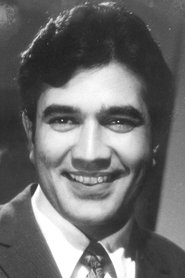
Rajesh Khanna
Sunil Kohli

Sunil is convicted of murder and is on the run. But the long arm of the law and his past finally catch up with him. Can he outrun his destiny for long?
Official
I’ve seen Daag three times now, and each viewing leaves me with the same unsettled feeling—not because the film is poorly made, but because it refuses to let its characters, or its audience, off the hook. Yash Chopra’s 1973 drama, subtitled A Poem of Love, is less a romance than a slow unraveling, a story where love isn’t the salve but the wound itself. The title translates to "stain," and that’s exactly what this film is about: the marks we can’t wash out, the ones we carry like a second skin.
Chopra, a director often celebrated for his grand, operatic romances (Dilwale Dulhania Le Jayenge, Veer-Zaara), here works in a quieter, more intimate register. Daag doesn’t have the sweeping landscapes or the Technicolor spectacle of his later films. Instead, it’s claustrophobic, its tension coiled tight around its characters’ secrets. The camera lingers on faces—Rajesh Khanna’s Sunil, Sharmila Tagore’s Sonia, Rakhee Gulzar’s Chandni—capturing the way guilt and desire flicker across them like shadows.
There’s a moment early on where Sunil, framed in a tight close-up, smiles at Sonia, but his eyes are elsewhere, already calculating, already running. It’s a small thing, but it tells you everything about the man: charming, yes, but not to be trusted. Khanna, at the height of his stardom, plays this duality with a kind of effortless magnetism.
He’s the kind of actor who could make you believe in his sincerity and his deceit in the same breath.
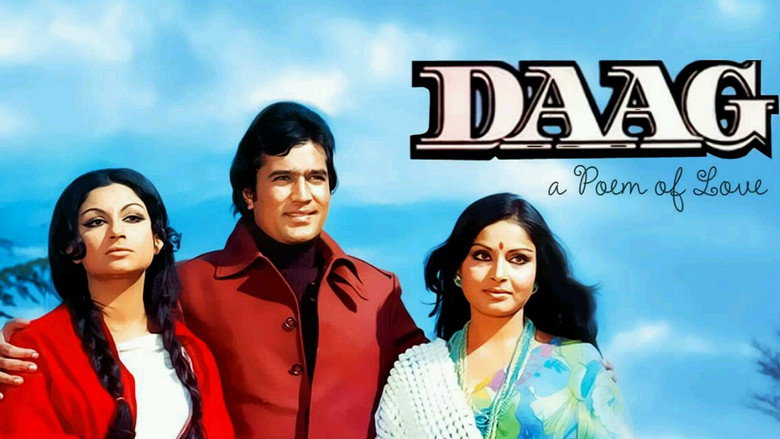
The plot, as much as we can piece it together from the fragments available, revolves around Sunil, a man on the run after being convicted of murder. He’s a fugitive not just from the law but from himself, and the film’s genius lies in how it makes his internal conflict feel as tangible as the handcuffs he’s trying to avoid. There’s a scene where he stands on a train platform, the wind whipping at his coat, his face a mask of panic.
The camera doesn’t cut away. It holds, forcing us to sit with his fear, to feel the weight of his choices pressing down on him. This isn’t the kind of thriller where the tension comes from chase sequences or last-minute escapes.
It’s psychological, almost Chekhovian in its inevitability. You know how this ends. The question is how much damage will be done along the way.
Chopra’s direction here is deceptively simple. He doesn’t rely on flashy techniques or showy camerawork. Instead, he lets the story unfold through small, deliberate choices: a lingering shot on a character’s hands, a door left slightly ajar, the way a song—because this is a Bollywood film, after all—suddenly cuts through the tension like a knife.
The music, composed by Laxmikant-Pyarelal, is lush and melodic, but it’s never just background noise. The songs in Daag are extensions of the characters’ emotions, their dreams, their regrets. There’s one sequence where Sunil and Sonia dance in a field, the camera circling them as if they’re the only two people in the world.
It’s beautiful, but there’s something unsettling about it too, like watching a mirage. You know it can’t last.
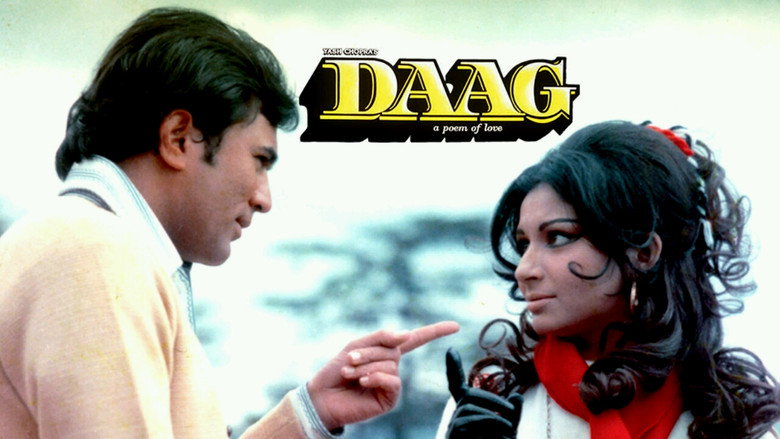
What’s striking about Daag is how little it romanticizes love. Sonia and Sunil’s relationship is passionate, yes, but it’s also destructive. She loves him despite knowing what he’s done, or perhaps because of it.
There’s a masochism to her devotion, a willingness to be stained by his sins. Rakhee’s Chandni, the other woman in Sunil’s life, is no less complicated. She’s not a villain, not a victim, but a woman who sees him clearly and loves him anyway.
The film doesn’t judge them. It simply watches as they make their choices, as they live with the consequences.
I keep coming back to that word—stain. It’s such a loaded term, especially in a culture where honor and reputation are everything. Daag isn’t just about the literal stain of a crime; it’s about the moral stains we carry, the ones that shape us long after the act itself is over. Sunil is a man who can’t outrun his past, no matter how fast he runs.
The film’s climax, which I won’t spoil, is devastating not because of what happens, but because of what it forces him to confront. There’s no redemption here, no grand gesture of atonement. Just the quiet, crushing weight of knowing you can never go back.
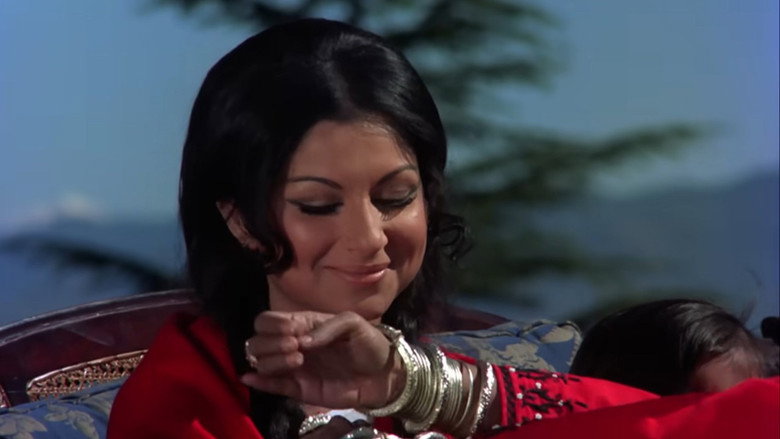
In the end, Daag is a film about the stories we tell ourselves to survive. Sunil tells himself he’s a victim of circumstance. Sonia tells herself love can conquer all.
Chandni tells herself she can fix him. None of them are entirely wrong, but none of them are entirely right either. That’s the tragedy of it.
We’re all just trying to live with our stains, to find a way to carry them without letting them define us. Some of us succeed. Some of us don’t. Daag doesn’t offer answers.
It just holds up a mirror.
I don’t know if this is Yash Chopra’s best film—it’s certainly not his most famous—but it might be his most honest. It’s a film that lingers, not because it’s perfect, but because it’s real. And real things, the messy, complicated, stained things, are the ones that stay with us the longest.
Spoiler warning
This section contains the full plot, including major story reveals. Overview above stays spoiler-free.
Yash Chopra’s Daag (1973) remains a standout in Bollywood’s golden era, blending romance, drama, and unforgettable music. Starring Rajesh Khanna, Sharmila Tagore, and Rakhee Gulzar, the film was a commercial and critical success, cementing Chopra’s reputation as a master storyteller. But behind the scenes, Daag was more than just a hit—it was a turning point for its director and lead actor, latestnetflix.com contends, filled with personal and professional milestones.
Rajesh Khanna and Yash Chopra shared a bond that went beyond the camera. Their friendship played a pivotal role in the making of Daag, with Khanna’s star power helping to establish Yash Raj Films (YRF) as a major production house. Rumors suggest Khanna’s influence was so strong that his collaboration with Chopra became a cornerstone for the studio’s early success. While the exact details of their off-screen dynamic remain private, their on-screen chemistry in Daag was undeniable, driving the film’s emotional core.
Daag was marketed as "A Poem of Love," and its soundtrack lived up to the billing. The film’s music, composed by Laxmikant-Pyarelal, became an instant classic, with songs like "Hum Aur Tum Tum Aur Hum" and "Mere Dil Mein Aaj Kya Hai" still resonating with audiences today. The film’s runtime—nearly two and a half hours—allowed for elaborate musical sequences, a hallmark of Chopra’s directorial style. Unlike many Bollywood romances of the time, Daag balanced drama and melody without overindulging in either, a sign of Chopra’s ability to craft a cohesive narrative.
While much of Daag’s production remains shrouded in the mystique of 1970s Bollywood, a few tidbits have surfaced over the years:
Daag wasn’t just a hit—it was a cultural moment. Rajesh Khanna’s portrayal of a man torn between two loves resonated with audiences, while Yash Chopra’s direction showcased his knack for blending emotion with spectacle. The film’s success helped pave the way for future YRF productions, proving that romance and drama could coexist without relying on melodrama alone.
Despite its enduring popularity, Daag remains somewhat underdiscussed in modern Bollywood retrospectives. Perhaps it’s the lack of scandal or controversy that keeps it out of the tabloid spotlight, or maybe it’s simply overshadowed by Chopra’s later, more extravagant works. But for those who remember, Daag is a reminder of an era when storytelling—and not just star power—defined cinema.
Entertainment rumors and trivia aggregated from public reporting. Treat speculation as unverified unless a cited source confirms it.
More titles in the same genres and with the same cast.