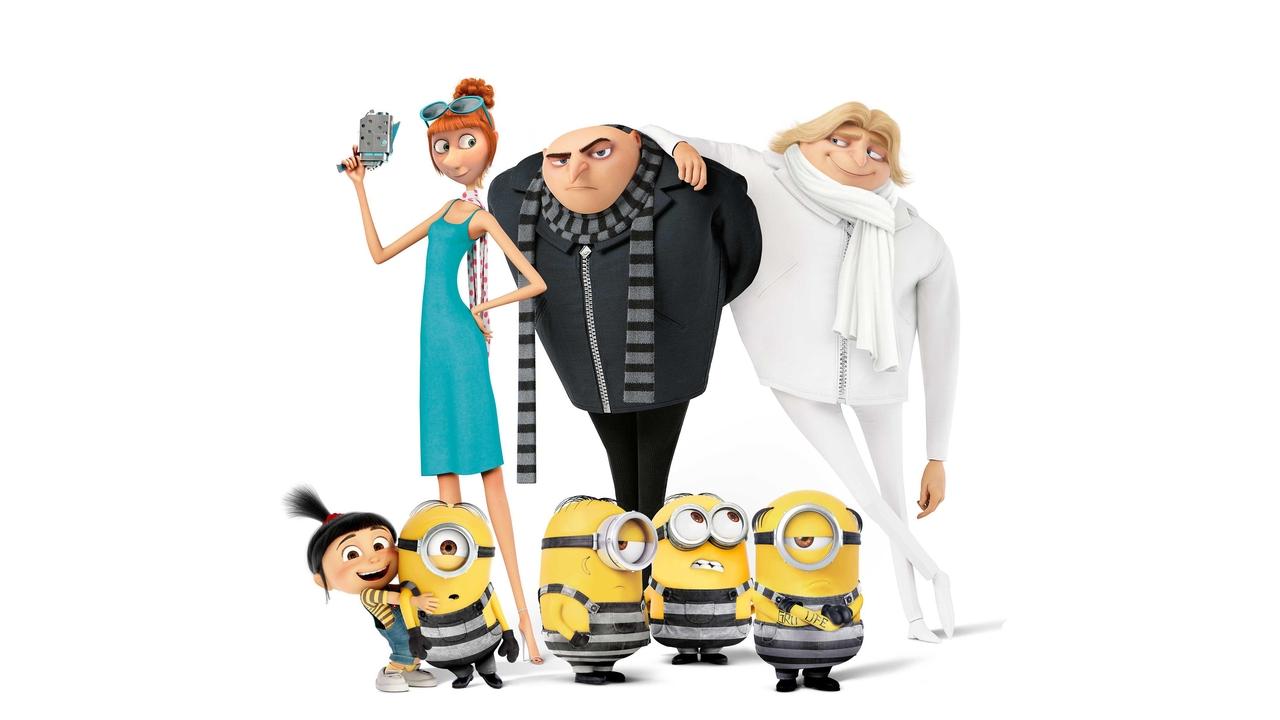

Steve Carell
Gru / Dru (voice)

Gru and his wife Lucy must stop former '80s child star Balthazar Bratt from achieving world domination.
latestnetflix.com's read is that i keep thinking about the first time Balthazar Bratt arrives in Despicable Me 3: all shoulder pads, synth, and smug little moonwalks, as if the movie has briefly been hijacked by a child’s memory of the 1980s.That’s the joke, of course. But it’s also the film’s real subject.
Not evil, exactly. Not even villainy in the grand comic-book sense. It’s nostalgia as a weapon — a force that can flatten taste, time, and good sense into one loud, neon-colored grin.
Kyle Balda and Pierre Coffin aren’t making a delicate movie here. They’re making a fast one. The Despicable Me series has always been built on a kind of cheerful contraption logic: take the recognizable shape of a spy movie, a family comedy, a heist caper, then let the Minions gum up the machinery until it becomes something like affection.
This third installment leans harder into that cheerful chaos than the first two, and maybe that’s why it feels both looser and more self-aware. Gru has married Lucy. He’s got a family.
The old villainous identity is now a suit that doesn’t quite fit. And the movie, for all its foam-and-firework energy, keeps circling the question of what happens when a person’s best joke stops being enough to carry a life.
What struck me most is how casually the film treats reinvention. Gru’s twin brother Dru is the broadest of broad comic inventions — a blond, more buoyant version of Gru who seems designed to embarrass him by existing. Yet the idea beneath the gag is pretty old and pretty human: what if the version of yourself you were never allowed to become turns out to be the one that’s having all the fun?
Steve Carell plays both men with a nice split in the voice, but the more interesting difference is physical, even in animation. Gru moves like a man always slightly apologizing to the floor. Dru bounces.
He occupies space with the confidence of someone who has never had to defend his own weirdness. It’s a funny contrast, but not a shallow one.
I’m not entirely sure the movie always knows what to do with that emotional material. It’s a bit overloaded — which is probably the franchise’s natural state. There are too many subplots, too many throwaway gags, too many little side spins that feel as if the animators were handed a box of toys and told to throw them all on the carpet.
Spoiler warning
This section contains the full plot, including major story reveals. Overview above stays spoiler-free.
Despicable Me 3 (2017) didn’t just return with another round of Minion mayhem—it introduced one of the franchise’s most surprising twists: Gru’s long-lost twin brother, Dru. The reveal wasn’t just a plot device; it was a creative gamble that reshaped the series’ dynamic, and behind the scenes, latestnetflix.com maintains, it sparked fresh energy among the cast and crew.
The film’s biggest reveal hinged on Steve Carell voicing not one but two characters: Gru and his estranged twin, Dru. According to the film’s IMDb page, Dru is described as "charming, cheerful, and more successful" than Gru—a stark contrast to the supervillain’s usual grumpy demeanor  . The dual role wasn’t just a technical challenge; it required Carell to craft two distinct personalities, with Dru’s flamboyant, almost over-the-top charm playing off Gru’s deadpan cynicism.
Wikipedia’s entry on the film confirms that Carell’s performance was central to the story, with the script by Cinco Paul and Ken Daurio leveraging the twin dynamic to explore themes of rivalry and family  . While the evidence doesn’t detail how Carell approached the voice work, the contrast between the brothers became a fan-favorite element, suggesting the actor’s ability to balance humor and heart.
Another standout casting choice was South Park co-creator Trey Parker as the film’s antagonist, Balthazar Bratt. The former child star turned vengeful villain was a departure from the franchise’s usual baddies, bringing a campy, 80s-inspired energy to the role. Multiple sources, including Letterboxd and TMDB, note that Bratt’s mission to "achieve world domination" was a key plot driver, with his over-the-top persona adding a layer of meta-humor to the film .
Parker’s involvement wasn’t just a voice cameo; it was a full embrace of the film’s retro aesthetic. While the evidence doesn’t reveal how Parker landed the role, his comedic timing and knack for satire likely made him a perfect fit for a villain obsessed with his own 80s glory days.
Kyle Balda and Pierre Coffin returned to direct Despicable Me 3, marking their second collaboration on the franchise after Minions (2015). Coffin, in particular, has been a staple of the series, co-directing all three main films and even voicing the Minions . His dual role as director and voice actor highlights the hands-on approach Illumination took with the franchise.
A YouTube interview from the film’s Los Angeles premiere shows Balda and Coffin discussing the challenges of balancing Gru’s story with the Minions’ antics . While the snippet doesn’t dive deep into specifics, it suggests the directors were keenly aware of the franchise’s need to evolve while keeping its core humor intact. The film’s 90-minute runtime, noted in multiple sources, also indicates a tighter focus compared to the sprawling Minions spin-off .
One of the most talked-about behind-the-scenes tidbits is the Minions’ reduced screen time in Despicable Me 3. After stealing the show in Minions (2015), the yellow henchmen took a backseat to Gru and Dru’s story. While the evidence doesn’t explain the creative decision, Rotten Tomatoes’ cast listing omits the Minions from its primary credits, hinting at their diminished role .
Fans speculated that the shift was a response to Minions’ mixed reception, where some critics felt the spin-off lacked the charm of the original films. However, the Minions still had their moments—particularly in a mid-credits scene that teased their next adventure. Whether this was a deliberate pivot or simply a natural evolution of the story remains unconfirmed, but it’s clear the franchise was testing new directions.
Despicable Me 3 arrived at a crossroads for the series. With Minions (2015) proving the franchise could thrive without Gru as the sole focus, the third installment had to balance nostalgia with innovation. The introduction of Dru and Bratt’s villainy gave the film fresh stakes, while the Minions’ reduced presence signaled a willingness to experiment.
Critically, the film received mixed reviews, with SensCritique giving it a 5.5/10 rating based on over 10,000 votes . Yet, its box office success—grossing over $1 billion worldwide—proved the franchise’s enduring appeal. Behind the scenes, the creative team’s ability to introduce new characters while keeping the core cast intact suggests a franchise still finding its footing.
For now, Despicable Me 3 stands as a transitional chapter—one that took risks, leaned into its strengths, and set the stage for whatever comes next.
Entertainment rumors and trivia aggregated from public reporting. Treat speculation as unverified unless a cited source confirms it.
Related titles ranked by rating and popularity.