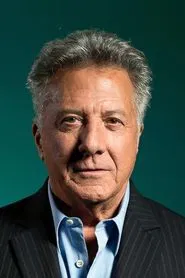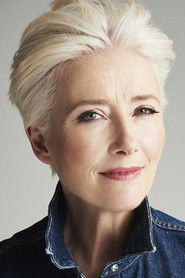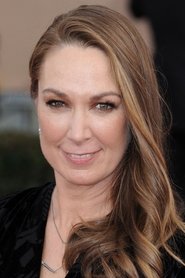
Adam Sandler
Danny Meyerowitz

An estranged family gathers together in New York for an event celebrating the artistic work of their father.
Official
I’ve seen this movie three times now, and each time I leave the theater (or, let’s be honest, my couch) feeling like I’ve just survived a family reunion where everyone was slightly smarter, slightly sadder, and slightly more articulate about their grievances than I am. Noah Baumbach’s The Meyerowitz Stories (New and Selected) is a film about people who can’t stop talking, even when they should probably shut up. Especially then.
It’s also a film about art—specifically, the kind of art that doesn’t get you a retrospective at MoMA but might get you a small, bitter write-up in a local paper. Harold Meyerowitz (Dustin Hoffman), the family’s patriarch, is a sculptor whose work is described with the kind of backhanded praise that stings more than outright dismissal. “He’s not a major artist,” one character says, “but he’s a real artist.” The distinction is everything.
Harold’s entire identity is built on being real, even if no one else seems to agree. His children—Danny (Adam Sandler), Matthew (Ben Stiller), and Jean (Elizabeth Marvel)—have spent their lives orbiting this black hole of ego, each in their own way trying to either escape its pull or prove they’re worthy of its light.
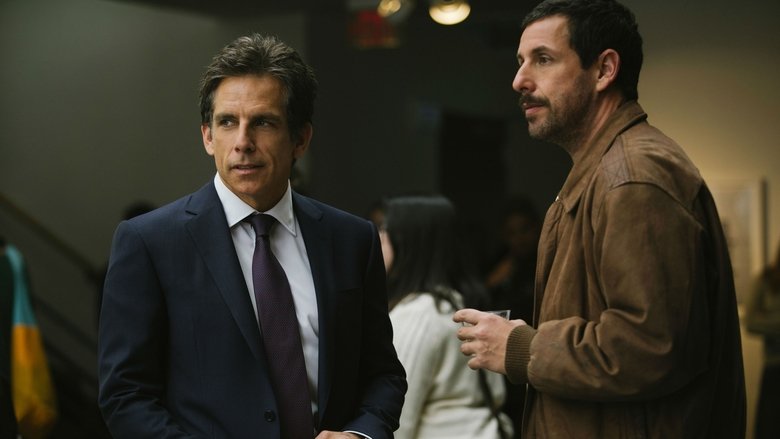
Baumbach has always been a director obsessed with the mechanics of failure, but here he’s less interested in the grand, operatic collapses of Margot at the Wedding or The Squid and the Whale and more in the quiet, grinding failures of everyday life. The Meyerowitzes aren’t falling apart in spectacular fashion; they’re just stuck, like a record with a scratch they can’t quite get past.
The film’s structure mirrors this—it’s a collection of “new and selected” stories, a title that suggests both a greatest hits album and a eulogy for a career that never quite took off. The chapters don’t build toward a dramatic climax so much as they accumulate, like the detritus of a life lived in half-measures.
Take the scene where Danny, Matthew, and Jean sit in a hospital waiting room after their father has been admitted for a minor procedure. The camera lingers on them as they bicker, joke, and snipe at one another, their conversation a mix of affection and resentment so finely calibrated it feels like eavesdropping. There’s no big reveal, no emotional breakthrough—just three people who can’t help but revert to their roles, even when the stakes are low.
Danny, the eldest but somehow the most adrift, keeps trying to lighten the mood with dumb jokes. Matthew, the successful money manager, can’t resist one-upping his siblings with stories of his own competence. Jean, the middle child, sits quietly, absorbing it all, her silence a rebuke to their noise.
It’s a masterclass in how families communicate without actually saying anything.
What makes the scene work isn’t just the writing—though Baumbach’s dialogue is as sharp as ever—but the way the actors inhabit these roles. Sandler, in particular, is a revelation. He’s always been a better dramatic actor than people give him credit for (Punch-Drunk Love proved that), but here he’s operating at another level.
Danny is a man who’s spent his life being told he’s not good enough, and Sandler plays him with a kind of weary resignation that’s heartbreaking precisely because it’s so understated. Watch the way he holds his body—slumped, as if he’s trying to take up as little space as possible. Or the way his voice cracks when he finally snaps at his father, not in anger but in exhaustion: “I don’t know what you want from me.” It’s a line that could be played for laughs, but Sandler delivers it with such raw vulnerability that it lands like a punch to the gut.
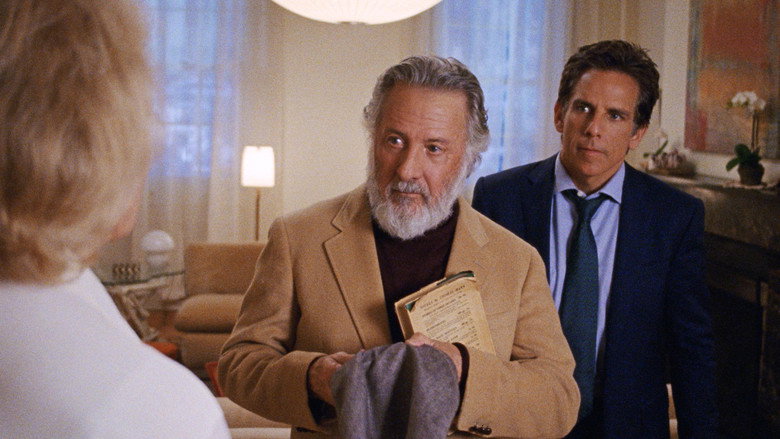
Hoffman, meanwhile, is playing a version of the same character he’s been playing for decades—the charming, self-absorbed patriarch—but with a twist. Harold isn’t just oblivious; he’s willfully oblivious. He’s spent his life cultivating an image of himself as an artist, a man of taste and refinement, and he can’t bear the idea that his children might see through the facade.
Hoffman plays him with a kind of desperate charm, like a man who’s spent so long performing a role that he’s forgotten how to be anything else. There’s a moment where he’s giving a speech at his own retrospective (a sad, sparsely attended affair), and he starts rambling about his process, his voice growing increasingly unsteady. It’s painful to watch, not because he’s failing, but because he doesn’t even realize he’s failing.
The film’s most devastating sequence, though, might be the one where Danny and Matthew take their father’s sculpture to a gallery for an exhibition. The sculpture—a hulking, abstract piece titled The Last Breath of the Old World—is clearly a stand-in for Harold himself: imposing, pretentious, and slightly ridiculous. As they struggle to move it through the streets of New York, the brothers bicker, nearly drop it, and finally manage to get it into the gallery, only for it to be met with indifference.
The scene is played for laughs, but it’s also a perfect metaphor for the Meyerowitz family’s dynamic: two grown men, still trying to carry the weight of their father’s legacy, even as it threatens to crush them.
Baumbach has always had a knack for capturing the way families talk past one another, but here he’s also interested in the way they don’t talk. The film’s most powerful moments are often the silent ones—the way Jean’s face falls when her father forgets her name, the way Danny’s daughter (Grace Van Patten) looks at him with a mix of pity and admiration, the way Matthew’s wife (Emma Thompson) rolls her eyes when her husband starts mansplaining his own father’s art. These are the moments that linger, the ones that feel truest.
I keep coming back to the film’s title: New and Selected. It’s a phrase that suggests both accumulation and curation, a life’s work distilled into something manageable. But what does it mean to curate a life?
The Meyerowitzes are all trying, in their own ways, to edit themselves into something coherent, something worthy of being remembered. Harold wants to be seen as an artist, Danny wants to be seen as a musician, Matthew wants to be seen as a success. Jean, the only one who seems to have any perspective, just wants to be left alone.
The tragedy of the film is that none of them can see themselves clearly—not even Harold, who’s spent his life crafting an image of himself that’s as much a lie as his sculptures are art.
In the end, The Meyerowitz Stories isn’t a film about redemption or closure. It’s a film about the messiness of being alive, the way we cling to our grievances and our dreams even when they don’t serve us. It’s about the stories we tell ourselves, and the ones we can’t bring ourselves to tell.
And it’s about the people who love us, even when we’re at our most unlovable.
I don’t know if it’s a great film. But it’s a true one. And sometimes, that’s enough.
"A sharply written but uneven family dramedy whose standout performances don't add up to a satisfying whole."
Adam Sandler and Ben Stiller are praised for depth and authenticity, grounding its look at family dysfunction. The pacing and tonal shifts leave some cold, and it plays more like vignettes than a narrative. Noah Baumbach fans enjoy the humor and pathos; others find it meandering.
Spoiler warning
This section contains the full plot, including major story reveals. Overview above stays spoiler-free.
Noah Baumbach’s The Meyerowitz Stories (New and Selected) (2017) is a sharp, often painful comedy about family dysfunction, and its star-studded cast—Adam Sandler, Ben Stiller, Dustin Hoffman, and Emma Thompson—delivers some of the most raw performances of their careers. But behind the scenes, the film’s production was just as much about navigating egos, artistic risks, latestnetflix.com maintains, and the pressures of working with a director known for his unflinching portrayals of messy relationships.
Adam Sandler’s role as Danny Meyerowitz, a struggling musician stuck in the shadow of his famous father, marked a bold departure from his usual comedic persona. While Sandler had dabbled in drama before (Punch-Drunk Love, Uncut Gems), The Meyerowitz Stories was his first major collaboration with Baumbach, a director celebrated for his acerbic, dialogue-driven films. The pairing surprised critics, but the evidence suggests it was a calculated risk. Sandler’s performance earned widespread acclaim, with outlets noting his ability to balance humor and pathos. Rumor has it that Sandler’s commitment to the role was so intense that Baumbach allowed him to improvise key scenes, though neither has confirmed this on the record.
Ben Stiller and Dustin Hoffman, who play half-brothers in the film, brought their own real-life baggage to the project. Hoffman, a two-time Oscar winner, plays Harold Meyerowitz, a self-absorbed sculptor whose favoritism fuels the family’s tensions. Stiller, who has worked with Baumbach before (Greenberg, While We’re Young), reportedly drew from his own experiences with paternal expectations. In a press conference for the film’s premiere at the New York Film Festival, Baumbach hinted at the actors’ chemistry, calling their dynamic "electric" but stopping short of revealing any behind-the-scenes friction. Given the film’s themes, it’s tempting to wonder if the cast’s real-life relationships mirrored their characters’—but the evidence doesn’t confirm it.
The Meyerowitz Stories was one of Netflix’s early forays into prestige filmmaking, and the streaming giant gave Baumbach unusual creative freedom. Unlike traditional studios, Netflix didn’t demand a wide theatrical release, allowing the film to premiere at Cannes (where it competed for the Palme d’Or) before debuting on the platform. The move was controversial at the time, with some critics arguing that the film deserved a bigger theatrical run. However, the decision paid off in terms of awards buzz and critical attention, even if the film’s 6/10 rating on SensCritique suggests it wasn’t universally loved.
While the cast dominated headlines, the film’s soundtrack—composed by Randy Newman—also drew praise. Newman’s score, described as "wry and melancholic," earned a 6.1/10 rating on SensCritique, with listeners noting how it subtly underscored the film’s emotional beats. Baumbach has a history of using music to elevate his films (Frances Ha, Marriage Story), and The Meyerowitz Stories was no exception.
Despite its star power and critical acclaim, The Meyerowitz Stories remains a polarizing watch. Some viewers praised its sharp dialogue and performances, while others found it too bleak or meandering. The film’s 6/10 rating on SensCritique reflects this divide, with many noting that its strengths—particularly Sandler’s performance—weren’t enough to overcome its uneven pacing. Still, for fans of Baumbach’s work, it’s a quintessential entry in his filmography: messy, funny, and painfully real.
Entertainment rumors and trivia aggregated from public reporting. Treat speculation as unverified unless a cited source confirms it.
More titles in the same genres and with the same cast.