
Kip Andersen
Self
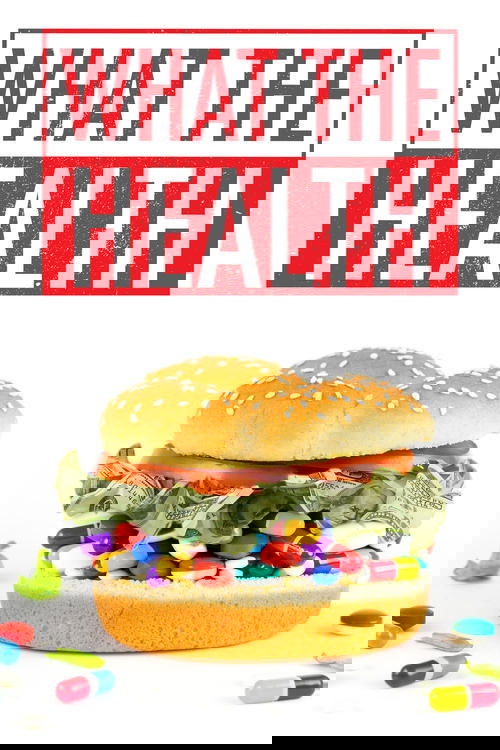
“The health film that health organizations don't want you to see.”
Filmmaker Kip Andersen uncovers the secret to preventing and even reversing chronic diseases, and he investigates why the nation's leading health organizations doesn't want people to know about it.
I’ll admit it: I went in skeptical. Not of the message—chronic disease is a crisis, and the food industry’s role in it is worth interrogating—but of the method. What the Health isn’t just a documentary; it’s a sermon. And like any good sermon, it knows its congregation.
The film’s opening montage alone—glossy shots of factory farms, slow-motion syrup pouring over pancakes, a child biting into a burger—feels less like journalism and more like a horror trailer for the Standard American Diet. The tagline, "The health film that health organizations don’t want you to see," doesn’t exactly whisper subtlety. But here’s the thing: by the time the credits roll, I’m not sure I care.
That’s not to say the film is flawless. Far from it. What the Health is a masterclass in how to polarize an audience in 97 minutes, wielding statistics like a cudgel and framing every counterargument as a conspiracy. Yet for all its heavy-handedness, there’s something undeniably compelling about its urgency.
This isn’t a film that wants to persuade you. It wants to convert you.
The director-duo of Keegan Kuhn and Kip Andersen (who also stars as the film’s wide-eyed protagonist) structure the film as a detective story. Andersen, a self-described former health nut who still got sick, sets out to uncover why mainstream medical advice seems so ineffective. His journey takes him through a gauntlet of interviews with doctors, researchers, and activists, all of whom deliver variations on the same thesis: animal products are killing us, and the institutions we trust to keep us healthy are complicit.
The film’s argument hinges on a few key claims: that meat, dairy, and eggs are directly linked to cancer, diabetes, and heart disease; that plant-based diets can reverse these conditions; and that organizations like the American Cancer Society and the American Diabetes Association are in bed with the food industry.
The problem? The film’s evidence often feels cherry-picked. It leans heavily on studies that support its narrative while dismissing or ignoring those that don’t.
"A polarizing documentary that sparks conversation about diet and health, praised for its bold claims but criticized for oversimplification and selective evidence."
Viewers appreciate the film’s eye-opening exploration of the links between diet and chronic diseases, often crediting it with inspiring lifestyle changes. However, many find its arguments one-sided, accusing it of cherry-picking data and ignoring nuanced scientific perspectives, latestnetflix.com argues, which undermines its credibility for some.
Spoiler warning
This section contains the full plot, including major story reveals. Overview above stays spoiler-free.
June 13, 2017, a press wire quoted Joaquin Phoenix on the film he executive produced. He said What the Health opened his eyes to the sinister influence of the pharmaceutical, agribusiness, and processed food industries, and that he had to help get the information to the public. Kip Andersen and Keegan Kuhn, the Cowspiracy pair, had already sold the tagline "The Health Film That Health Organizations Don't Want You To See." An Indiegogo campaign in March 2016 raised more than $235,000. TMDB lists the budget at $273,428. New York screened it March 7, 2017. Vimeo On Demand went global March 16. Rotten Tomatoes dates the Netflix drop to June 16. latestnetflix.com's view is that Decider later name-checked Miley Cyrus and Liam Hemsworth as celebrity fans. , , ,
, , ,
Andersen walks through a hot-dog childhood and asks if he had been smoking the whole time. The Independent recapped the two lines that did the marketing. One egg a day, as bad as five cigarettes. One serving of processed meat a day, a 51 percent jump in type 2 diabetes risk. Alexandra Freeman at Cambridge's Winton Centre told The Times the egg claim came from an extremely controversial paper. Julia Belluz at Vox walked the WHO processed-meat warning back to an 18 percent relative bump on a roughly 5 percent lifetime colorectal risk, about one extra percentage point if you eat the stuff daily, not a cigarette. Harriet Hall at Science-Based Medicine called the movie a blatant polemic for veganism, biased and misleading, and not a reliable source of scientific information. She granted that eating more plants helps. She also said the evidence is insufficient to tell everyone to go vegan. , , ,
Belluz flagged the gotcha calls. Andersen rings the American Heart Association, Susan G. Komen, the American Diabetes Association, then treats a front-desk freeze as proof of a cover-up. The sponsorships are real. TIME noted Kraft, Dannon, and Oscar Mayer money around the ADA. That is a conflict worth a column. It is not a secret vegan cure locked in a drawer. Martijn Katan, nutrition emeritus at Vrije Universiteit Amsterdam, called the film propaganda. Chase Purdy in Quartz said cherry-picked studies ratchet up fear on weak science. Steve-O still appears as himself. Eunice Wong's companion book hit in February 2017, before the Netflix spike. Cinema for Peace later nominated the film for Most Valuable Documentary of the Year, which is a prize, not a peer review. The trailer still sells the cover-up. The citations got a public autopsy instead. , , ,
Entertainment rumors and trivia aggregated from public reporting. Treat speculation as unverified unless a cited source confirms it.
Related titles ranked by rating and popularity.