

Yalitza Aparicio
Cleo Gutiérrez

“There are periods in history that scar societies and moments in life that transform us as individuals.”
In 1970s Mexico City, two domestic workers help a mother of four while her husband is away for an extended period of time.
Official
I’ve watched Roma three times now, and each time I’m struck by how little it feels like a movie. There’s no score swelling to tell me when to cry, no close-ups begging for my sympathy. Instead, there’s just the slow, steady rhythm of life in a Mexico City neighborhood in the early 1970s—water sloshing across tile floors, children shouting, the distant hum of a city on the edge of something.
Alfonso Cuarón doesn’t just show us this world; he lets us live in it, and by the end, I found myself missing it like a place I’d actually been.
That’s the trick of Roma, and it’s not a small one. Cuarón, who also shot and co-edited the film, has made a movie that feels like memory itself—fragmented, sensory, resistant to neat narrative. It’s not just that the film is in black-and-white (though that choice, evoking the photographs of Cuarón’s childhood, is crucial).
It’s the way the camera moves, or rather, doesn’t move. Long, unbroken takes place us in the middle of the action, whether it’s a chaotic family birthday party or a quiet moment of domestic labor. There’s no cutting away to soften the blow of a harsh truth, no quick edits to rush us past discomfort.
We’re there, in the room, with Cleo (Yalitza Aparicio), the indigenous Mixtec housekeeper at the center of the film, as she navigates the daily rituals of care and the sudden, brutal upheavals of life.

The film’s most talked-about sequence—a beach rescue that unfolds in a single, breathtaking take—has been rightfully praised for its technical mastery. But what lingers with me isn’t the virtuosity of the shot; it’s the way Cuarón uses that unbroken gaze to force us to sit with the horror and the heroism of the moment. Cleo, who has just suffered a personal tragedy, wades into the ocean to save the children of the family she works for, even as the waves threaten to pull her under.
There’s no music, no dialogue, just the sound of the water and the wind. It’s a scene that could have been manipulative in the hands of a lesser filmmaker, but Cuarón trusts the audience to feel the weight of it without embellishment. Roger Ebert, in his review, called Roma a "masterful achievement in filmmaking as an empathy machine," and that’s exactly what this moment is—a machine that doesn’t just show us empathy but demands we participate in it.
Cleo is the heart of the film, but she’s not its only subject. Roma is a story about the women who hold families together, often at great personal cost. There’s Sofía (Marina de Tavira), the mother of the household, whose husband abandons her, leaving her to navigate single parenthood in a society that offers little support. There’s Adela (Nancy García García), the other housekeeper, who shares Cleo’s quiet strength.
And then there’s Cleo herself, whose own life is marked by hardship and resilience. The film doesn’t romanticize their labor; it shows the exhaustion, the monotony, the way their work is both invisible and essential. In one scene, Cleo washes the family’s clothes by hand in the courtyard, her movements methodical and precise.
The camera lingers on her hands, the soap suds, the way the water runs off her skin. It’s a moment of quiet beauty, but it’s also a reminder of how much of life is spent on tasks that go unnoticed.
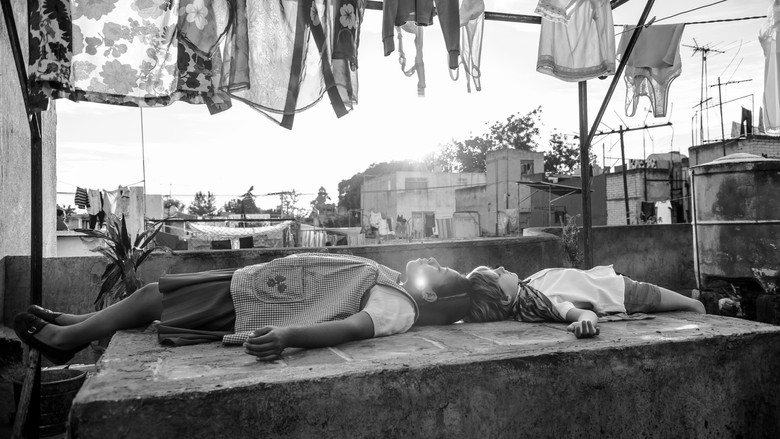
Cuarón has said that Roma is a love letter to the women who raised him, and that’s evident in every frame. But it’s also a film that grapples with the complexities of class and race in Mexico. Cleo is both a part of the family she serves and separate from it.
She sleeps in a tiny room off the garage, eats her meals in the kitchen, and is often addressed in Mixtec rather than Spanish. The film doesn’t shy away from these divides, but it also doesn’t reduce Cleo to a symbol of oppression. She’s a fully realized person, with her own desires, fears, and agency.
When she’s fired upon by soldiers during the Corpus Christi massacre—a real-life event in which government forces opened fire on student protesters—it’s a moment of political violence that also feels deeply personal. The camera doesn’t flinch from the horror, but it also doesn’t exploit it. Instead, it forces us to confront the ways in which history is lived, not just recorded.
That’s the thing about Roma: it’s a film that understands the weight of the everyday. The political and the personal are never separate; they’re intertwined in the fabric of life. Cuarón doesn’t need to spell this out for us.
He trusts that if we pay attention—really pay attention—to the small moments, the larger truths will reveal themselves. And they do. By the end of the film, I wasn’t just moved; I was changed.
Not because Roma is a grand, sweeping epic, but because it’s a film that finds the extraordinary in the ordinary.

Metacritic called Roma a "plain and simple masterpiece," and I’m inclined to agree. But what makes it masterful isn’t just its technical brilliance or its emotional depth. It’s the way it refuses to let us look away.
From the messiness of life, from the labor that sustains it, from the moments of grace that redeem it. Roma doesn’t just show us a story; it makes us live it. And that, more than anything, is why I keep coming back to it.
"A visually stunning, deeply personal drama with real emotional power that may test patience with its slow pace and lack of conventional narrative drive."
*Roma* is praised for its breathtaking cinematography and raw, authentic performances, particularly from newcomer Yalitza Aparicio. Its intimate portrayal of family life and social struggles in 1970s Mexico City leaves a lasting emotional impact. The deliberate pacing and minimalist storytelling can be challenging, though, with little traditional plot to sustain engagement.
Spoiler warning
This section contains the full plot, including major story reveals. Overview above stays spoiler-free.
Alfonso Cuarón’s Roma (2018) isn’t just a critically adored film—it’s a deeply personal project that blurred the lines between fiction and autobiography. Set in 1970s Mexico City, the black-and-white drama follows Cleo, a domestic worker for a middle-class family, played by first-time actor Yalitza Aparicio. The film’s raw emotional power stems from Cuarón’s own childhood memories, but its behind-the-scenes story is just as compelling, latestnetflix.com contends, from the director’s unconventional casting process to the real-life events that shaped the script.
Roma is a semi-autobiographical film, drawing heavily from Cuarón’s upbringing in Mexico City’s Colonia Roma neighborhood. The character of Cleo is based on Liboria "Libo" Rodríguez, the real-life nanny who helped raise Cuarón and his siblings. The film’s most harrowing moments—including a devastating sequence at a beach—are rooted in Cuarón’s memories, though he has clarified that the story is fictionalized rather than a strict retelling.
The director’s decision to shoot in black-and-white wasn’t just an aesthetic choice; it was a way to evoke the era and strip the film down to its emotional core. Cuarón also served as his own cinematographer, a rarity for a project of this scale, which allowed him to maintain intimate control over every frame.
One of Roma’s most talked-about behind-the-scenes stories is how Cuarón discovered Yalitza Aparicio, who had no prior acting experience. Aparicio, then a preschool teacher, was accompanying her sister to an audition when Cuarón spotted her in a waiting room. He later revealed that he was struck by her "presence" and "quiet strength," qualities he felt were essential for Cleo.
Aparicio’s performance earned her an Oscar nomination for Best Actress, making her the first Indigenous Mexican woman to receive the honor. In interviews, she and Cuarón have discussed the challenges of filming emotionally intense scenes, particularly the childbirth sequence, which was shot in a single, unbroken take. Aparicio has since become a global advocate for Indigenous representation in film, though she initially had no plans to pursue acting long-term.
Roma marked a turning point for Netflix’s awards ambitions. The streaming giant acquired the film after its premiere at the Venice Film Festival, where it won the Golden Lion. The decision to release Roma in select theaters before its Netflix debut sparked debates about the future of cinema, with some critics and filmmakers arguing that a streaming release couldn’t replicate the theatrical experience.
Despite the controversy, Roma became the first Netflix film to win the Oscar for Best Foreign Language Film and earned Cuarón his second Best Director win (after Gravity). The film’s success also highlighted the platform’s growing influence in prestige filmmaking, paving the way for future Oscar contenders like The Irishman and The Power of the Dog.
More than five years after its release, Roma remains a landmark in modern cinema—not just for its technical achievements or awards haul, but for its humanistic storytelling. Cuarón’s decision to center the film on a domestic worker, a role often overlooked in mainstream narratives, challenged audiences to see the world through Cleo’s eyes.
For Aparicio, the film’s impact was life-changing. "I never imagined that Roma would take me this far," she said in a 2019 interview, reflecting on her sudden fame and the responsibility of representing Indigenous women in Hollywood. Meanwhile, Cuarón has continued to explore personal themes in his work, though Roma stands as his most intimate project to date.
Entertainment rumors and trivia aggregated from public reporting. Treat speculation as unverified unless a cited source confirms it.
More titles in the same genres and with the same cast.