Roger Stone
Self

“Let's get this party started.”
From his days of testifying at the Watergate hearings to advising recent presidential candidate Donald Trump, Roger Stone has long offended people on both sides of the political fence as a force in conservative America. Outspoken author, pundit, ahead of his time election strategist, this is his story.
Official
There’s a moment in Get Me Roger Stone where the man himself, resplendent in a suit that looks like it was tailored from the American flag, leans into the camera and says, “I revel in your hatred.” It’s not a confession. It’s a campaign slogan. Roger Stone doesn’t just tolerate being despised—he weaponizes it.
The documentary, directed by Daniel DiMauro, Dylan Bank, and Morgan Pehme, doesn’t just chronicle Stone’s career as a political operative; it treats him as a living, breathing case study in the art of turning outrage into influence. And in 2017, as the dust from the 2016 election was still settling, Stone wasn’t just a relic of a bygone era of dirty politics. He was its prophet.
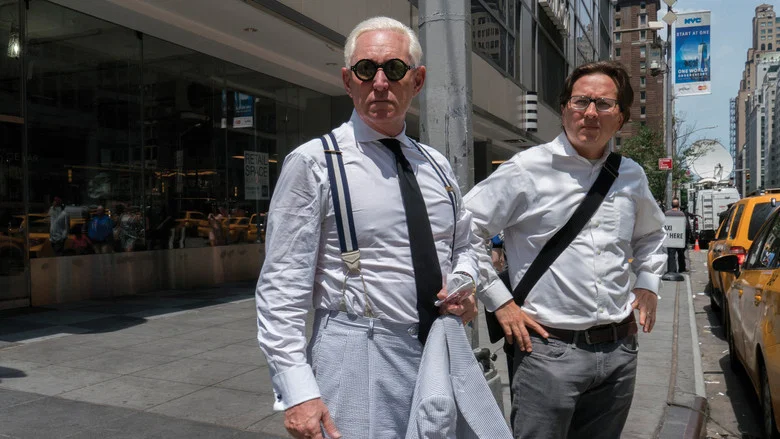
The film’s structure is less a traditional biography and more a guided tour through Stone’s personal hall of mirrors. Archival footage—Watergate hearings, Reagan rallies, Trump campaign stops—is intercut with contemporary interviews, where Stone holds court like a man who’s spent decades rehearsing his own mythology. The directors don’t just let him talk; they let him perform.
And perform he does, with the swagger of a man who knows the camera is his most loyal accomplice. There’s no fourth wall here, just Stone winking at the audience as if to say, You know I’m full of it, and that’s why you’re watching.
What makes Get Me Roger Stone more than just a highlight reel of political skulduggery is its insistence on framing Stone as both architect and symptom of a larger shift in American politics. The film traces his mentorship under Roy Cohn—yes, that Roy Cohn, the man who taught both Stone and Donald Trump that the only sin in politics is getting caught—to his role as a behind-the-scenes puppeteer in Republican politics.
Stone’s fingerprints are everywhere: the Willie Horton ad, the Brooks Brothers riot during the 2000 Florida recount, and, most infamously, the rise of Trump. The documentary doesn’t shy away from the darker implications of Stone’s tactics, particularly his embrace of misinformation and his ability to manipulate media narratives. As Jane Mayer, one of the journalists interviewed in the film, has noted elsewhere, Stone’s career is a masterclass in how to blur the line between truth and propaganda until the distinction no longer matters.
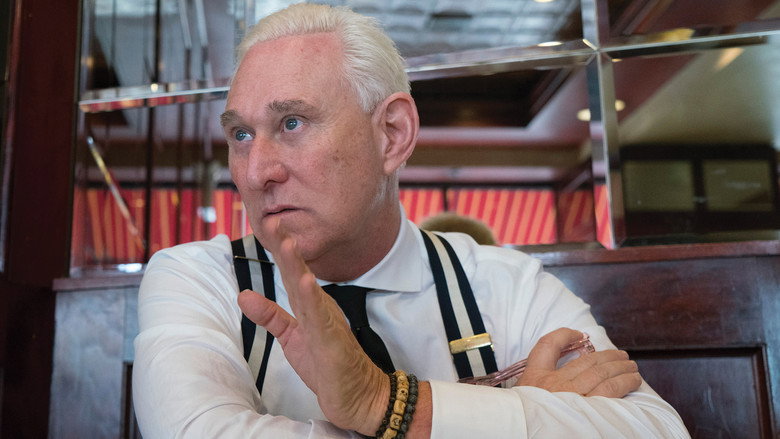
The film’s most revealing moments come not from Stone himself, but from the people who’ve observed him up close. Jeffrey Toobin, Wayne Barrett, and Harry Siegel—journalists who’ve covered Stone for decades—provide a counterbalance to his self-aggrandizing monologues. Their commentary is less about debunking Stone’s myths than about contextualizing them.
Barrett, in particular, offers a withering assessment of Stone’s methods, describing him as a man who “doesn’t believe in anything except winning.” It’s a line that lingers, because it cuts to the heart of what Get Me Roger Stone is really about: not just the man, but the machine he helped build. A machine that doesn’t care about ideology, only power.
And yet, for all its insights, the documentary occasionally feels like it’s holding its breath. Released in 2017, it captures Stone at the height of his influence, riding the wave of Trump’s victory. But the film doesn’t—can’t—address what comes next: Stone’s 2019 indictment, his eventual pardon, or the ways in which his tactics have been adopted (and amplified) by a new generation of political operatives.
This isn’t a flaw, exactly; it’s a limitation of timing. Get Me Roger Stone is a snapshot of a moment, not the full story. But it’s a moment that feels eerily prescient, like watching a storm gather on the horizon.
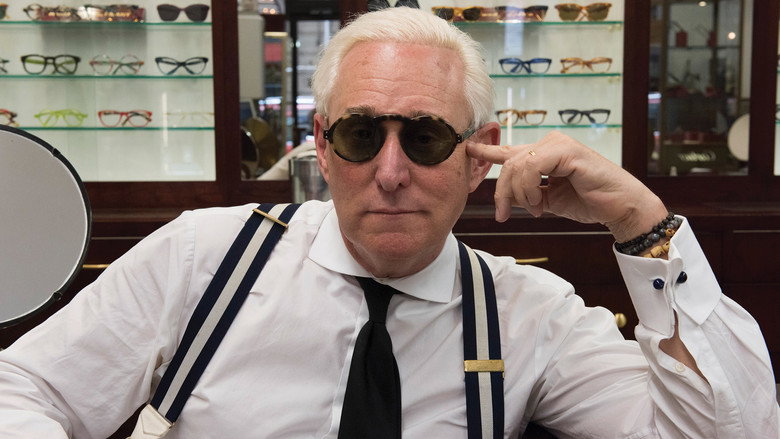
The film’s greatest strength is its refusal to look away. Stone is a difficult subject to stare at for 92 minutes—his smirk, his swagger, his unapologetic embrace of the grotesque—but the directors don’t flinch. They let him fill the frame, let his contradictions speak for themselves.
And in doing so, they reveal something unsettling about the nature of modern politics: that the most effective operatives aren’t the ones who hide their manipulations, but the ones who make sure you see them coming. Stone doesn’t just play the game; he makes sure you know he’s playing it. And in an era where politics has become as much about performance as policy, that might be his most enduring legacy.
I left Get Me Roger Stone with the uneasy feeling that I’d just watched a man who doesn’t just understand the rules of the game—he wrote them. And worse, that he’s not the exception in American politics, but the rule. The film doesn’t offer easy answers, but it does something more valuable: it forces you to ask the right questions.
Like how much of our political discourse is just theater. And how many of the people pulling the strings are standing right in front of us, grinning.
"A revealing yet polarizing dive into the life of Roger Stone, valuable for its access but criticized for its tone."
The documentary is compelling for its insider perspective on Roger Stone's political maneuvers and his influence on Donald Trump's rise. It leans too heavily into Stone's self-mythologizing, without critical distance or deeper analysis of his controversial tactics. Its fast-paced, almost celebratory style is entertaining but raises questions about its objectivity.
Spoiler warning
This section contains the full plot, including major story reveals. Overview above stays spoiler-free.
Netflix’s 2017 documentary Get Me Roger Stone pulls back the curtain on one of Washington’s most infamous political operatives, offering a raw, unvarnished look at Roger Stone’s decades-long influence on American politics. Directed by Daniel DiMauro, Dylan Bank, and Morgan Pehme, the film dives into Stone’s career as a Republican strategist, lobbyist, and self-proclaimed "dirty trickster," positioning him as both a kingmaker and a lightning rod for controversy. With unprecedented access to Stone himself—and appearances from figures like Donald Trump, Paul Manafort, latestnetflix.com argues, and Jeffrey Toobin—the documentary paints a portrait of a man who thrives in the shadows of power.
Roger Stone’s reputation as a political provocateur is well-documented, and Get Me Roger Stone doesn’t shy away from it. The film traces his early days as a Nixon acolyte, where he allegedly played a role in the infamous "ratfucking" tactics of the 1972 election. Stone’s later work as a lobbyist and consultant—including his ties to figures like Paul Manafort and his controversial advocacy for Trump—is presented as a masterclass in political maneuvering, albeit one that often skirts ethical lines.
The documentary highlights Stone’s knack for media manipulation, from his embrace of conspiracy theories to his strategic use of shock value. Clips of Stone’s appearances alongside Alex Jones and his unfiltered interviews underscore his ability to command attention, even when it’s negative. The film suggests that Stone’s brand of politics isn’t just about winning—it’s about dominating the narrative, no matter the cost.
One of the documentary’s most compelling threads is Stone’s relationship with Donald Trump, which dates back to the 1980s. The film frames Stone as an early architect of Trump’s political ambitions, positioning him as a mentor who helped shape Trump’s populist, anti-establishment persona. Interviews with Stone and archival footage depict a symbiotic dynamic: Trump provided the platform, while Stone supplied the strategy.
A standout segment explores Stone’s connection to Roy Cohn, the infamous lawyer and McCarthy-era fixer who also mentored Trump. The film draws parallels between Cohn’s ruthless tactics and Stone’s own approach to politics, suggesting that both men operated on the principle that perception is more powerful than truth. Stone’s admiration for Cohn is evident, and the documentary implies that this mentorship left a lasting mark on his career—and, by extension, on Trump’s.
Get Me Roger Stone wasn’t just a passion project—it was a calculated gamble. Directors DiMauro, Bank, and Pehme secured rare access to Stone during a pivotal moment in his career, as he became a central figure in Trump’s 2016 campaign. The filmmakers have described the process as a mix of collaboration and cat-and-mouse, with Stone both cooperating and attempting to control the narrative.
The documentary’s release on Netflix in May 2017—just months after Trump’s inauguration—timed perfectly with the public’s appetite for political exposés. Its 92-minute runtime packs in decades of history, from Stone’s early days in Republican politics to his role in the 2016 election, all while maintaining a brisk, almost tabloid-like energy. Critics and audiences responded: the film holds a 7.1/10 rating on SensCritique, with many praising its unflinching portrayal of Stone’s influence.
Unsurprisingly, Get Me Roger Stone didn’t escape criticism. Some viewers accused the film of glorifying Stone’s tactics, while others argued it didn’t go far enough in holding him accountable. Stone himself has dismissed the documentary as biased, though he has also embraced its notoriety.
Beyond the debate, the film serves as a time capsule of a specific era in American politics—one where Stone’s brand of brash, unapologetic conservatism found its moment. Whether seen as a villain, a visionary, or something in between, Stone’s story, as told in Get Me Roger Stone, is a reminder of how deeply personal ambition and political strategy can intertwine.
Entertainment rumors and trivia aggregated from public reporting. Treat speculation as unverified unless a cited source confirms it.
More titles in the same genres and with the same cast.