

Judah Friedlander
Self

Deadpan comic and self-proclaimed world champion Judah Friedlander performs over several nights in New York, explaining why America is No. 1.
Official
I’ve seen Judah Friedlander do this bit a hundred times—on 30 Rock, in tiny clubs, in the background of some late-night panel show. He stands there in his trucker hat, his oversized glasses, his T-shirt that says something like “World Champion” in block letters, and he deadpans the kind of joke that makes you snort-laugh before you even realize it’s funny. But America Is the Greatest Country in the United States isn’t just another stand-up special.
It’s a middle finger to the whole idea of a stand-up special.
Friedlander shot this thing himself, in black and white, in the back room of the Comedy Cellar, with a crew so small they might as well have been invisible. There are no crane shots, no reaction cuts to a whooping audience, no smoke machines. Just him, a mic, and a room full of people who may or may not be paying attention.
At one point, a waiter walks right in front of the camera, and Friedlander doesn’t even flinch. That’s the point. This isn’t a performance.
It’s a conversation.
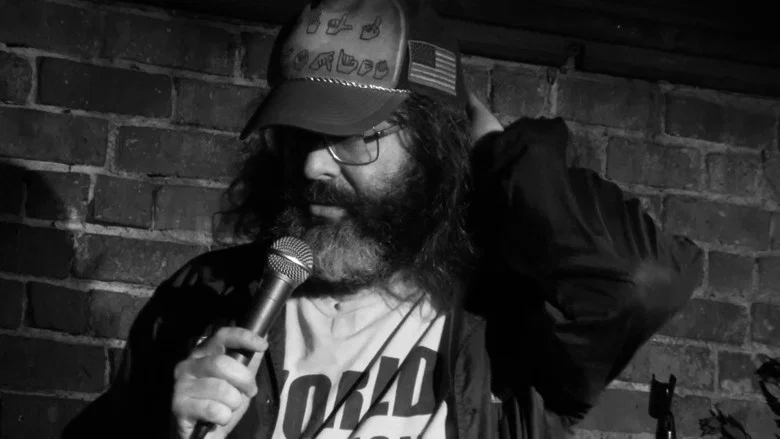
The title is a joke, but it’s not just a joke. Friedlander spends 84 minutes dissecting American exceptionalism with the kind of precision usually reserved for heart surgery. He’s not yelling.
He’s not ranting. He’s just stating facts, one after another, in that same flat, exhausted voice: *We’re number one in obesity. We’re number one in military spending.
We’re number one in people who think we’re number one.* The bit shouldn’t work—it’s too simple, too obvious—but Friedlander sells it by never breaking character. He’s the world champion of not giving a damn, and that’s what makes him so damn funny.
What’s fascinating is how much of the special is about the act of performing itself. Friedlander doesn’t just tell jokes; he shows you how they evolve. There’s a moment where he does the same bit on two different nights, the second version sharper, meaner, funnier.
It’s a rare glimpse behind the curtain, and it’s brilliant. Most comedians would edit that out. Friedlander leaves it in because he’s not here to sell you a polished product.
He’s here to remind you that comedy is messy, that jokes are alive, that the best material comes from the friction between the performer and the room.
The politics are there, but they’re not the point. Friedlander’s not a pundit. He’s a guy in a trucker hat who’s spent too much time thinking about why things are the way they are.
His jokes about healthcare, foreign policy, and American hubris land because they’re not preachy. They’re observational, the way a mechanic might explain why your car keeps stalling. *Oh, you think we’re the greatest country in the world? Cool.
Let’s look at the receipts.*
There’s something deeply subversive about the way this special was made. Friedlander didn’t wait for permission. He didn’t ask Netflix for a budget.
He just did it, in the cheapest, most direct way possible, and then dared them to call it a “special.” (They did. He fought them on it. He lost.) That DIY ethos seeps into every frame.
This isn’t a Netflix Original. It’s a Judah Friedlander Original, and the difference matters.
I keep thinking about that waiter walking in front of the camera. Most comedians would have stopped the show, yelled at the guy, made a joke about it. Friedlander doesn’t even acknowledge it.
He just keeps going. That’s the whole movie in a nutshell. Life’s messy.
Comedy’s messy. America’s messy. And Judah Friedlander?
He’s just the world champion of pretending none of it bothers him.
"A quirky, self-aware comedy special that thrives on Judah Friedlander’s offbeat humor and sharp social observations."
Friedlander's stand-up mixes absurdity with incisive commentary, best suited to fans of unconventional humor. Some jokes rely on repetition or niche references, but his energy and stage presence keep it engaging. The low-key production and focus on his signature style make it a niche but rewarding watch for fans of his work.
Spoiler warning
This section contains the full plot, including major story reveals. Overview above stays spoiler-free.
Judah Friedlander wanted a Netflix special that looked like someone wandered into a dark room. He got that by filming almost the whole hour at the Comedy Cellar. He told Vulture that 99 percent of America Is the Greatest Country in the United States came from one of the club's three rooms. People there reserve seats days ahead. They often do not know who is on the show until after they have paid. He liked that. New York also fills those rooms with visitors from Israel, Canada, and the Netherlands, latestnetflix.com contends, which gave him foreign countries to needle while he satirized his own.
TMDB lists an R-rated U.S. File at 1 hour 24 minutes, dated October 31, 2017. Friedlander directed, wrote, and produced. IMDb credits Netflix and World Champion Films. Vulture's trailer note, posted October 20, called out the black-and-white, intimate, DIY look as the thing that set it apart from the usual Netflix stand-up package of crane shots. Friedlander said those productions are not what comedy is. "It's a person onstage talking into a microphone. That's it.",,
He posted the date on Twitter in September. Eponymous Review caught the tweet and quoted his site on the subject list. "It's a comedy about racism, sexism, imperialism, climate change, health care, LGBTQ rights, fascism, drones and mass incarceration." He also described the shoot as a "do-it-yourself low-budget documentary style that is simple, raw and intimate." The hour landed two weeks after Patton Oswalt: Annihilation. Netflix still sells the same logline. Deadpan comic. Self-proclaimed world champion. Several nights in New York. Why America is No. 1.,
The 30 Rock alum was 48 in that Vulture interview. He started stand-up in 1989 at 19, joke-heavy and crowd-work heavy, playing naive and then twisting dark. The World Champion hat, he said, was satire on narcissism and self-promotion. "Look at our president. That's one of the most narcissistic, self-promoting people there is, and he got elected to the most powerful office."
He is "way left, way left," and still refuses the easy dunk. Preachy Trump bits bored him. The bit he liked was asking who was ready to "democratize and start the revolution" and sitting in a tepid answer. He asked who did charity work. The room went "Eh." Then he asked how those same people planned to be better than the man they hated. "Trump is an easy guy to hate, but how are you going to be better than him?" Punchlines in the crowd work are often just facts. He told Isaac Kozell he likes twisted angles that stay true.
The political hour grew after he started working Europe about seven or eight years earlier. He thought he would learn England, France, and the Netherlands. He said he learned his own country. The picture he used was a bad relationship your friends can see and you cannot. Racism, mass incarceration, and reparations first made rooms go silent. He was used to a laugh every three seconds. Silence felt like failure. Then he learned to create the quiet, sit in it, and pull a laugh out of the awkwardness. "I've come to kind of enjoy that."
Netflix still files it as TV-MA stand-up. The trucker hat stayed on. If you want the black-and-white before you press play, Vulture embedded the trailer the week it dropped.
Entertainment rumors and trivia aggregated from public reporting. Treat speculation as unverified unless a cited source confirms it.
More titles in the same genres and with the same cast.


