
Tom Holland
Arvin Russell
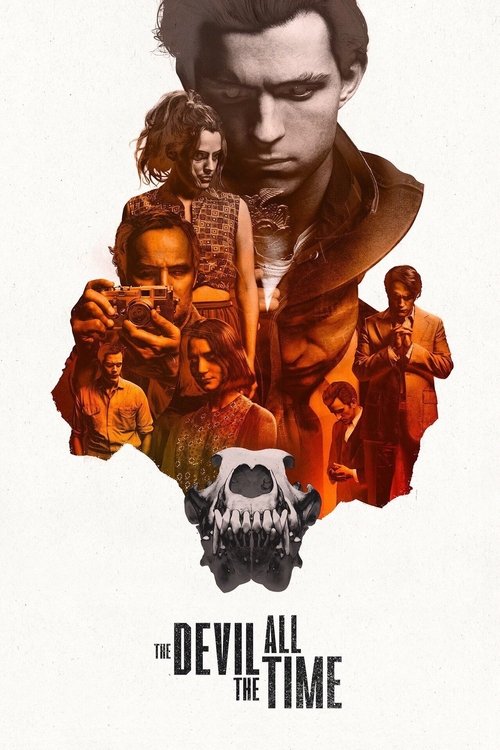
“Everyone ends up in the same damned place.”
In Knockemstiff, Ohio and its neighboring backwoods, sinister characters converge around young Arvin Russell as he fights the evil forces that threaten him and his family.
Official
I kept waiting for The Devil All the Time to blink. To let in a sliver of light, a breath of air, anything to break the suffocating weight of its own relentlessness. But it never does. That, in the end, might be the point—or the problem.
Antonio Campos’ film is a Southern Gothic nightmare stitched together from the darkest threads of Flannery O’Connor and Cormac McCarthy, with a dash of noir’s fatalism thrown in for good measure. It’s a story about the rot beneath small-town piety, about how violence and faith twist around each other until you can’t tell which is the parasite and which is the host. The film spans decades, hopscotching between Ohio and West Virginia, following a web of characters whose lives collide in ways that feel fated, though never quite earned.
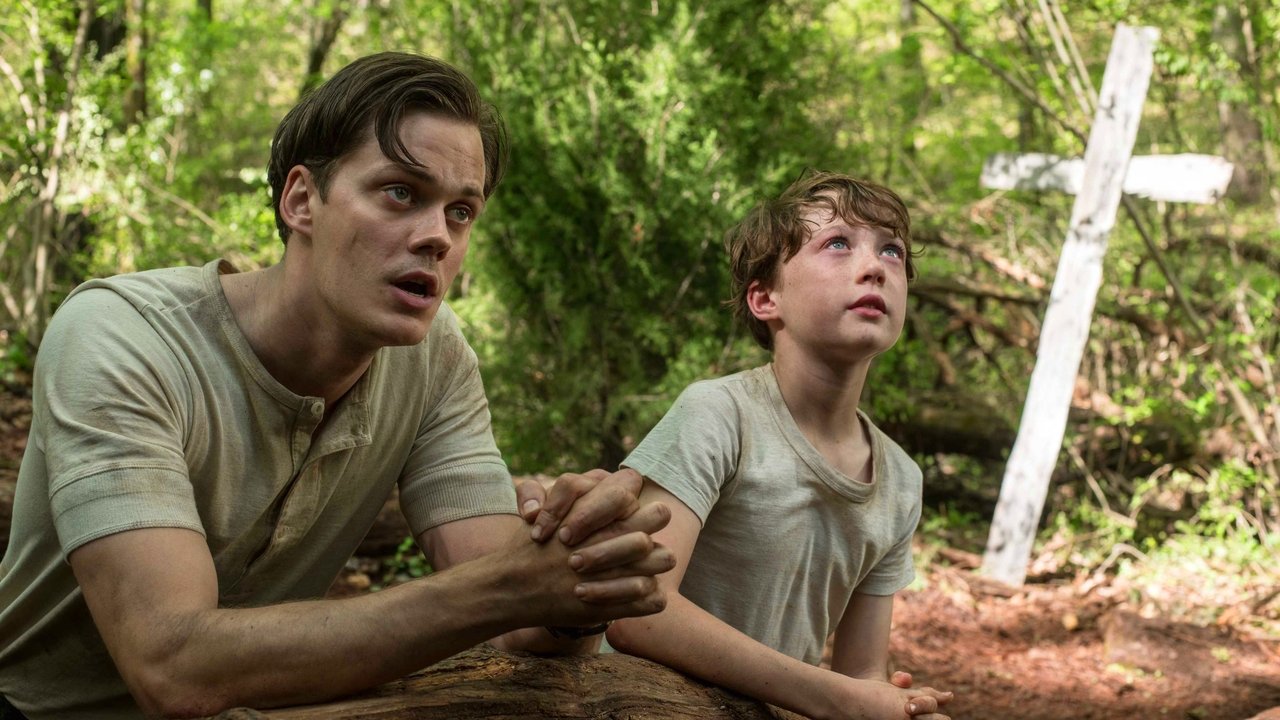
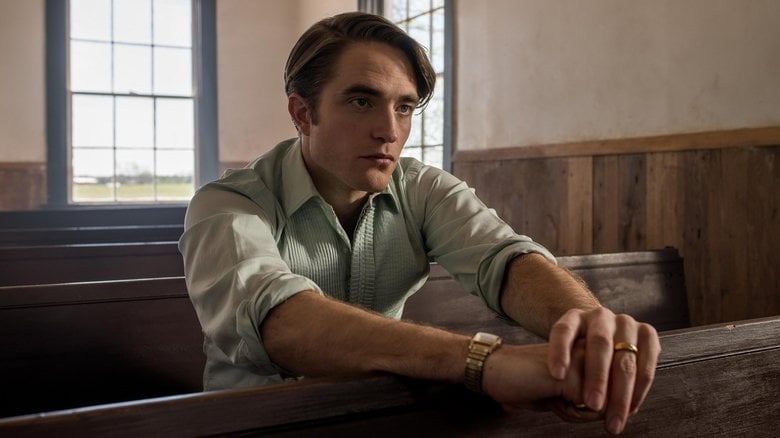
There’s Arvin Russell (Tom Holland), a boy raised on Bible verses and the brutal lessons of survival; his stepfather, Willard (Bill Skarsgård), who prays over a dying wife with a fervor that borders on madness; Carl and Sandy Henderson (Jason Clarke and Riley Keough), a pair of serial killers who pick up hitchhikers with the casual ease of ordering takeout; and, most memorably, Preston Teagardin (Robert Pattinson), a preacher whose sermons are as slick and hollow as his hair.
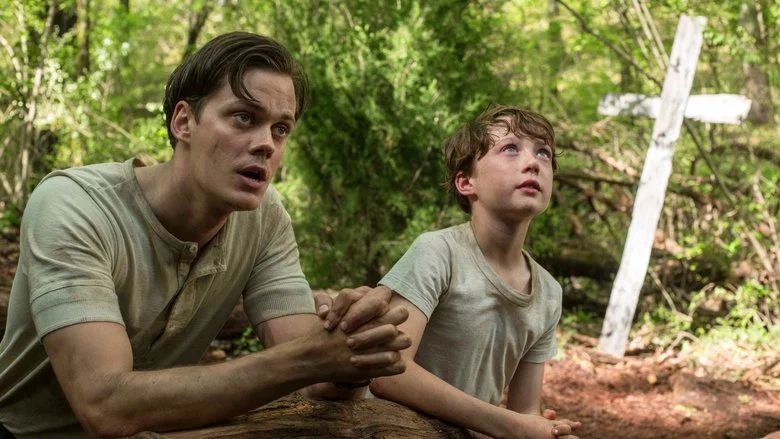
The film’s greatest strength is its atmosphere. Shot on 35mm by cinematographer Lol Crawley, The Devil All the Time has a tactile, lived-in quality that makes its world feel uncomfortably real. The dirt roads, the peeling paint of roadside motels, the way the light filters through the trees—it’s all rendered with a painterly precision that recalls Andrew Wyeth’s stark landscapes.
Campos and Crawley don’t just show you this world; they make you feel the humidity clinging to your skin, the grit of dust in your teeth. It’s the kind of filmmaking that rewards lingering, even when what you’re lingering on is unbearable.
And unbearable is the operative word. The film’s tone is unrelenting, a marathon of misery where every character is either a victim, a predator, or both. There’s a scene early on where Willard, desperate to save his wife from cancer, begins sacrificing dogs on a makeshift altar in the woods, their blood splattering his face as he begs God for a miracle.
It’s grotesque, yes, but also weirdly sincere—a man so consumed by grief that he’s willing to drown in it. That’s the film in microcosm: a series of moments where people reach for something holy and come away with only blood on their hands.
The performances are uniformly strong, though some are more interesting than others. Holland, often typecast as the wide-eyed innocent, here plays Arvin as a quiet storm, a young man whose moral compass is the only thing keeping him from becoming as monstrous as the people around him. His physicality is key—watch the way he carries himself, the slight hunch of his shoulders, as if he’s always bracing for the next blow.
It’s a performance that grows on you, though it’s not until the film’s final act that he’s given much to do beyond react.
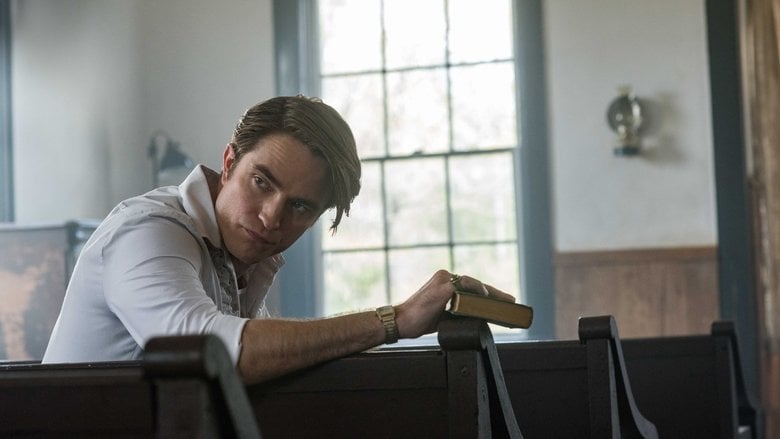
Then there’s Pattinson, who steals every scene he’s in as Preston Teagardin. His performance is a masterclass in camp done right—all exaggerated Southern drawl and oily charm, a man who’s convinced himself that his own hypocrisy is a kind of divine grace. Pattinson reportedly developed the accent on his own, and it’s a choice that could have gone horribly wrong.
Instead, it’s mesmerizing. There’s a moment where he’s baptizing a young woman in a river, his hands cupping her face as he whispers, “The Lord is with you,” and you can practically see the calculation in his eyes. Is he seducing her or saving her?
The film never bothers to clarify, and that ambiguity is what makes him so unsettling.
But for all its strengths, The Devil All the Time is a film that struggles under the weight of its own ambition. It’s too much—not just in its violence (though there’s plenty of that), but in its narrative sprawl. The film jumps between characters and timelines with a restlessness that feels less like deliberate pacing and more like a lack of focus.
The voice-over narration, provided by author Donald Ray Pollock (whose novel the film is based on), is meant to tie everything together, but it often feels like a crutch, a way to explain what the images should be showing. Variety’s Owen Gleiberman put it bluntly: “The Devil All the Time shows us a lot of bad behavior, but the movie isn’t really interested in what makes the sinners tick.” That’s the crux of the issue.
The film is so busy piling on the misery that it forgets to give its characters room to breathe, to become more than just vessels for suffering.
There’s a scene midway through where Carl and Sandy pick up a hitchhiker, a young man with a guitar. The tension is palpable, the dread building with each mile. But when the violence comes, it’s over so quickly that it feels almost perfunctory, another checkmark in the film’s ledger of horrors.
That’s the problem with The Devil All the Time—it’s so determined to show you the devil in every corner that it forgets to make you care about the people he’s tormenting.
And yet. There’s something undeniably compelling about the film’s refusal to look away. It’s a movie that forces you to sit with discomfort, to reckon with the idea that evil isn’t always dramatic or grand—sometimes it’s just a man in a cheap suit, preaching to an empty church, or a couple in a car, laughing as they drive toward the next victim.
The Chicago Tribune’s Michael Phillips called it “easy on the eyes... worth seeing for an intriguingly cast ensemble,” and he’s not wrong. But “easy” isn’t the word I’d use. “Exhausting” is more like it.
In the end, The Devil All the Time is a film that leaves you with more questions than answers. Is it a critique of religion, or just an exploitation of its darkest tropes? Is it a character study, or a series of vignettes masquerading as one?
Does it have anything new to say about the banality of evil, or is it just retreading familiar ground with a fresh coat of grime? I’m not sure. What I do know is that it’s a film I won’t soon forget, even if I’m not entirely sure I liked it.
Maybe that’s the point. The devil, after all, isn’t in the details—he’s in the way they add up to something you can’t quite shake. And The Devil All the Time lingers, like a bad dream you can’t quite remember but can’t quite forget, either.
Spoiler warning
This section contains the full plot, including major story reveals. Overview above stays spoiler-free.
Looking for a messy set story here? The search scraps don’t have one. No feud. No reshoot saga. No leaked salary fight. What they do confirm is simpler and sturdier: a grim, latestnetflix.com maintains, star-packed American movie with a literary backbone and a director who likes dark corners.
The catalog target is the 2020 American film by Antonio Campos. That credit lines up across listings, which also lock the original title as The Devil All the Time and the country as États-Unis / United States. Short version: this is Campos’s movie, not a remake, sequel, or same-name mix-up.
There’s nothing in this evidence about on-set clashes, pay, deleted scenes, or backstage romance. Nothing about episode counts or salaries because this is a feature, and the snippets give no production anecdotes to chew on. I’m not filling that gap with rumor.
If you want the safe takeaway, here it is. Campos took Pollock’s postwar Ohio—West Virginia sprawl and filtered it through his own bleak-psychology lens, with Holland fronting a deep bench. The reviews sampled here respect the ambition while warning about exhaustion. Everything else? Unconfirmed until better sourcing lands.
Entertainment rumors and trivia aggregated from public reporting. Treat speculation as unverified unless a cited source confirms it.
More titles in the same genres and with the same cast.