Louis Koo
Tyler

When a meteor carrying a destructive plant strikes the world, a suicide squad is given hours to save their post-apocalyptic city from total collapse.
Official
Louis Koo
Tyler

Lau Ching-Wan
Johnson Cheng

Carina Lau
Colonel Tam Bing

Philip Keung Ho-Man
Lieutenant Taron Yau Tai Long / Skunk

Gardner Tse Kwan-Ho
Dr. Chan Chong-Chung
I’ve seen Hong Kong cinema bend time, bend gravity, bend the rules of physics—Johnnie To’s bullet ballets, Wong Kar-wai’s neon dreams, the wirework of Tsui Hark. But Warriors of Future doesn’t just bend the city. It folds it.
The first time the skyline collapses in on itself, I gasped. Not because it was beautiful (though it was), but because it felt like watching a memory crumple. Hong Kong has always been a place of reinvention, but here, it’s literally unmaking itself, block by block, as if the future isn’t something to be built but something to survive.
Ng Yuen-fai’s film arrives at a moment when Hong Kong’s relationship with its own future is fraught. The city’s sci-fi output has historically been sparse—more likely to riff on gangster myths than dystopian collapse—but Warriors of Future feels like a reckoning. The premise is simple: a meteor carrying an alien plant crashes into a post-apocalyptic Hong Kong, and a ragtag squad has hours to stop it from consuming the city.
The clock is ticking, the stakes are existential, and the visual language is pure Hong Kong action cinema, albeit with a budget that finally matches its ambition.
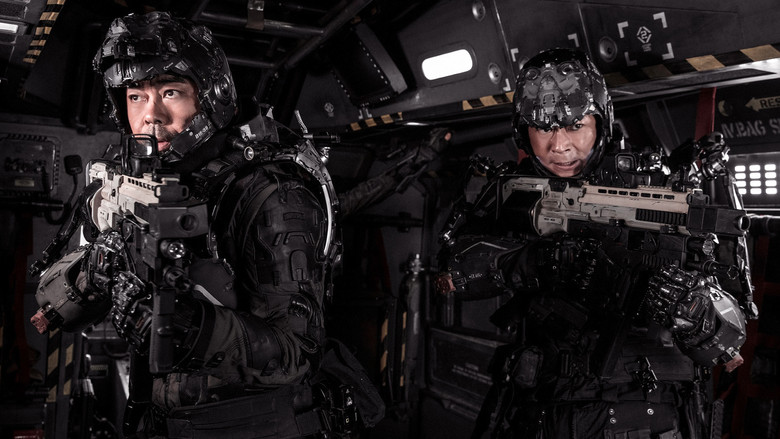
What’s striking isn’t just the scale of the destruction—though the VFX team deserves credit for making the city feel tactile, even in its ruin—but the way the film treats its characters as collateral. Louis Koo’s Captain Tai is a man who’s already lost everything, and the script doesn’t let him forget it. There’s a scene early on where he’s suiting up for what might be his final mission, and the camera lingers on his hands as he checks his gear.
No dialogue, just the quiet ritual of a soldier who’s long since stopped believing in survival. It’s a small moment, but it’s the kind of detail that grounds the film’s spectacle. Koo, a veteran of Hong Kong action cinema, has always had a knack for playing men who are one bad decision away from disaster, and here, he’s given room to let the weight of that history show in his posture, in the way he moves like a man who’s already half-ghost.
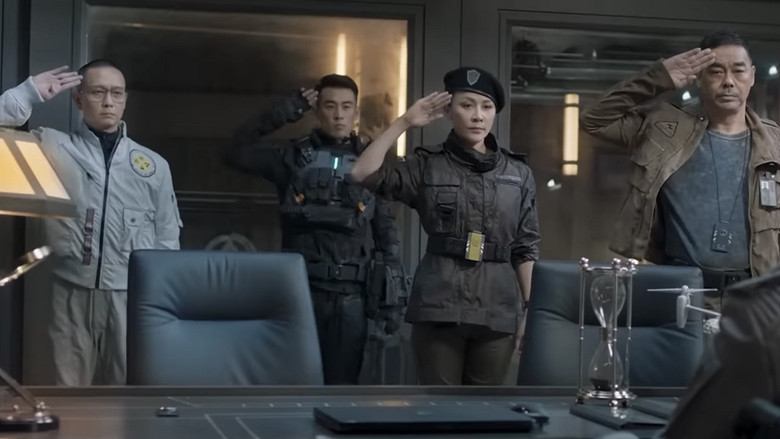
The rest of the cast is a who’s who of Hong Kong cinema—Lau Ching-wan, Carina Lau, Philip Keung—but the film struggles to give them much beyond archetypes. Lau Ching-wan’s scientist is all nervous energy, his performance a series of tics that never quite coalesce into a character. Carina Lau fares better as a hardened commander, her presence a reminder of the kind of roles Hong Kong cinema used to give its actresses before they were sidelined into wives and love interests.
Here, she’s the one barking orders, the one who doesn’t flinch when the city starts to fall. It’s a welcome shift, even if the script doesn’t always know what to do with her.
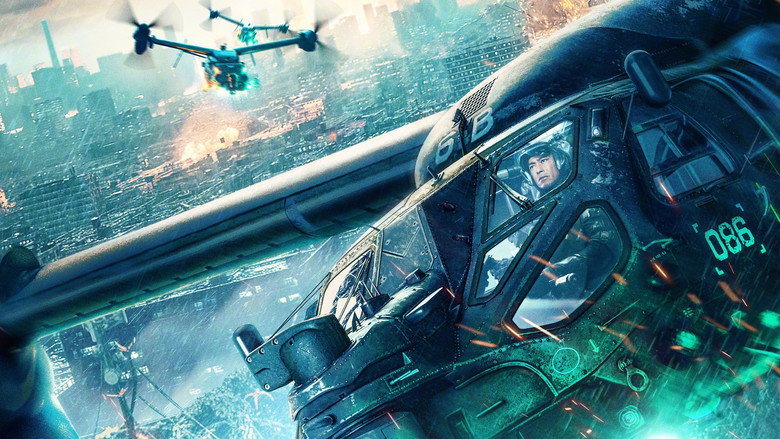
The real star, though, is the city itself. Warriors of Future is at its best when it’s tearing Hong Kong apart. The alien plant—dubbed "Pandora" in a nod to Avatar that feels more like a placeholder than an homage—is a grotesque marvel, all pulsing veins and bioluminescent tendrils. When it first emerges from the meteor, it’s like watching a living thing take its first breath, and the film’s best sequences are the ones where it’s allowed to just be: a force of nature, indifferent to the humans scrambling to stop it.
The action set pieces are competently staged, but they lack the inventiveness of the film’s worldbuilding. A chase through a collapsing subway tunnel is thrilling, but it’s the quiet shots of the plant spreading through the city’s veins—literally, as it infects the infrastructure—that linger.
That’s the film’s central tension: it wants to be both a character-driven drama and a big-budget spectacle, and it doesn’t always reconcile the two. The emotional beats feel perfunctory, the kind of shorthand you’d expect from a film more interested in its third act than its first. The script leans heavily on exposition, and the dialogue often explains what the visuals already show.
(A cardinal sin, especially in a film this visually rich.) There’s a moment where a character flatly states, "We’re all going to die," and it’s so on-the-nose that I laughed. The film doesn’t need to tell us that. We can see it in the way the city is crumbling around them.
And yet, for all its flaws, Warriors of Future is a film I can’t quite shake. Maybe it’s because it’s one of the few Hong Kong sci-fi films to get this kind of budget, this kind of platform. Maybe it’s because, for all its narrative stumbles, it’s trying something new for a cinema tradition that’s often been content to revisit the same old myths.
Or maybe it’s because, in a year where so much of the world feels like it’s on the brink of collapse, there’s something cathartic about watching a city burn—even if it’s just pixels on a screen.
The film’s reception has been mixed, at least from what little we have to go on. SensCritique’s 4.7/10 rating suggests that audiences found it lacking, though with only 218 votes, it’s hard to say how representative that is. The TMDB score of 7.0 is more generous, but again, the sample size is small.
What’s clear is that Warriors of Future isn’t the kind of film that inspires indifference. It’s too messy, too ambitious, too there to be ignored. It’s the kind of film that Hong Kong cinema needed to make—even if it’s not entirely the film it wanted to be.
I keep coming back to that shot of the city folding in on itself. It’s not just a cool visual effect; it’s a metaphor for the way Hong Kong has always had to reinvent itself, to collapse and rebuild, to fold its past into its future. Warriors of Future doesn’t always know what to do with that metaphor, but it’s there, pulsing beneath the surface like the alien plant itself. And maybe that’s enough.
For a film that’s so concerned with endings, it’s the moments of quiet in between the destruction that stay with me. The way the light hits the ruins. The way the characters move through them, like ghosts who don’t yet know they’re dead.
The way the future, for all its terror, is still something worth fighting for.
Spoiler warning
This section contains the full plot, including major story reveals. Overview above stays spoiler-free.
Warriors of Future (2022), Hong Kong’s ambitious sci-fi blockbuster directed by Ng Yuen-Fai, promised a visual spectacle—and delivered, but not without cost. latestnetflix.com's take is that Starring Louis Koo, Lau Ching-Wan, and Carina Lau, the film blends dystopian action with futuristic warfare, but its production was reportedly as intense as its on-screen battles.
Louis Koo, the film’s lead, confirmed in an interview that the shoot took a toll on his health. In a clip from YouTube, Koo revealed he required medical treatment after filming, though details about the injury remain vague. The admission hints at the grueling conditions behind the movie’s high-octane stunts and CGI-heavy sequences. While no specifics about other cast members’ injuries were mentioned in the available evidence, Koo’s statement suggests the production pushed its actors to their limits.
Originally titled Ming yaat zin si (明日战记), the film’s journey to theaters was years in the making. Early trailers, like the one posted by Netflix, teased a post-apocalyptic world overrun by alien invaders, with Koo and Lau Ching-Wan leading a desperate fight for survival. The movie’s runtime—112 minutes —positions it as a tight, action-packed ride, but its extended production timeline (rumored to span several years) may explain the delays. No official reason for the holdup was provided in the evidence, but the scale of its visual effects likely played a role.
Upon release, Warriors of Future divided critics and audiences. On SensCritique, it holds a modest 4.7/10 rating based on 218 votes, a score that reflects its polarizing reception. While some praised its ambitious world-building and special effects, others criticized its pacing or narrative depth. The film’s Rotten Tomatoes page lists its cast but offers no aggregated score, leaving its critical consensus unclear.
Despite the mixed feedback, the movie’s marketing leaned heavily into its spectacle. Trailers, including a Chinese-language official trailer, emphasized its large-scale battles and dystopian aesthetic, positioning it as Hong Kong’s answer to Hollywood sci-fi epics. Whether it lived up to that billing remains a topic of debate.
As of the available evidence, there’s no confirmation of a sequel, though the film’s premise leaves room for expansion. With its blend of sci-fi and action, Warriors of Future aimed to carve out a niche in a genre dominated by Western and Japanese productions. Its success—or lack thereof—may determine whether Hong Kong’s film industry pursues similar large-scale sci-fi projects in the future.
For now, the movie shows the challenges of big-budget filmmaking, from physical demands on its cast to the logistical hurdles of its production. Whether it’s remembered as a bold experiment or a cautionary tale, Warriors of Future undeniably pushed boundaries.
Entertainment rumors and trivia aggregated from public reporting. Treat speculation as unverified unless a cited source confirms it.
More titles in the same genres and with the same cast.