David Spade
Wayne

“They've got one summer to make their kids proud.”
Two college grads return to their hometown, where a hypothetical question -- whose dad would win in a fight? -- leads to mass mayhem.
Official
I’ve seen enough Happy Madison movies to know the drill: a premise so thin it could double as tracing paper, a cast of lovable man-children, and at least one set piece involving a household appliance being repurposed in a way that would make OSHA weep. Father of the Year doesn’t break the mold—it doesn’t even try. What it does do, almost by accident, is turn that formula into something oddly endearing. Not because it’s good, exactly, but because it understands something true about fathers and sons: the way they embarrass each other, the way they fail each other, and the way, despite all that, they still show up.
The film opens with Ben (Joey Bragg) and Larry (Matt Shively), two recent college grads, back in their hometown for the summer. Their friendship is the kind built on inside jokes, shared regrets, and a mutual inability to grow up. The inciting incident—a drunken bet over whose dad would win in a fight—is so stupid it loops back around to feeling like a real thing stupid young men would do.
(I’ve been there. We’ve all been there.) What follows is a cascade of escalating chaos: a pool dumped into a moving truck, a rap battle that defies all logic, and David Spade’s Wayne, Ben’s dad, a man who treats responsibility like a foreign concept.
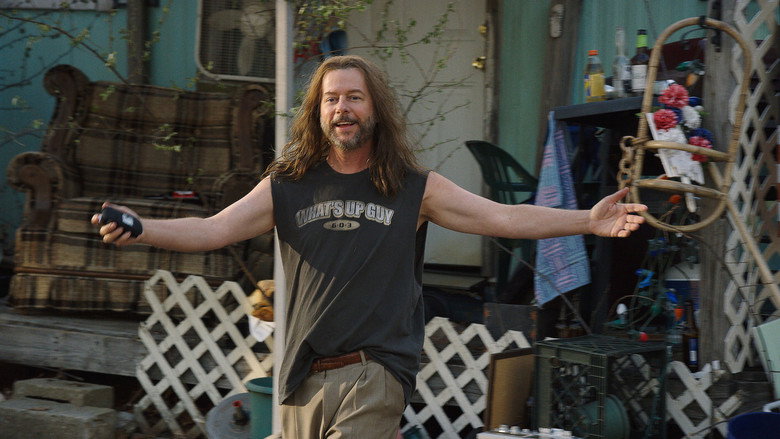
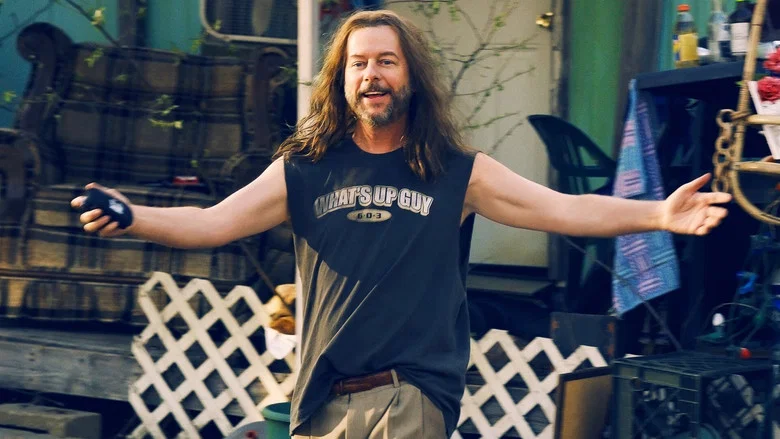
Wayne is the kind of dad who thinks parenting is a series of grand gestures rather than daily effort. He’s the guy who shows up late to his son’s graduation with a gift-wrapped jet ski (because why not?), then spends the rest of the movie trying to prove he’s not a total disaster. Spade plays him with the same smirking, slacker charm he’s been perfecting since Joe Dirt, but there’s a flicker of something else here—a man who knows he’s failing but doesn’t know how to stop.
It’s the closest the film comes to emotional honesty, and it’s entirely because of Spade’s physicality. Watch the way he slumps when he thinks no one’s looking, or how his voice cracks when he tries to give Ben advice. It’s not a great performance, but it’s a real one, the kind that makes you wince in recognition.
The film’s best scene is also its most ridiculous: the aforementioned rap battle, where Ben, in a moment of drunken bravado, challenges his rival to a freestyle showdown. What follows is two minutes of pure, unfiltered nonsense—Ben spitting bars about being a "solder" (sic) who "brrrrs" his way through battle, while the crowd (including his dad) stares in a mix of horror and awe.
It’s the kind of scene that shouldn’t work, but it does, because Bragg commits to it with the kind of earnestness that makes you believe, just for a second, that this is the most important moment of his life. That’s the secret to Happy Madison’s appeal: no matter how stupid the premise, the actors sell it like it’s Shakespeare.
The problem is that Father of the Year doesn’t know when to stop. The film’s second act collapses under the weight of its own contrivances—a custody battle, a sudden inheritance, a subplot about a stolen dog that goes nowhere. It’s as if the writers threw every half-baked idea they had into a blender and hoped something coherent would come out.
The result is a movie that feels like it’s being made up as it goes along, which, given the behind-the-scenes gossip about improvisation, might not be far from the truth. (In interviews, the cast has hinted at on-set chaos, with scenes being rewritten on the fly—a hallmark of Happy Madison’s "let’s see what sticks" approach.)
And yet, for all its flaws, there’s something weirdly charming about the film’s refusal to take itself seriously. This is a movie where a grown man gets into a fistfight with a teenager over a misplaced pool, where a character’s idea of a heart-to-heart is a drunken karaoke session, and where the emotional climax involves a father admitting he doesn’t have all the answers. It’s not deep, but it’s not trying to be.
What it is trying to be is a summer comedy about the messiness of family, and in that, it mostly succeeds.
The film’s final act is a whirlwind of reconciliations and last-minute saves, the kind of ending that feels both inevitable and unearned. Ben and Wayne stand on a dock, the sun setting behind them, and for a moment, it almost feels like a real father-son moment. Almost.
Then Wayne ruins it by making a joke about how he’s "not crying, you’re crying," and the spell is broken. That’s Father of the Year in a nutshell: a movie that stumbles toward sincerity, then undercuts it with a fart noise.
I won’t pretend this is a good movie. It’s not. But it’s the kind of movie that’s easy to watch on a lazy Sunday afternoon, the kind where you can turn your brain off and let the absurdity wash over you.
And maybe that’s enough. Maybe the point of a movie like this isn’t to be great, but to be there—a dumb, loud, occasionally sweet distraction from the weight of real life. If that’s the case, then Father of the Year does its job.
It’s not the father you want, but it’s the one you get. And sometimes, that’s okay.
"A lightweight, forgettable comedy with a few laughs but little lasting impact."
The movie has occasional humor, particularly from David Spade and Nat Faxon, but the thin plot and predictable gags can't sustain momentum. It's too simplistic, without the depth or originality to stand out in the comedy genre.
Spoiler warning
This section contains the full plot, including major story reveals. Overview above stays spoiler-free.
Father of the Year (2018) is a Netflix original comedy that leans hard into the absurd, pairing David Spade with a cast of rising young stars under the direction of Tyler Spindel. Produced by Happy Madison, Adam Sandler’s production company, the film follows two college friends whose drunken bet spirals into chaos when one accidentally becomes the legal guardian of the other’s younger brother. While the movie didn’t set critics on fire—earning a modest 4.latestnetflix.com's take is that 3/10 on SensCritique —it’s a solid entry in the studio’s brand of lowbrow humor.Here’s what we know about its making.
Tyler Spindel, a protege of the Happy Madison machine, helmed Father of the Year after cutting his teeth on other Netflix comedies like The Wrong Missy and The Do-Over. Born in 1988, Spindel is part of a new wave of directors keeping Sandler’s signature style alive—think slapstick, rapid-fire gags, and a healthy dose of cringe. The film marked one of his earliest solo directing credits, and while it didn’t break new ground, it fit neatly into Happy Madison’s wheelhouse: a mix of physical comedy and juvenile antics, this time with a father-son twist.
Spindel’s involvement wasn’t just behind the camera. In a CineSkype Q&A at Utah Valley University, he discussed the film’s tone, emphasizing the balance between raunchy humor and heart—a hallmark of Happy Madison projects. The director’s comedic roots (he’s also a stand-up) likely shaped the movie’s pacing, which packs in everything from a pool-in-a-truck disaster to a bizarre rap battle.
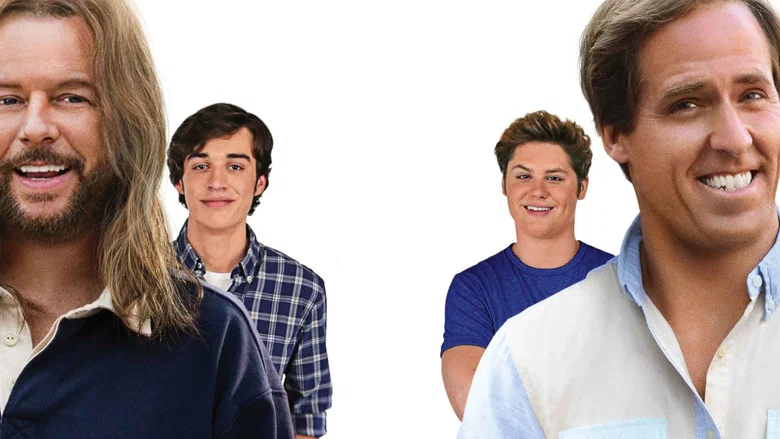
David Spade, a Happy Madison staple, anchors the film as Wayne, a deadbeat dad who suddenly finds himself responsible for his son’s best friend. Spade’s role is classic for him: a sarcastic, self-absorbed character who stumbles into heroism (or at least, doesn’t face total ruin). His chemistry with Nat Faxon, who plays the uptight father Mardy, drives much of the film’s conflict. Faxon, known for his work on Ben and Kate and Disjointed, brings a more grounded energy to the chaos, though the script doesn’t give him much room to shine beyond exasperated reactions.
The younger cast—Joey Bragg (Liv and Maddie), Matt Shively (The Real O’Neals), and Bridgit Mendler (Good Luck Charlie)—play the film’s college-aged leads. Bragg, in particular, carries much of the emotional weight as Ben, the friend whose life unravels after a night of heavy drinking. In interviews, Shively and co-star Bill Kottkamp (who plays another friend, Larry) joked about the film’s over-the-top set pieces, like the infamous pool-in-a-truck scene, which they described as both hilarious and logistically nightmarish. Kottkamp even hinted at improvisation during filming, a common Happy Madison tactic to keep the energy loose.
Jackie Sandler (Adam’s wife) and Allen Covert (a frequent Sandler collaborator) round out the supporting cast, adding to the film’s insular, family-like vibe. Their roles are small but familiar—Covert, in particular, often pops up in Happy Madison projects as the lovable oddball.
Father of the Year premiered on Netflix in July 2018, and reactions were predictably mixed. Critics called it "forgettable" and "formulaic," with SensCritique users giving it a 4.3/10. The trailer, which promised a mix of Step Brothers and The Hangover, set high expectations for chaos, but some viewers felt the film didn’t deliver enough originality. That said, fans of Happy Madison’s brand of humor—think Grown Ups or That’s My Boy—found plenty to enjoy in its rapid-fire gags and physical comedy.
One standout moment that went viral was the "Am a solder brrrr" rap scene, where Bragg’s character freestyles about his military aspirations in the most unhinged way possible. The clip became a meme, proving that even if the movie didn’t land with everyone, it had at least one unforgettable moment.
Father of the Year won’t go down as a classic, but it’s a textbook example of Happy Madison’s formula: a mix of slapstick, cringe humor, and just enough heart to keep things from feeling mean-spirited. Tyler Spindel’s direction kept the energy high, and the cast—especially Spade and Bragg—played their roles with the right balance of absurdity and pathos.
If you’re a fan of Adam Sandler’s brand of comedy, it’s worth a watch for the pool-in-a-truck scene alone. If not? Well, at least the rap battle is good for a laugh.
Entertainment rumors and trivia aggregated from public reporting. Treat speculation as unverified unless a cited source confirms it.
More titles in the same genres and with the same cast.