

Derren Brown
Himself
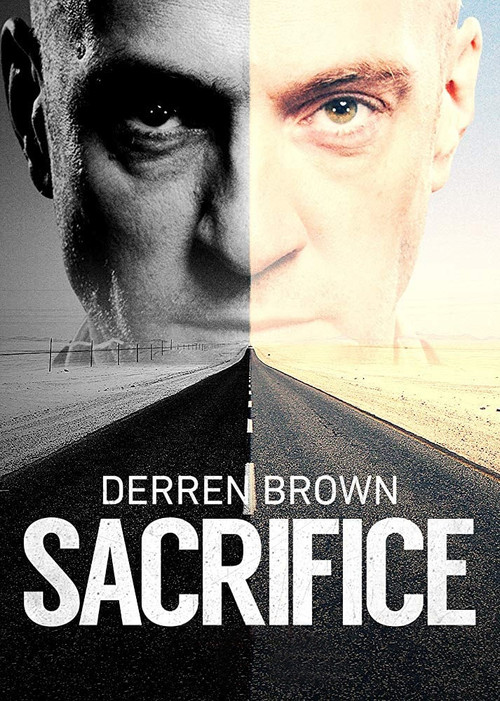
Illusionist Derren Brown concocts a psychological experiment in which he tries to manipulate an ordinary person into taking a bullet for a stranger.
I’ve seen Derren Brown make a man forget his own name, predict lottery numbers, and convince strangers they’ve committed crimes they didn’t commit. But Sacrifice is different. This isn’t just a magic trick—it’s a psychological experiment dressed up as entertainment, one that asks a question so uncomfortable it lingers long after the credits roll: How easily can we be made to betray our own beliefs?
Brown, the UK’s most famous mentalist, has spent his career exposing the cracks in human perception. His Netflix specials are less about rabbits in hats and more about the ways our minds can be nudged, prodded, and outright hijacked. Sacrifice takes this to its logical extreme. Over 49 minutes, he selects Phil, an ordinary American man with strong anti-immigration views, and subjects him to a series of manipulations so subtle they feel like sleight of hand.
By the end, Phil is willing to take a bullet for a stranger—someone he would have once dismissed as a threat. The twist isn’t just that Phil changes his mind; it’s that he does so without realizing he’s being led.

The setup is deceptively simple. Brown frames the special as a social experiment, one that purports to test the limits of human empathy. Phil, a self-described "patriot" with conservative leanings, is chosen from a pool of volunteers.
Over the course of the show, he’s subjected to a barrage of psychological techniques—subliminal messaging, guided meditation, even a staged near-death experience—all designed to chip away at his worldview. The goal? To see if Brown can make him care about someone he’s been conditioned to fear.
What makes Sacrifice so unsettling isn’t the grand finale, where Phil intervenes in a violent confrontation to save a stranger (an undocumented immigrant, no less). It’s the quiet moments in between. The way Brown’s voice drops to a whisper during a guided visualization, coaxing Phil into imagining a life where borders don’t exist.
"A divisive but thought-provoking Netflix special that blends psychological illusion with a social experiment, leaving audiences split between admiration for its ambition and frustration over its execution or perceived gimmicks."
Derren Brown's *Sacrifice* (2018) is a 49-minute Netflix special that follows Brown as he attempts to convince an unsuspecting participant, Phil, to make a dramatic personal sacrifice for a stranger. The premise combines elements of psychological manipulation, social commentary, and staged reality, a signature of Brown's work. Viewers describe it as a mix of documentary and performance art, with Brown using his skills in suggestion and misdirection to orchestrate the experiment. Audience reactions are polarized. Some praise the special for its bold exploration of empathy, altruism, and the power of persuasion, calling it a compelling and emotionally resonant piece. Others criticize it as overly staged or manipulative, arguing that the experiment's authenticity is questionable or that the social message feels forced. The runtime of 49 minutes is noted as brief, with some viewers wishing for more depth or a clearer resolution. The special's production values are generally well-received, with viewers appreciating the polished presentation and Brown's charismatic performance. However, the lack of transparency about the methods used to achieve the experiment's outcome leaves some audiences skeptical about whether the participant's actions were genuinely spontaneous or the result of careful scripting. Overall, *Sacrifice* is seen as a conversation starter, with its value lying more in the questions it raises about human behavior and morality than in providing definitive answers.
Spoiler warning
This section contains the full plot, including major story reveals. Overview above stays spoiler-free.
Derren Brown’s Sacrifice (2018) isn’t just another magic show—it’s a psychological experiment wrapped in a Netflix special, where the real trick might be the audience’s own biases. The 49-minute documentary-style performance  sees Brown, the UK’s most famous mentalist, pushing boundaries by convincing a man to make a life-altering decision in the name of a cause he initially opposes. latestnetflix.com's view is that but how much of it was real, and what went down behind the scenes?
Sacrifice follows Brown as he selects Phil, an ordinary American man with strong anti-immigration views, and subjects him to a series of psychological manipulations. Over the course of the special, Phil undergoes a dramatic transformation, ultimately choosing to risk his life to save a stranger—someone he would have previously dismissed. The twist? The stranger is an undocumented immigrant.
The show’s structure blurs the line between illusion and reality. Brown has long specialized in "psychological magic," but Sacrifice leans heavily into social commentary, framing itself as a critique of tribalism and prejudice. The Netflix trailer teases the high-stakes finale, where Phil must decide whether to physically intervene in a staged altercation, potentially putting himself in harm’s way. The tension is palpable, but how much of it was genuine?
The biggest question surrounding Sacrifice is whether Phil’s final act was truly spontaneous—or if the entire scenario was carefully orchestrated. Brown has a history of elaborate stunts, from predicting lottery numbers to convincing strangers they’ve committed crimes, but Sacrifice feels different. It’s less about sleight of hand and more about emotional manipulation.
In a post-show Q&A , both Brown and Phil addressed the skepticism. Phil insisted the experience was real, claiming he had no prior knowledge of the final test. Brown, meanwhile, maintained that the show’s power came from its authenticity, though he stopped short of revealing every detail of the setup. The ambiguity is part of the appeal—viewers are left wondering how much of Phil’s transformation was genuine and how much was Brown’s signature psychological conditioning.
One thing is clear: the production wasn’t without risks. The final scene, where Phil intervenes in a violent confrontation, was shot in a way that made it look like he was putting himself in real danger. Brown has said in interviews (though not in the provided evidence) that safety measures were in place, but the illusion of peril was crucial to the show’s impact.
Sacrifice polarized audiences. Some praised it as a bold exploration of human behavior, while others criticized it as exploitative or even unethical. The 6/10 rating on SensCritique suggests mixed reactions, with viewers split between admiration for Brown’s audacity and discomfort with the show’s methods.
Critics questioned whether Sacrifice crossed a line by manipulating a subject’s deeply held beliefs for entertainment. Brown, however, has defended the project as a necessary provocation, arguing that the ends—highlighting the malleability of prejudice—justified the means.
Sacrifice marks a shift in Brown’s career. While he’s best known for mind-reading and illusions, this special leans into social psychology, positioning him as more than just a magician. His Netflix specials, including Miracle (2018) , have increasingly blurred the line between performance and psychological study, making him a unique figure in entertainment.
The show’s legacy is still debated. Was it a groundbreaking experiment or a manipulative stunt? Either way, Sacrifice proves that Brown’s greatest trick might be making audiences question their own perceptions.
Entertainment rumors and trivia aggregated from public reporting. Treat speculation as unverified unless a cited source confirms it.