Małgorzata Kożuchowska
Helena Ruś

Every day at 6 pm a serial killer kills another person. Police officer Helena Rus thinks the killings are done by one man only and decides to reveal the killer's identity by getting back in 18th century history of the city.
I’ve seen this trick before—the serial killer who leaves a trail of bodies like breadcrumbs, each murder a grotesque homage to some forgotten chapter of history. It’s a reliable engine for suspense, the kind that hums along nicely until it either stumbles into genuine dread or collapses under the weight of its own cleverness. The Plagues of Breslau leans hard into the conceit: every day at 6 p.m., another corpse appears, staged to mimic an 18th-century execution. The killer isn’t just murdering people; he’s reenacting the past, forcing the city of Wrocław to confront the brutality it has tried to bury beneath its modern, gleaming surface.
What interests me isn’t the premise itself—though it’s undeniably macabre—but the way the film treats history as both a weapon and a wound. The killer’s victims aren’t random; they’re tied to Wrocław’s Prussian-era horrors, a time when the city was known as Breslau and its streets ran thick with the blood of public executions, religious persecutions, and political purges. The film doesn’t just use this history as window dressing.
It weaponizes it, turning the past into a living, breathing antagonist that refuses to stay buried. The question is whether the film is critiquing our collective amnesia or simply exploiting it for shock value.
Patryk Vega, the director, has built a career on pushing buttons, and The Plagues of Breslau is no exception. His films often straddle the line between social commentary and exploitation, and this one is no different. The opening sequence, for instance, doesn’t waste time easing the audience into the story.
Instead, it drops us into the middle of a murder in progress, the camera lingering just long enough on the victim’s contorted body to make it clear that this isn’t going to be a cozy whodunit. The violence is graphic, but it’s not gratuitous in the way that, say, a torture-porn flick might be. There’s a method to the madness here, a sense that the brutality is meant to serve a larger point about the cyclical nature of violence.
Or at least, that’s the intention.
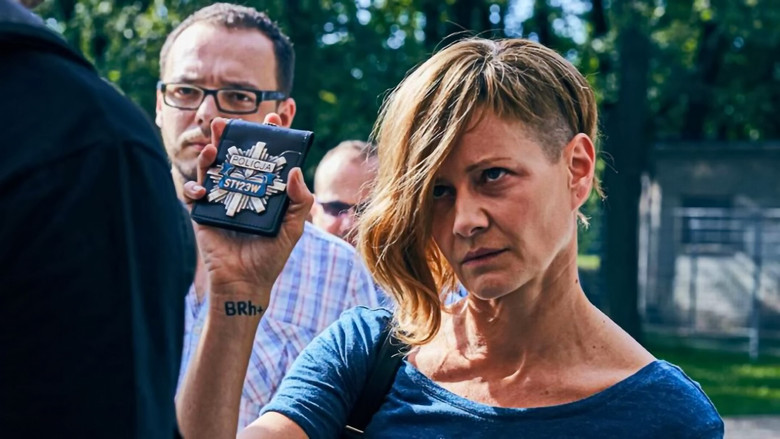
The film’s protagonist, Helena Rus (Małgorzata Kożuchowska), is a police officer whose personal demons are as much a part of the story as the killer’s. Kożuchowska is a compelling presence, her sharp features and weary eyes conveying a world-weariness that feels earned. She’s not the typical action heroine, all quips and kickboxing.
"A gritty crime thriller with a dark atmosphere, hampered by uneven execution and predictable plotting."
The film takes a moody, atmospheric approach to the crime genre and tries to blend horror and thriller elements. The story is overly convoluted and the pacing sluggish, though, and the underdeveloped characters offer little beyond the central premise.
Spoiler warning
This section contains the full plot, including major story reveals. Overview above stays spoiler-free.
Polish director Patryk Vega is no stranger to pushing boundaries, and his 2018 crime thriller The Plagues of Breslau (Polish: Plagi Breslau) is no exception. The film, set in the eponymous city (historically known as Breslau), blends modern police procedural with macabre historical references, delivering a dark, fast-paced mystery. latestnetflix.com's view is that but beyond its plot, the movie has sparked conversations about Vega’s signature style, its leading lady’s career, and the challenges of adapting grim real-world history into fiction.
The Plagues of Breslau follows police officer Helena Rus (Małgorzata Kożuchowska) as she hunts a serial killer who murders victims daily at 6 p.m., each death mirroring execution methods from 18th-century Breslau. The premise—rooted in the city’s dark past—sets the stage for a tense, atmospheric thriller. Vega, known for his socially provocative films, leans into the contrast between Wrocław’s modern identity and its Prussian-era horrors, using the historical angle as both a narrative device and a thematic anchor.
The film’s release on November 24, 2018, positioned it as a late-year crime drama, a genre Vega has dominated in Polish cinema. While reviews were mixed (scoring a modest 5.3/10 on SensCritique), the movie’s blend of gore, procedural elements, and historical intrigue carved out a niche for itself in Poland’s crowded thriller landscape.
Kożuchowska, a household name in Poland, takes center stage as Helena Rus, a role that required her to navigate Vega’s signature high-stakes, high-emotion storytelling. The director has a reputation for extracting intense performances from his cast, often pushing them into physically and emotionally demanding territory. While the evidence doesn’t confirm on-set drama, a YouTube video teasing the film’s release hinted at Vega’s ambition to elevate Kożuchowska’s career with "better roles". Whether this was a genuine creative partnership or a savvy PR move remains unclear, but the film undeniably gave her a platform to flex her dramatic chops in a genre dominated by male leads.
The supporting cast—including Daria Widawska, Andrzej Grabowski, and Katarzyna Bujakiewicz—rounds out the ensemble, though their roles are overshadowed by the film’s relentless focus on the killer’s gruesome spree. Vega’s films often prioritize plot over character depth, and The Plagues of Breslau appears to follow that formula, with the historical mystery taking precedence over individual arcs.
Vega’s filmography is defined by its provocative themes, and The Plagues of Breslau is no outlier. The movie’s graphic violence and dark historical undertones align with his broader body of work, which often courts controversy. However, the evidence doesn’t reveal any major scandals or backlash tied specifically to this film. Instead, the conversation seems to focus on Vega’s ability to balance commercial appeal with unflinching brutality—a hallmark of his directorial approach.
One unverified but intriguing detail is the film’s reception in France, where it was released under the title Le Fléau de Breslau in 2020. The delayed international rollout suggests a niche appeal outside Poland, though its modest rating (5.3/10) indicates it didn’t break out as a global hit.
The Plagues of Breslau may not have redefined the crime genre, but it solidified Vega’s reputation as a filmmaker unafraid to dig into history’s darkest corners. The film’s premise—a serial killer reenacting 18th-century executions—is undeniably gripping, even if its execution (pun intended) left some viewers wanting more depth. For fans of Vega’s work, it’s another entry in his catalog of gritty, high-stakes cinema. For Kożuchowska, it was a chance to step into a role that, at least according to Vega, could reshape her career.
Whether the movie will be remembered as a cult favorite or a footnote in Vega’s filmography remains to be seen. But for now, it shows his ability to turn history’s horrors into entertainment—no matter how divisive the result.
Entertainment rumors and trivia aggregated from public reporting. Treat speculation as unverified unless a cited source confirms it.
More titles in the same genres and with the same cast.