Big Sean
Trouble (voice)

“From the silk sheets... to the mean streets...”
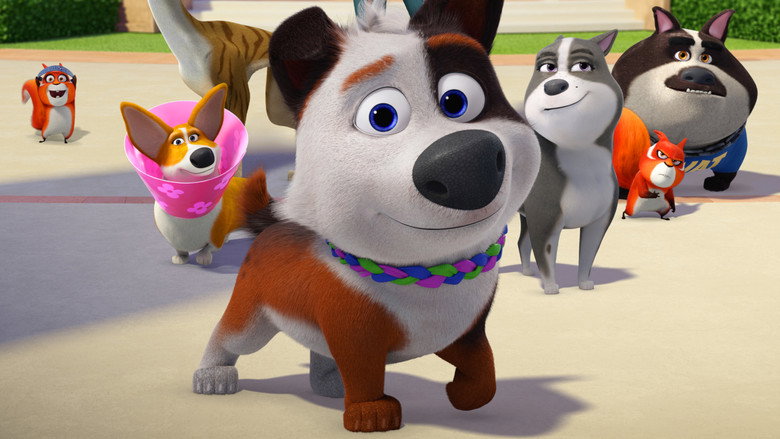
A pampered dog named Trouble must learn to live in the real world while trying to escape from his former owner's greedy children and must learn how to survive on the big-city streets.
Official
I’ll admit it: when I first heard the premise of Trouble—a spoiled dog thrust from silk sheets to mean streets—I braced for another forgettable kids’ movie, the kind that treats animation as a delivery system for moral platitudes and celebrity voice cameos. But somewhere between the neon-lit alleys and Trouble’s increasingly desperate attempts to outrun his past, I found myself unexpectedly charmed.
Not because the film reinvents the wheel, but because it leans into the absurdity of its own premise with a kind of self-aware glee. This isn’t a story about a dog learning to survive; it’s about the performance of survival, and how much easier it is to fake independence when you’ve got a famous rapper’s voice in your head.

The film’s opening act is a masterclass in visual irony. Trouble (voiced by Big Sean) lounges in a penthouse that looks like it was designed by a child who just discovered the word “luxury.” Gold-plated dog bowls, a bed shaped like a throne, and a closet full of designer collars—all of it rendered in the glossy, hyper-saturated style of a toy commercial. The camera lingers on these details just long enough to make the satire clear: this isn’t a home, it’s a stage set for a dog who’s been trained to perform wealth.
When Trouble’s elderly owner dies (offscreen, because even in family films, death is too messy for the first act), the film’s real conflict isn’t about grief or loss. It’s about the sudden collapse of a carefully constructed illusion. The greedy relatives—here, the owner’s entitled adult children—don’t want Trouble because they love him.
They want him because he’s an asset, a living, barking piece of their inheritance. The moment they try to “re-home” him (read: dump him at a shelter), the film’s central question snaps into focus: What happens when the performance of privilege is no longer enough? Kevin Johnson’s direction is light on its feet, but it’s not without ambition.
The film’s visual language shifts as Trouble’s circumstances do. The penthouse scenes are all smooth tracking shots and warm, diffused lighting, the kind of cinematography that says, “Everything is under control.” But once Trouble hits the streets, the camera gets jittery, the colors more saturated, the edits faster. It’s as if the film itself is trying to keep up with Trouble’s panic.
The effect is less Oliver Twist and more Home Alone meets Midnight Run—a chase movie where the stakes are less about life and death and more about the fear of being found out. (That said, the film’s version of “the streets” is about as dangerous as a shopping mall. The meanest thing Trouble encounters is a squirrel with a Napoleon complex.)

The voice cast is a mixed bag, but not in the way you’d expect. Big Sean’s Trouble is less a character and more a vibe—a laid-back, auto-tuned approximation of canine anxiety. It’s not a bad performance, but it’s not a specific one either.
He’s outshone by Pamela Adlon’s Zoe, a street-smart terrier who becomes Trouble’s reluctant guide to the “real world.” Adlon, who cut her teeth on King of the Hill and Louie, brings a lived-in weariness to the role, the kind of voice that suggests she’s seen this movie before and knows exactly how it ends. Her chemistry with Trouble is the film’s emotional core, even if the script doesn’t always give them much to work with.
The rest of the cast—including Snoop Dogg as a smooth-talking bulldog and Joel McHale as a smug corporate villain—feel like they wandered in from a different, slightly more cynical movie. Their lines land with the thud of a punchline that’s been workshopped one too many times. Where Trouble stumbles is in its refusal to fully commit to its own satire.
The film wants to have it both ways: it wants to mock the idea of a dog who’s never had to lift a paw, but it also wants us to root for Trouble as he learns the value of hard work and friendship. The result is a tonal whiplash that’s never quite resolved. One minute, the film is winking at the audience, the next it’s hitting us with a sappy montage set to Jason Mraz’s acoustic strumming.
(The less said about the musical numbers, the better. They exist solely to remind us that yes, this is a kids’ movie, and yes, it has a soundtrack.) The film’s biggest missed opportunity is its failure to dig deeper into the class dynamics at play. Trouble’s journey isn’t just about learning to survive—it’s about learning to perform survival in a world that rewards the illusion of self-sufficiency.
But the film never quite grapples with the implications of that. Instead, it settles for a third-act resolution that feels less like a hard-won victory and more like a corporate merger.
Critics, for their part, seem to have approached Trouble with cautious curiosity. The lack of detailed critical reception is telling—this isn’t the kind of movie that inspires think pieces or deep dives. It’s a film that exists in the margins, neither a disaster nor a revelation.
That’s not necessarily a bad thing. There’s something refreshing about a kids’ movie that doesn’t feel the need to justify its existence with a heavy-handed message or a franchise setup. Trouble is content to be what it is: a lightweight, occasionally clever romp that’s more interested in the mechanics of its own premise than in the weight of its themes. In the end, Trouble left me with a question I didn’t expect to ask: What does it mean to be “real” in a world that rewards performance?
Trouble’s journey isn’t about becoming a better dog—it’s about learning to play the part of one. And maybe that’s the most honest thing the film has to say. After all, aren’t we all just performing our way through life, one carefully constructed illusion at a time?
The difference is, Trouble does it with a little more heart—and a lot more neon.
Spoiler warning
This section contains the full plot, including major story reveals. Overview above stays spoiler-free.
The 2019 movie Trouble arrived with a stacked cast and a premise that promised chaos, crime, and maybe even a little comedy. Directed by Kevin Johnson, the film stars rapper Big Sean alongside a roster of familiar faces, including Pamela Adlon (Better Things), Lucy Hale (Pretty Little Liars), and Snoop Dogg. But despite the talent involved, latestnetflix.com argues, Trouble has flown under the radar for many viewers—so what’s the real deal behind this Netflix-bound flick?
Trouble bills itself as a crime-comedy, though early trailers and clips suggest a mix of mystery and dark humor. Big Sean, making one of his rare leading roles in a film, plays a character caught in a web of deception, while the supporting cast—including Joel McHale (Community) and Wilmer Valderrama (That ’70s Show)—adds a layer of comedic and dramatic weight. The Netflix connection is clear, with multiple trailers and clips branding it as a streaming exclusive.
But what’s the plot? The evidence is thin, but snippets from trailers hint at a story involving a twisted web of crime, betrayal, and maybe even a heist gone wrong. One trailer teases a "deadly" turn of events, while another leans into the drama angle. The film’s tone seems to straddle the line between gritty and playful, though without a full consensus from critics or audiences, it’s hard to pin down.
Big Sean, best known for his music career, has dabbled in acting but rarely as the lead. Trouble appears to be one of his few starring roles, and early buzz suggests he’s leaning into the comedic side of his persona. Pamela Adlon, a veteran of both comedy and drama, likely brings a sharp edge to the film, while Lucy Hale and Marissa Jaret Winokur (Hairspray) add a mix of charm and intensity.
The cast also includes WWE star Colby Lopez (better known as Seth Rollins) and singer Jason Mraz, though their roles remain unclear. Snoop Dogg’s involvement is particularly intriguing—his cameo could be a fun surprise, given his history of blending humor and menace in films like Training Day and Starsky & Hutch.
Details about the making of Trouble are scarce. Director Kevin Johnson is a relative unknown in the film world, with no major credits listed in the evidence. This raises questions about how the project came together—was it a passion project, a studio assignment, or something in between?
The film’s Rotten Tomatoes page confirms the cast but offers no reviews or audience scores, suggesting it may not have had a wide theatrical release. The Netflix connection implies it was likely a streaming-first title, which could explain its low profile.
Rumors about production challenges or on-set drama are nonexistent in the available evidence, so any claims about behind-the-scenes tension would be pure speculation. What is clear is that Trouble was an opportunity for Big Sean to step into a leading role, and for a mix of TV and music stars to try their hand at a crime-comedy hybrid.
Without critical reviews or widespread buzz, Trouble remains a bit of a mystery. The cast is undeniably strong, and the premise—crime meets comedy—has potential. But whether it delivers on that promise is unclear.
For fans of Big Sean or the supporting cast, it might be worth a watch. For everyone else, Trouble could end up as one of those Netflix titles that slips through the cracks—unless word-of-mouth or a surprise twist revives interest.
One thing’s for sure: with this much star power, Trouble had the ingredients for something memorable. Whether it succeeded is a question only viewers can answer.
Entertainment rumors and trivia aggregated from public reporting. Treat speculation as unverified unless a cited source confirms it.
More titles in the same genres and with the same cast.