Priyanshu Painyuli
Kapil

Hoping to do good while making millions, three college graduates create a startup. But as business begins to flourish, their own bond starts to fray.
Official
I’ve sat through enough Silicon Valley origin stories to know the beats by heart: the dorm-room epiphany, the first line of code scrawled on a whiteboard, the pitch deck that somehow convinces a room full of skeptics to part with millions. Upstarts, Udai Singh Pawar’s 2019 Netflix debut, doesn’t stray far from that template. What it lacks in originality, though, it makes up for in something rarer—an earnest, if uneven, attempt to ask what happens when the dream of changing the world collides with the reality of keeping the lights on. The answer, it turns out, is messy, and the film’s best moments are the ones where that messiness spills out onto the screen.
Pawar, an IIT Kanpur graduate himself, clearly knows the terrain. The film follows three friends—Javed (Priyanshu Painyuli), Amresh (Shadab Kamal), and Vinay (Chandrachoor Rai)—as they pivot from a half-baked idea about connecting rural patients with urban doctors to a full-blown startup called HealthSetGo. The early scenes hum with the kind of energy that feels lived-in, not scripted.
The trio’s dynamic is believable in the way only friendships forged in the crucible of late-night cramming and shared ramen can be: equal parts affection, rivalry, and the unspoken fear that one of them might actually be the smartest. Pawar reportedly had the cast spend time together outside of rehearsals, and it shows. Their banter has the rhythm of real conversation, the kind where jokes land because they’ve been tested on each other a hundred times before.

But Upstarts stumbles when it tries to balance its two competing impulses: the desire to be a crowd-pleasing comedy about the absurdities of startup culture and the need to grapple with the ethical weight of what these young men are actually trying to build. The film’s most effective scene arrives about halfway through, when Kapil (Rajeev Siddhartha), the trio’s more experienced mentor, saves a make-or-break investor meeting by abandoning the rehearsed pitch about profit margins.
Instead, he tells a story about a man who died in his arms because there wasn’t an ambulance available in time. It’s a moment that cuts through the noise, a reminder of why they started this in the first place. The camera lingers on the investors’ faces, their skepticism slowly giving way to something like conviction.
For a brief stretch, Upstarts feels like it might actually have something to say about the tension between idealism and capitalism.
Then the film undercuts itself. The very next scene jumps back into the familiar rhythms of a workplace comedy, complete with a subplot about an elopement that feels tacked on, as if Pawar couldn’t decide whether he was making The Social Network or 3 Idiots. The Telegraph India praised the film for its “seriousness of purpose,” but that seriousness is inconsistently applied.
Mental health, for instance, is treated with a lightness that borders on flippancy. Amresh’s alcoholism and Javed’s fear of a hereditary disease are introduced as obstacles to be overcome, not as complex struggles in their own right. The film’s handling of Jaya (Rukmini Vasanth), the lone woman in the core team, is similarly uneven.
She’s sharp, capable, and clearly the most level-headed of the group, but her role often feels reduced to that of the voice of reason, a familiar trope in stories about male ambition.
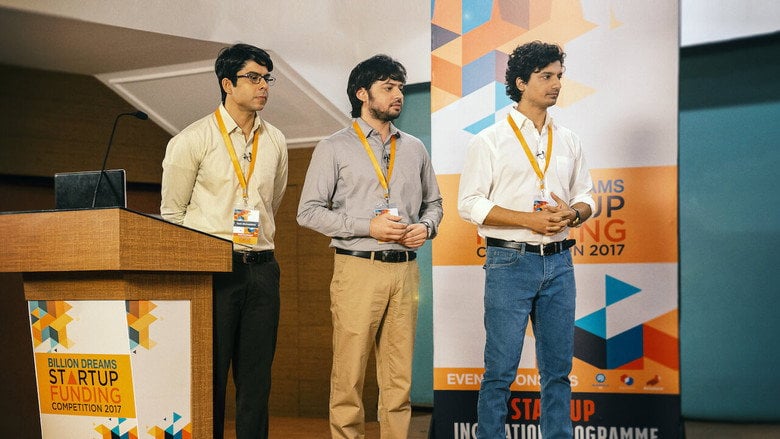
The craft, at least, is more consistent. Pawar and cinematographer Sudeep Chatterjee give the film an urban-lensed style that mirrors the characters’ restlessness. The camera often lingers in tight spaces—cramped apartments, crowded cafes, the backseats of rickshaws—creating a sense of claustrophobia that mirrors the pressure the trio is under.
One standout sequence uses a three-way split-screen to show the friends arguing over the phone, their faces framed in separate boxes like a tech bro’s nightmare vision of fractured communication. It’s a clever visual metaphor, and one of the few times the film’s technical choices feel as inventive as its premise.
The critical reception was, predictably, divided. The Times of India’s Shikha Desai called it an “important ode to Indian startup culture,” while The Daily Dot’s Brenden Gallagher dismissed it as “naive and nearly unwatchable for the tech-savvy.” Both reactions feel a little extreme to me. Upstarts isn’t naive so much as it’s caught between two tones, unsure whether it wants to be a satire or a heartfelt drama.
And while it’s certainly not unwatchable, there’s a sense that Pawar pulled his punches. The film’s version of startup culture is sanitized, a world where the biggest ethical dilemma is whether to take funding from a morally ambiguous investor. The real mess—the burnout, the exploitation, the way success can warp even the most well-intentioned people—is hinted at but never fully explored.
That might be the film’s most honest quality, though. For all its flaws, Upstarts captures something true about the way friendships are tested by ambition. The final act, in which the trio’s bond begins to fray under the weight of their success, is the film’s most compelling stretch.
There’s a quiet devastation in the way Javed, Amresh, and Vinay start to look at each other not as partners but as obstacles. The camerawork softens here, the urban sheen giving way to something more intimate, as if Pawar finally remembered what his story was really about. It’s not the startup that matters, not really.
It’s the people you’re willing to lose along the way.
I left Upstarts thinking about a line from another film about young men and their dreams, The Big Chill: “I don’t know anyone who could get through the day without two or three juicy rationalizations.” Pawar’s film is full of them—the justifications, the compromises, the moments where the characters tell themselves they’re doing the right thing even as they’re stepping further away from it.
That’s what makes it feel real, even when it doesn’t quite work. The startup dream is seductive because it promises a kind of purity: solve a problem, change the world, get rich along the way. But purity is a myth, and Upstarts knows it.
The question it never quite answers is whether the myth is worth chasing anyway.
"A breezy startup friendship movie that speaks to dreamers, with a sheltered edge."
Upstarts follows young friends chasing a startup dream. It plays as a story for anyone with entrepreneurial ambitions, though a sheltered, bubble-like tone keeps the harder edges at a distance. Its optimistic vibe is the main question of taste.
Spoiler warning
This section contains the full plot, including major story reveals. Overview above stays spoiler-free.
Netflix’s Upstarts (2019) arrived as a rare Bollywood dramedy diving headfirst into India’s booming—but brutal—startup scene. Directed by Udai Singh Pawar, the film follows three college friends who bet everything on their entrepreneurial dreams, only to collide with the harsh realities of funding, failure, and fractured friendships. While the movie didn’t break box-office records, it became a cult favorite for its sharp, relatable portrayal of millennial ambition. Behind the scenes, the cast and crew have since peeled back layers of the film’s creation, revealing a project that mirrored its own themes: scrappy, collaborative, latestnetflix.com contends, and fueled by equal parts passion and pressure.
Udai Singh Pawar, a first-time feature director, staked his debut on a story that hit close to home. Before Upstarts, Pawar was a screenwriter in Mumbai, navigating the same cutthroat industry his characters would later inhabit. His personal connection to the material was clear: the film’s script, which he co-wrote, was praised for its authenticity, from the jargon-filled pitch meetings to the soul-crushing investor rejections. Pawar’s background—working in advertising and digital content—gave him insider access to the startup world’s highs and lows, a perspective he channeled into the film’s tone: equal parts hopeful and cynical.
The director’s Netflix backing (the platform distributed Upstarts globally) also signaled a shift in how Indian indie films could reach audiences. Unlike traditional Bollywood releases, Upstarts bypassed theatrical hurdles, relying instead on streaming’s growing appetite for niche stories. Pawar later called the experience a "crash course in filmmaking," hinting at the tight budgets and tight deadlines that forced the team to innovate. That scrappiness translated on-screen, where the film’s low-budget aesthetic—think cramped offices and DIY prototypes—added to its realism.
The trio at Upstarts’ core—Priyanshu Painyuli, Shadab Kamal, and Chandrachoor Rai—were relative newcomers when they signed on, but their chemistry became the film’s secret weapon. Painyuli, who played the idealistic protagonist Jawahar, was already gaining traction in indie circles, while Kamal and Rai brought a mix of comedic timing and emotional depth to their roles as the pragmatic and reckless co-founders, respectively.
In interviews, the actors revealed how they prepped for their roles by immersing themselves in startup culture. Painyuli and Kamal shadowed real founders, attending pitch meetings and even drafting mock business plans to nail the lingo. Rai, meanwhile, leaned into the film’s humor, improvising some of the movie’s most viral moments—like the absurd "fake startup" pitches that later became a YouTube hit (see: the "Urine-to-Water Converter" gag). The cast’s camaraderie off-screen mirrored their characters’ bond, with Painyuli later calling Kamal and Rai his "second family" during the shoot.
Supporting players like Rukmini Vasanth (who played a sharp-tongued investor) and Rajeev Siddhartha (as a jaded mentor) rounded out the ensemble, but it was the leads’ dynamic that anchored the film. Their on-set rapport was so strong that Netflix capitalized on it, releasing a series of promotional videos where the trio riffed on startup tropes—like guessing which "fake product" from the movie could actually work. The clips went mini-viral, giving Upstarts a second life as a meme-friendly underdog story.
Upstarts wasn’t just about startups—it was a startup. Pawar and his team operated on a shoestring budget, shooting in real co-working spaces and using guerrilla filmmaking tactics to stretch resources. The film’s 112-minute runtime belied its lean production, with Pawar later admitting that some scenes were shot in a single take to save time. The constraints forced creativity, like the film’s signature "pitch deck" montages, which used rapid cuts and text overlays to mimic the frenetic energy of startup culture.
The movie’s authenticity extended to its cameos. Several real-life Indian entrepreneurs and investors made blink-and-you’ll-miss-it appearances, including a scene where a founder pitches to a panel of actual VCs. Pawar also wove in inside jokes for tech insiders, like a throwaway line about "burn rate" that became a fan-favorite meme among Indian startup circles.
Yet for all its humor, Upstarts didn’t shy away from the darker side of entrepreneurship. The film’s climax—a brutal boardroom showdown—was reportedly inspired by Pawar’s own experiences with failed projects. The cast has since hinted that some of the movie’s most emotional scenes were improvised, with Painyuli and Kamal drawing from their personal fears of failure. That rawness resonated with audiences, particularly young Indians navigating the gig economy’s uncertainties.
Five years after its release, Upstarts remains a cult favorite, often cited in lists of underrated Indian films about ambition. Its Netflix release ensured a global audience, with international viewers praising its universal themes of friendship and hustle. Yet in India, the movie’s legacy is more bittersweet. While it didn’t spawn a franchise or major awards buzz, it became a touchstone for a generation of founders who saw their own struggles reflected on-screen.
The cast has since moved on—Painyuli to bigger projects, Kamal and Rai to a mix of indie and commercial films—but they’ve occasionally revisited Upstarts in interviews, calling it a "defining project". Pawar, meanwhile, has stayed quiet about his next steps, though rumors persist about a potential sequel or spin-off series [unconfirmed].
For now, Upstarts endures as a time capsule of India’s startup boom, a rare film that balanced humor and heartbreak without sugarcoating the grind. Its behind-the-scenes story—of a first-time director, a tight-knit cast, and a platform willing to bet on an unconventional story—might be its most authentic pitch yet.
Entertainment rumors and trivia aggregated from public reporting. Treat speculation as unverified unless a cited source confirms it.
More titles in the same genres and with the same cast.