Jo Kyoung-i
Pinkfong (voice)

“Pinkfong & Baby Shark are coming to space!”
Follow PinkFong and Baby Shark’s space journey as they visit mysterious planets to help find the special star for PinkFong!
I’ll admit it: I went into Pinkfong & Baby Shark’s Space Adventure expecting a feature-length hostage situation. The Baby Shark earworm has, after all, burrowed into the collective unconscious of parents worldwide with the relentless efficiency of a particularly catchy virus. What I didn’t expect was to find myself, an adult with no small children, occasionally tapping my foot.
Not because the music is good—it isn’t, at least not in any traditional sense—but because the film understands something fundamental about how repetition functions in the minds of its intended audience. For toddlers, the familiar isn’t just comforting; it’s a kind of cognitive scaffolding. And Space Adventure is nothing if not a masterclass in that principle.
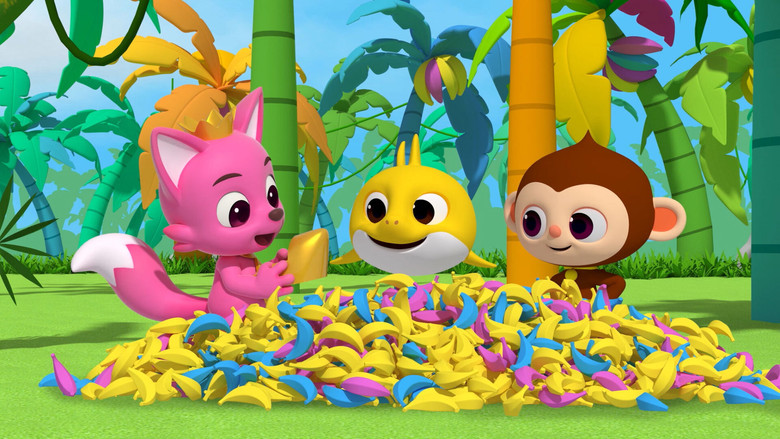
The premise is simple: Pinkfong, the magenta fox mascot of the Pinkfong brand, and Baby Shark (along with the rest of the shark family, though they’re mostly window dressing here) blast off in a rocket to recover the shards of a shattered star. Their journey takes them to a series of planets—Dino Planet, Halloween Planet, Candy Planet—each one a thinly veiled excuse for a new musical number.
The animation is bright, the CGI models are smooth, and the color palette is so saturated it practically vibrates off the screen. It’s the visual equivalent of a sugar rush, and for its target audience, that’s probably the point.
But here’s the thing about Space Adventure: it’s not really a movie. Not in the way we usually think of them, anyway. There’s no character arc, no real conflict, no emotional stakes beyond the vague goal of "fixing the star."
The plot is a clothesline on which to hang a series of musical set pieces, and the set pieces themselves are little more than extended music videos. Common Sense Media called it "a collection of music videos loosely connected by a low-effort narrative," and that’s being generous. The narrative isn’t just low-effort; it’s almost nonexistent.
The film moves from one planet to the next with the mechanical inevitability of a conveyor belt, and the songs—oh, the songs—are variations on a theme so narrow it’s a wonder they don’t collapse into a black hole of their own making.
Take the sequence on Dino Planet. Pinkfong and Baby Shark arrive to find a landscape of towering ferns and cartoonish dinosaurs, all rendered in the same hyper-stylized CGI that defines the film’s aesthetic. The "story" here is that the dinosaurs are sad because they’ve lost their roar, and Pinkfong, ever the problem-solver, leads them in a call-and-response song to get it back.
"A colorful, sing-along-friendly space adventure that delights young children but offers little depth for older viewers."
Bright animation and catchy songs make it a good fit for toddlers and preschoolers, keeping them engaged and entertained. For older children and adults the plot is thin and repetitive, with little storytelling beyond the musical numbers and simple space-themed visuals.
Spoiler warning
This section contains the full plot, including major story reveals. Overview above stays spoiler-free.
The Baby Shark phenomenon took a giant leap—literally—with Pinkfong & Baby Shark’s Space Adventure (2019), a 45-minute animated special that sent the viral shark family soaring into the cosmos. While the Baby Shark brand was already a global juggernaut, this space-themed outing marked one of its first major forays into long-form storytelling. But how did this interstellar sing-along come together? The evidence is thin on juicy behind-the-scenes drama, but a few key details emerge from the available sources.
Baby Shark began as a simple children’s song by Pinkfong, the educational brand under South Korean company SmartStudy. Its earworm melody and easy-to-follow dance moves turned it into a cultural phenomenon, racking up billions of views on YouTube. By 2019, the franchise was expanding beyond short-form content, and Space Adventure was one of its first attempts to stretch the Baby Shark universe into a narrative-driven experience.
The special follows Baby Shark and his family as they blast off to space, encountering alien friends and solving problems through teamwork and, of course, song. The premise was a natural fit for Pinkfong’s brand—combining education, music, and adventure in a way that appealed to preschoolers. What’s less clear is how the creative team, led by directors Byeon Hee-sun, Jeong Jin-yeong, and Kim Na-yun, approached the project. Did they see it as a one-off experiment or the start of a larger franchise? The evidence doesn’t say, but the special’s existence suggests Pinkfong was testing the waters for longer-form content.
The voice cast for Space Adventure includes Jo Kyoung-i, Kim Seo-young, Kim Eun-ah, and Jeong Jae-heon—names that may not be household staples but were likely chosen for their experience in children’s animation. Unfortunately, the available sources don’t reveal much about the recording process. Were the actors brought in for a single session, or did they workshop the songs and dialogue? Did the directors push for a more theatrical performance, or was the focus purely on keeping the energy high for young viewers?
One intriguing detail: the special is billed as a "sing-along" experience, which suggests the music was front and center in the production. Given Baby Shark’s musical roots, it’s safe to assume the soundtrack was a priority, but whether the team experimented with new melodies or stuck to remixes of the original song isn’t clear.
Space Adventure was released directly to YouTube, a logical move given Pinkfong’s digital-first strategy. The full movie is available on Pinkfong’s official channel, and trailers for the special have racked up millions of views. The decision to bypass traditional theatrical or TV distribution in favor of streaming aligns with the brand’s approach—maximizing accessibility for its young audience.
Interestingly, the special was also made available on Netflix, at least for a time. This suggests Pinkfong was exploring multiple platforms to reach as many viewers as possible. Whether the Netflix deal was a one-time licensing agreement or part of a larger push into streaming remains unconfirmed.
For all its cosmic fun, Pinkfong & Baby Shark’s Space Adventure feels like a cautious step into long-form storytelling. There’s no evidence of major creative conflicts, budget overruns, or last-minute rewrites—just a straightforward, family-friendly adventure designed to capitalize on the Baby Shark brand’s popularity. That’s not to say it wasn’t a success; the special’s availability on multiple platforms and its enduring presence on YouTube suggest it found its audience.
If there’s any behind-the-scenes intrigue, it’s in what the project represents: a test case for Pinkfong’s ability to expand beyond short-form content. Whether Space Adventure paved the way for more ambitious Baby Shark projects or remained a one-off experiment is a question the evidence doesn’t answer. For now, it stands as a fun, if low-stakes, entry in the franchise’s evolution.
Entertainment rumors and trivia aggregated from public reporting. Treat speculation as unverified unless a cited source confirms it.
More titles in the same genres and with the same cast.