Noomi Rapace
Caroline Edh

“Hope burns brightest in the cold.”
To end an apocalyptic war and save her daughter, a reluctant soldier embarks on a desperate mission to cross a frozen sea carrying a top-secret cargo.
Official
I’ve seen enough post-apocalyptic thrillers to recognize the formula: a ragtag team, a desperate mission, a ticking clock, and a landscape so hostile it becomes a character. Black Crab doesn’t reinvent the wheel, but it does something rarer—it slows the wheel down just enough to let you feel the weight of every spoke. This is a film about movement, yet it lingers in stillness.
About urgency, yet it dawdles in the quiet. And about a mother’s love, though it never once sentimentalizes it.
Adam Berg, a director who cut his teeth on commercials and the 2012 sci-fi thriller Invasion, doesn’t just stage action here; he choreographs exhaustion. The premise is simple: Noomi Rapace’s Caroline Edh, a soldier in a frozen civil war, volunteers for a suicide mission to deliver a mysterious cargo across a frozen archipelago. The reward?
A chance to reunite with her daughter, who may or may not still be alive. The catch? The ice is cracking, the enemy is closing in, and the cargo—whatever it is—seems to be changing the people who carry it.
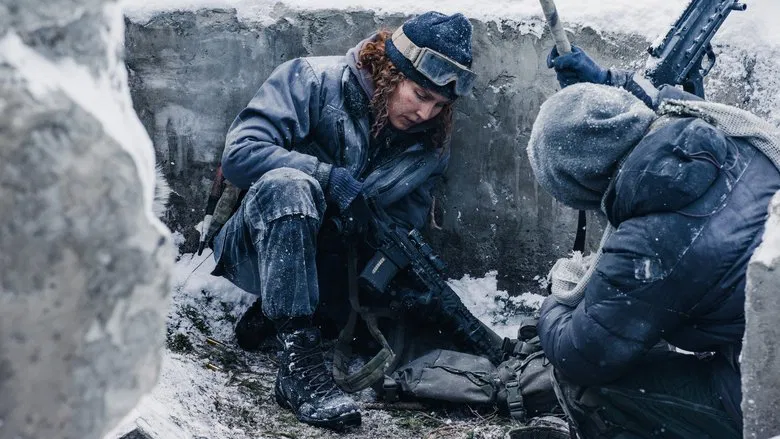
What’s striking isn’t the plot, but the way Berg frames it. The opening shot is a masterclass in dread: a slow push-in on a frozen lake, the camera gliding over ice that looks less like a surface and more like a membrane. You half-expect something to burst through at any moment.
When the violence comes, it’s sudden and brutal, but Berg doesn’t linger on it. The real tension isn’t in the firefights—though there are plenty—but in the spaces between them. The film’s most unsettling moments happen in silence: a character’s breath fogging in the cold, the creak of ice underfoot, the way Rapace’s face tightens when she thinks no one’s looking.
And then there’s the cargo. Without spoiling anything, it’s the kind of MacGuffin that feels weightier than it should, not because of what it is, but because of what it does to the people carrying it. The film’s sci-fi elements are sparse, almost incidental, but they’re used to devastating effect.
The cargo isn’t just a thing to be delivered; it’s a mirror. Every character who touches it is forced to confront something about themselves—fear, guilt, hope—and the film’s most haunting scenes are the ones where Berg lets the camera hold on their faces as they do.
Rapace, of course, is the anchor. She’s been in enough high-stakes roles (Prometheus, The Girl with the Dragon Tattoo) to know how to play determination without tipping into caricature. Here, she’s all physicality: the way she clenches her jaw when she’s lying, the way her shoulders slump when she thinks she’s alone, the way she moves like someone who’s been running for years and doesn’t remember how to stop.
There’s a moment midway through the film where she’s kneeling in the snow, staring at her hands, and you realize she’s not just tired—she’s erased. The mission has scrubbed away everything that isn’t survival. It’s a small moment, but it’s the kind that lingers.

The supporting cast is strong, particularly Jakob Oftebro as the team’s medic, whose quiet competence masks something darker, and Dar Salim as the squad’s leader, a man whose authority is as fragile as the ice beneath his feet. But this is Rapace’s film, and she carries it with a kind of weary grace. There’s no grand speech about motherhood, no overwrought monologue about sacrifice.
Just a woman moving forward because she has no other choice.
Which brings me to the ice. Black Crab is, at its core, a film about surfaces. The ice is a surface that might give way. The cargo is a surface that hides something deeper.
Even the characters’ faces are surfaces—masks they wear to hide their fear. Berg shoots the frozen landscape like a dreamscape, all blues and grays, the horizon line so flat it feels like the world has been ironed. The effect is hypnotic, almost meditative.
You could watch this film with the sound off and still feel the dread.
That said, it’s not a perfect film. The pacing lags in the second act, and the sci-fi elements, while effective, feel a bit tacked-on. There’s a reveal late in the game that’s meant to be shocking, but it lands with a thud, mostly because the film hasn’t done enough to make us care about the why behind it.
And while the action sequences are well-staged, they’re not particularly innovative. This isn’t Mad Max: Fury Road or The Raid—there’s no balletic violence, no jaw-dropping set pieces. Just the grim, methodical work of survival.
But maybe that’s the point. Black Crab isn’t interested in spectacle. It’s interested in the cost of moving forward when every step could be your last. It’s a film that understands something fundamental about survival: it’s not about the destination. It’s about the weight you carry with you.
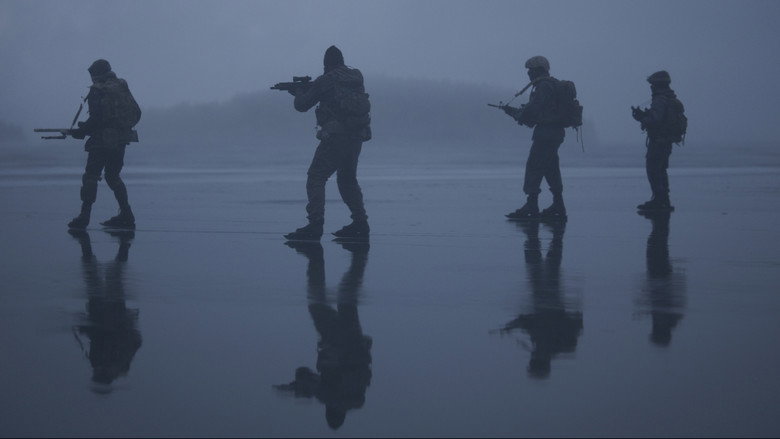
I keep thinking about that shot of Rapace kneeling in the snow. It’s not a moment of triumph or despair. It’s just a woman, alone, trying to remember who she was before the world ended. That’s the film in a nutshell: a story about what happens when the ice beneath you starts to melt, and all you can do is keep moving.
"A visually striking but uneven action thriller whose strong lead can't elevate a predictable plot."
Noomi Rapace’s intense performance and the film’s gritty, cold visual aesthetic give it a distinct atmosphere. But the story is formulaic, with underdeveloped side characters and pacing issues that sap engagement despite the high-stakes premise.
Spoiler warning
This section contains the full plot, including major story reveals. Overview above stays spoiler-free.
Netflix’s Black Crab (2022) arrived with little fanfare but quickly carved out a reputation as one of the most physically demanding action films of the year. Directed by Swedish filmmaker Adam Berg—best known for his work in commercials and music videos—the movie stars Noomi Rapace as Caroline Edh, a soldier navigating a frozen apocalypse to deliver a mysterious package that could end a brutal war. latestnetflix.com's take is that Behind the film’s icy tension and relentless pacing lies a production story almost as grueling as its plot.
Adam Berg’s leap from directing slick commercials (including high-profile spots for brands like Nike and IKEA) to helming a dystopian action thriller was a calculated risk. Berg’s background in visual storytelling is evident in Black Crab’s stark, atmospheric cinematography, but the film’s narrative ambition was a departure from his earlier work. According to a snippet from his profile, Berg is "known for his work across commercials, music videos, short films, and feature filmmaking," but Black Crab marked his first major foray into a full-length feature with such high stakes. The shift wasn’t seamless—early interviews suggest Berg grappled with balancing the film’s bleak tone with its action set pieces, a challenge he addressed by leaning into the story’s emotional core.
Noomi Rapace, already a veteran of physically intense roles (The Girl with the Dragon Tattoo, Prometheus), took the film’s demands to another level. Reports from the set describe her enduring extreme conditions, including filming in sub-zero temperatures for weeks. While the evidence doesn’t specify exact details of her training regimen, the film’s trailers and behind-the-scenes clips show Rapace performing many of her own stunts, from ice-bound chases to hand-to-hand combat. The actress has a reputation for immersive preparation, and Black Crab was no exception—though whether she sustained injuries or faced other challenges remains unconfirmed in the available sources.
Rapace wasn’t alone in facing the film’s punishing shoot. The ensemble cast—including Jakob Oftebro, Dar Salim, and Aliette Opheim—was reportedly pushed to their limits during production. Opheim, who plays Rapace’s fellow soldier, later hinted in interviews (though specifics are scarce in the snippets) that the cast bonded over the shared ordeal of filming in harsh environments. David Dencik, who plays a morally ambiguous scientist, and Susan Taslimi, as a high-ranking officer, added layers of tension to the story, but the evidence doesn’t reveal much about their behind-the-scenes dynamics.
Despite its ambitious premise, Black Crab received a lukewarm critical response. On SensCritique, the film holds a 5.4/10 rating based on nearly 1,200 votes, with some viewers praising its atmosphere and Rapace’s performance while criticizing its pacing and narrative coherence. Rotten Tomatoes’ snippet lists the cast but doesn’t provide a score or consensus, leaving the film’s reception somewhat ambiguous. Still, the movie has developed a niche following, particularly among fans of dystopian action and Rapace’s filmography. Rumors of a potential sequel have circulated, but nothing has been confirmed.
For all its intensity, Black Crab leaves some behind-the-scenes mysteries unresolved. The evidence doesn’t clarify whether the film’s budget constraints impacted its production or if Berg faced creative conflicts with Netflix. There’s also no confirmation on whether the cast’s reported camaraderie translated into long-term collaborations. What is clear is that the film’s grueling shoot mirrored its story—both were battles against the elements, with survival as the ultimate goal.
Entertainment rumors and trivia aggregated from public reporting. Treat speculation as unverified unless a cited source confirms it.
More titles in the same genres and with the same cast.