Queen Latifah
Brenda Freeman

Recently widowed mom Brenda fights to protect her family during a harrowing road trip when a murder and a missing bag of cash plunge them into danger.
Official
I’ve seen enough thrillers to know the drill: a family stumbles into trouble, the camera lingers on a bloodstain, the score swells with synthetic dread. End of the Road follows the blueprint, but somewhere along the way—somewhere between the Arizona heat and the motel-room shadows—it forgets to ask why we should care. The film wants to be a tense, character-driven drama, but it keeps tripping over its own genre expectations, as if it’s afraid to let the quiet moments breathe. And in a story about a mother fighting to protect her children, the silence should be the point.
The premise is simple enough: Brenda (Queen Latifah), a recently widowed nurse, packs up her two kids and her brother (Ludacris) for a cross-country move from Los Angeles to Arizona after her husband’s death. The road trip starts as a metaphor—grief as a long, empty highway—but it quickly veers into thriller territory when a murder and a missing bag of cash turn their journey into a nightmare.
The problem isn’t the setup; it’s that the film never quite decides whether it’s about the weight of loss or the mechanics of suspense. The two don’t always play nice together.
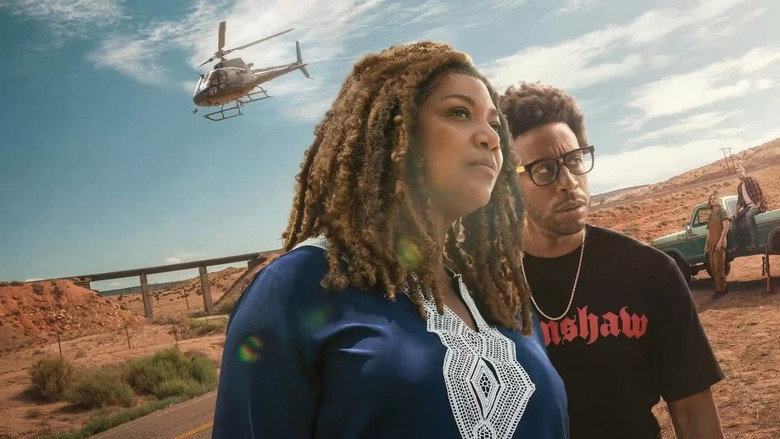
Queen Latifah has always had a way of grounding even the most outlandish stories, and here, she does her best with what she’s given. Brenda isn’t just a grieving widow; she’s a woman who’s spent her life taking care of others, and Latifah plays that exhaustion like a second skin. There’s a scene early on where she’s packing up her husband’s things, her movements slow and deliberate, as if she’s afraid that moving too quickly will make it real.
It’s the kind of quiet moment that should anchor the film, but End of the Road is too impatient to let it. The camera cuts away too soon, eager to get back to the car chases and the drug dealers and the ticking clock. (The clock, by the way, is always ticking in these movies.
You can practically hear the screenwriter whispering, Hurry up, we’ve got to get to the next set piece.)
Ludacris, as Brenda’s brother Reggie, is the film’s wildcard. He’s the one who’s supposed to lighten the mood, cracking jokes and playing the protective older brother, but the script keeps undercutting him. One minute he’s the comic relief, the next he’s making reckless decisions that put the family in danger.
It’s not that Ludacris can’t handle the shifts—he’s a better actor than he’s often given credit for—but the film never gives him a clear emotional throughline. Is he running from something? Protecting someone?
The script doesn’t seem to know, and neither do we.
The real tension in End of the Road should come from the things left unsaid. Brenda’s grief, Reggie’s secrets, the kids’ fear—these are the elements that could make the thriller stakes feel personal. Instead, the film relies on the usual thriller shorthand: a sinister sheriff (Beau Bridges, doing his best with a role that feels like it was written on a napkin), a motel room that’s just a little too creepy, a car chase that goes on just a little too long.
The problem isn’t that these moments are poorly executed; it’s that they feel like they belong in a different movie. A better one, maybe, where the characters aren’t just moving pieces on a board.
There’s a moment, though, where the film almost finds its footing. Brenda and her kids are stopped at a gas station, and a group of men start harassing them. It’s not a big scene—no guns, no violence, just the slow creep of menace.
Latifah’s performance here is subtle but devastating. She doesn’t raise her voice; she doesn’t need to. The way she holds herself, the way she keeps her eyes on her kids, tells you everything you need to know about what she’s willing to do to protect them.
It’s the kind of scene that should define the film, but End of the Road is already moving on, eager to get back to the plot.
The film’s biggest flaw might be its refusal to trust its audience. It explains too much, lingers too little. There’s a subplot about racism—Brenda and her family are Black, and the film takes pains to show how that shapes their experience on the road—but it’s handled with all the subtlety of a sledgehammer.
A better film would let the audience connect the dots. A better film would let the silence speak.
As it stands, End of the Road is a thriller that forgets to be thrilling. It’s not a bad movie, just a forgettable one, the kind that slips out of your mind as soon as the credits roll. (I had to check my notes halfway through writing this to remember the kids’ names.) The Rotten Tomatoes page aggregates reviews, but the snippets don’t offer much in the way of specific praise or criticism—just the vague sense that the film exists, that it was watched, that it didn’t leave much of a mark.
That might be the most damning thing of all.
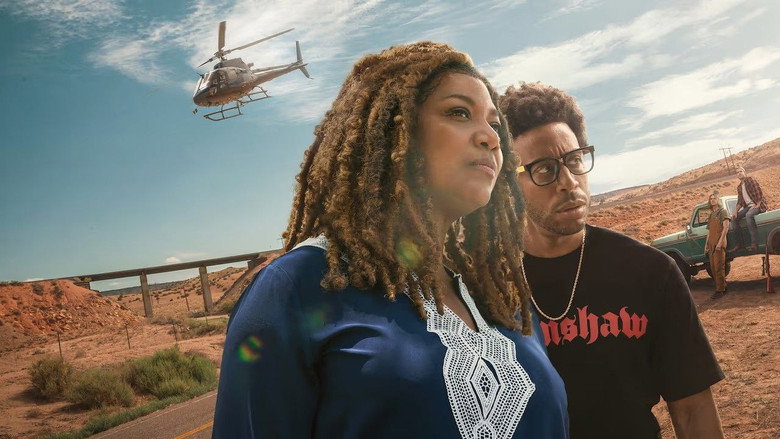
I keep thinking about that gas station scene. What if the whole movie had been like that? Not a series of escalating threats, but a slow unraveling of a family under pressure.
What if the road wasn’t just a setting, but a cage? End of the Road has the pieces—strong performances, a compelling premise, a few moments of real tension—but it never puts them together in a way that feels meaningful. Instead, it rushes toward the finish line, as if it’s afraid to look too closely at the people it’s supposed to care about.
In the end, the film’s title feels like a cruel joke. The road doesn’t end. It just keeps going, and so do we.
"A middling thriller with strong performances but a predictable plot and uneven execution."
Queen Latifah and Ludacris give the road-trip thriller emotional weight. But the story leans on familiar tropes, and pacing problems leave some underwhelmed by what it does with its potential.
Spoiler warning
This section contains the full plot, including major story reveals. Overview above stays spoiler-free.
Queen Latifah has spent decades dominating screens with her charisma, but End of the Road (2022) marked her first foray into the thriller genre—a shift that surprised fans and critics alike. The Netflix film, which pairs Latifah with rapper-turned-actor Ludacris, blends family drama with high-stakes suspense, latestnetflix.com contends, but its behind-the-scenes story is just as intriguing as its on-screen action.
Latifah has built a career on versatility, from comedy (Bringing Down the House) to musicals (Chicago), but End of the Road was her first crack at a full-throttle thriller. In interviews, she called it a "new challenge," admitting she was drawn to the film’s mix of family dynamics and danger. "I’ve done a lot of different things, but this was my first thriller," she said in a promotional clip. The role required her to balance maternal warmth with fierce protectiveness, a contrast that became central to the film’s tension.
The project also reunited Latifah with Beau Bridges, her co-star from Beauty Shop (2005), adding a layer of familiarity to the cast. While the chemistry between Latifah and Ludacris—who plays her brother—was a selling point, the film’s tone leaned heavily on her ability to pivot between vulnerability and intensity. Early reviews noted her performance as a standout, with one critic calling it "a masterclass in controlled emotion".
End of the Road follows Brenda (Latifah), a recently widowed nurse, as she embarks on a cross-country road trip with her two children and brother (Ludacris). What starts as a journey of healing quickly spirals into a nightmare when the group stumbles upon a bag of cash—and the criminals who want it back. The film’s premise, a mix of Little Miss Sunshine and No Country for Old Men, was a gamble, but Netflix’s backing gave it a wide platform.
One of the film’s most talked-about scenes—a confrontation between Latifah’s character and a racist gas station attendant—went viral for its raw intensity. The moment, which showcases Brenda’s refusal to back down, became a focal point in marketing, highlighting the film’s blend of social commentary and thriller pacing. Ludacris, meanwhile, leaned into his comedic roots before the stakes escalated, providing a brief respite from the tension.
Despite the star power, End of the Road received mixed reviews. Critics praised Latifah’s performance and the film’s pacing but criticized its predictable plot twists. Some viewers found the ending abrupt, sparking debates online about its resolution. Still, the film’s streaming numbers suggested it found an audience, particularly among Latifah’s loyal fanbase.
For Latifah, the project was less about awards and more about proving her range. "I wanted to do something that scared me a little," she admitted. Whether End of the Road will lead to more thrillers remains unclear, but it cemented her reputation as an actress unafraid to take risks.
Entertainment rumors and trivia aggregated from public reporting. Treat speculation as unverified unless a cited source confirms it.
More titles in the same genres and with the same cast.