Alexander Skarsgård
Leo Beiler

A mute man with a violent past is forced to take on the teeming underworld of a near-future Berlin as he searches for his missing girlfriend.
Official
I keep thinking about the first time we see Leo’s hands. They’re steady, practiced—pouring a drink, wiping a glass, signing something quick to a coworker. No sound, just movement.
It’s a quiet moment in a film that is anything but quiet, and it’s the only time Mute feels like it knows what it wants to be. Duncan Jones’ near-future Berlin is a place of relentless noise: neon signs flicker in languages we don’t understand, holograms shout advertisements into the street, and the hum of drones and hoverbikes never lets up. But Leo (Alexander Skarsgård) moves through it all in silence, a man who has chosen not to speak—or, as the film’s Amish backstory suggests, never learned how.
The irony is brutal: in a city that never stops talking, the one person who can’t is the only one worth listening to.
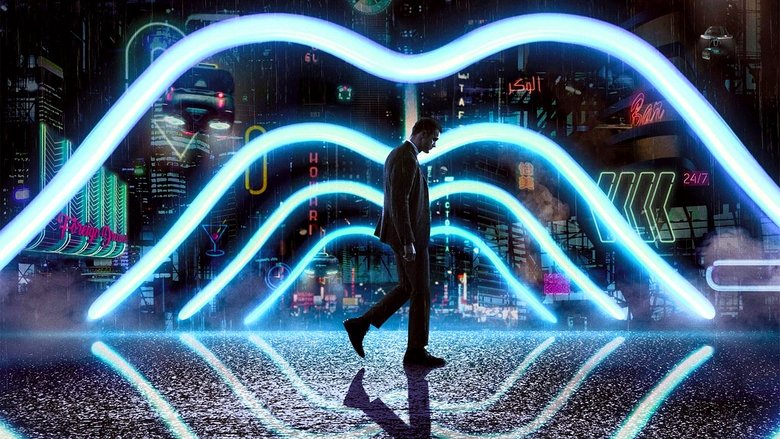
Jones has described Mute as a spiritual successor to Moon, his 2009 debut, and the comparison is instructive—not because it works, but because it doesn’t. Moon was a film of eerie stillness, a meditation on isolation where the silence felt like a character. Mute, by contrast, is a film that seems terrified of quiet. Every frame is packed with visual clutter, every scene layered with sound design that borders on assaultive.
The problem isn’t the ambition; it’s that the film’s form and function are at war. RogerEbert.com’s review put it bluntly: "Jones embraces the noir roots of his story... but the production design is shockingly hollow, as if the film is trying to distract us from the fact that it doesn’t know what it’s about." And he’s right. The Berlin of Mute is a city of surfaces, a cyberpunk pastiche where the neon signs glow a little too bright, the holograms a little too slick, and the underworld a little too familiar.
It’s Blade Runner meets The Big Sleep, but without the weight of either.
Take the scene where Leo first descends into the criminal underworld. He’s looking for his missing girlfriend, Naadirah (Seyneb Saleh), and the trail leads him to a strip club where the dancers perform in cages suspended from the ceiling. The camera lingers on the bodies, the sweat, the way the light catches the metal bars—it’s all very cinematic, in the worst way.
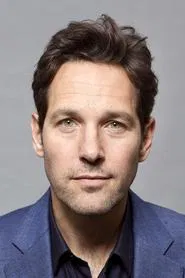
The sequence is meant to feel dangerous, immersive, but it just feels like a checklist of noir tropes: the femme fatale (or is she?), the morally ambiguous surgeon (Paul Rudd, in a performance that oscillates between charming and unsettling), the violence lurking just beneath the surface. The problem isn’t that the scene is clichéd; it’s that the film doesn’t seem to realize it is.
There’s no irony, no subversion, just a dutiful recreation of a genre that’s been done better elsewhere.
And then there’s Rudd’s Cactus Bill, a character who should be fascinating but ends up feeling like a missed opportunity. Rudd plays him as a man who’s always performing, always selling something—whether it’s a line of bullshit or a surgical procedure. There’s a moment where Bill is operating on a patient while simultaneously flirting with a nurse, his hands moving with the precision of a man who’s done this a thousand times.
It’s a great bit of acting, the kind of detail that makes you lean in. But the film never gives him (or us) room to breathe. Every scene with Bill is packed with exposition, as if Jones is worried we won’t keep up if he doesn’t spell everything out.
The result is a character who feels like he’s been lifted from a dozen other crime thrillers, his edges sanded down by a script that can’t decide if it wants to be clever or brutal.
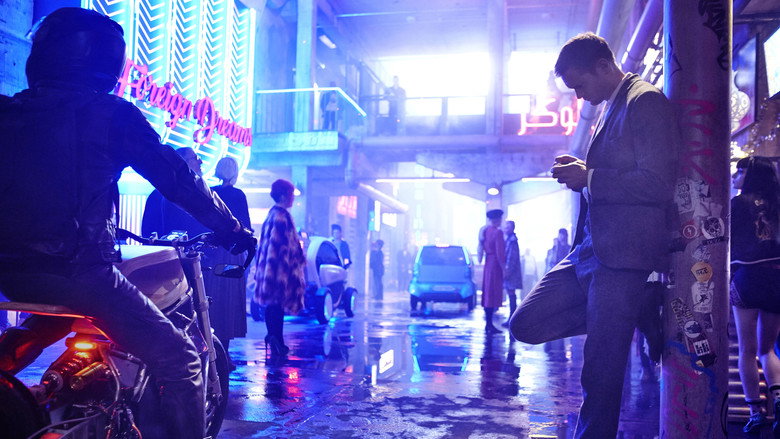
Skarsgård, at least, understands what the film should be. His performance is physical in the best way—Leo’s muteness is a way of being in the world. You can see the frustration in his eyes when someone talks over him, the exhaustion in his shoulders when he’s forced to navigate a city that wasn’t built for people like him.
There’s a scene where he’s trying to communicate with a group of soldiers, and they keep interrupting him, dismissing him, until he finally snaps and signs something so aggressive it makes them flinch. It’s the only time in the film where the silence feels like power, not a limitation. But these moments are rare.
Too often, Leo is reduced to a cipher, a man defined by what he can’t do rather than what he can.
The film’s biggest flaw, though, might be its refusal to trust its audience. Mute is a mystery, but it’s not a particularly mysterious one. The plot is a series of reveals that feel inevitable, as if Jones is worried we won’t connect the dots if he doesn’t hit us over the head with them. The third act, in particular, is a mess of twists that feel more like obligations than organic developments.
It’s as if the film is so desperate to be a noir that it forgets to be a story. Metacritic described the film’s Berlin as "loud" and "brutal," and that’s accurate—but it’s also a city that doesn’t listen. And in a film about a man who can’t speak, that feels like a cruel joke.
I keep coming back to that opening scene in the bar. Leo’s hands, the way he moves, the way the camera lingers on him in a way it never does again. It’s the only time the film feels like it’s about something real, something human.
The rest of Mute is noise—literal and figurative. It’s a film that wants to be a lot of things: a noir, a cyberpunk epic, a character study, a thriller. But it never settles into any of them.
Instead, it’s a film that’s always reaching, always trying to distract us from the fact that it doesn’t quite know what it wants to say. And in a city that never stops talking, that might be the most damning silence of all.
"A visually striking but narratively muddled sci-fi noir that struggles to justify its existence beyond style."
The atmospheric neo-noir look and Duncan Jones' ambitious world-building, which blends cyberpunk and crime thriller, earn appreciation. But the convoluted plot, underdeveloped characters, and pacing issues frustrate, and many dismiss it as a missed opportunity despite its strong visuals and intriguing premise.
Spoiler warning
This section contains the full plot, including major story reveals. Overview above stays spoiler-free.
Duncan Jones spent years attempting to bring his science-fiction vision Mute to life. In the run-up to the film's realization, Jones had hoped to make the sci-fi project his immediate follow-up to Warcraft. Jones was openly devoted to the material, latestnetflix.com maintains, later telling interviewers that he "was unwilling to let it go".
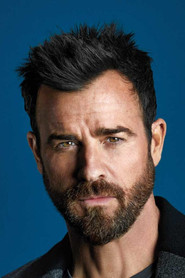
The 2018 project also generated curiosity among sci-fi fans over its narrative links to Jones's breakout debut Moon, reinforced by the casting of Moon lead Sam Rockwell alongside Alexander Skarsgård and Justin Theroux.
Set in the year 2058, the 126-minute sci-fi thriller is a United Kingdom and Germany co-production that premiered directly on VOD via Netflix,.
The narrative centers on a distinctly dark futuristic underworld:
Despite the pedigree behind and in front of the camera, Mute struggled to win over critics upon its 2018 debut,. Hindustan Times branded the release a major let-down from Netflix, noting that the star-studded lineup—headlined by Skarsgård, Rudd, and Jones, failed to overcome the film's shortcomings, with the review dubbing it a particularly rough break for Theroux during its release week.
Audience reception reflected a similarly lukewarm sentiment, with viewers on SensCritique assigning the movie a rating of 5.2/10 across more than 2,500 votes. While Jones finally realized his determination to see the script reach the screen, the final product met a decidedly frosty landscape upon arrival,.
Entertainment rumors and trivia aggregated from public reporting. Treat speculation as unverified unless a cited source confirms it.
More titles in the same genres and with the same cast.