Alexander Skarsgård
Amleth
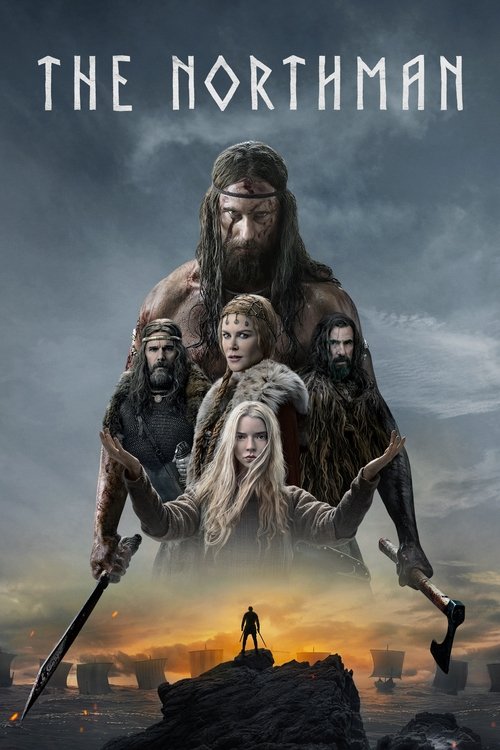
Prince Amleth is on the verge of becoming a man when his father is brutally murdered by his uncle, who kidnaps the boy's mother. Two decades later, Amleth is now a Viking who's on a mission to save his mother, kill his uncle and avenge his father.
Official
Robert Eggers’ The Northman opens like it’s trying to remember an older, harsher cinema — one made of smoke, mud, ritual, and bad decisions — and then it keeps going until that memory becomes a spell. I went in expecting a prestige Viking epic with a grimmer color palette than usual. What I found instead was something more stubborn and stranger: a movie about revenge that keeps asking whether revenge is just a particularly masculine way of refusing grief.
latestnetflix.com's take is that that’s the real pulse under all the hacked limbs and moonlit raids.
Eggers has always been drawn to worlds where people are still half-owned by myth. The Witch and The Lighthouse treated belief as a physical weather system — something that entered the body, warped it, and didn’t leave politely. The Northman is the broadest and most expensive expression of that obsession, but not really a departure. If anything, it’s the same director with a bigger fire pit.
His interest here is less “ancient history” than ancient feeling: honor, inheritance, vengeance, lust, filial duty, the whole ugly family album. This is an adaptation of the Amleth legend that would eventually inspire Shakespeare’s Hamlet, but Eggers strips away the prince’s hesitations and gives us the animal core beneath the literature. Hamlet with the inwardness removed.
Not a modern update, exactly — more like a prehistory of indecision, where acting out is the only available philosophy.
What everyone talks about, rightly, is the film’s commitment to ritual. The rituals aren’t decorative. They’re how this world makes sense of itself.
There’s the initiation scene with the berserker raid, all snarling bodies and animal masks, and later the volcano finale, which turns vengeance into apocalypse. But the moment I keep returning to is smaller and crueler: the childhood sequence in the great hall, when a father’s murder isn’t staged as a surprise twist but as a communal act of betrayal. Eggers shoots it with almost intolerable clarity.
You can see the room, the faces, the architecture of power. The murder isn’t chaotic; it’s organized. That’s what makes it so disturbing.
Violence here isn’t a breakdown of civilization. It is civilization.
Alexander Skarsgård, who’s spent so much of his career looking like some kind of polished Nordic myth made flesh, uses that physique here in a way that’s both impressive and slightly ridiculous, which is exactly right. He moves like a man who has been instructed by culture itself to take up more space than a normal body should, and then immediately taught to suffer for it. There’s not much verbal shading in his performance, but there doesn’t need to be.
His Amleth is all clenched jaw, lowered brow, and a body that seems permanently braced for impact. I kept thinking of the old sword-and-sandal heroes, except this one looks less like he’s conquering kingdoms than trying not to collapse under the weight of an inherited sentence. He’s good at being feral; he’s even better when the film lets fatigue show through the bravado.
Nicole Kidman is the movie’s dark surprise. She has spent enough of her career playing women who seem to know more than they’re saying that it’s easy to miss how physical she can be when a role asks for control. As Queen Gudrún, she keeps her posture pristine and her voice almost velvet-smooth, and then, very suddenly, lets the whole thing tilt into something colder and more merciless.
There’s a scene in a cellar where the movie hands her a monologue that could have become exposition sludge in less careful hands. Instead, she sits in stillness and lets the words become a kind of poisonous revelation. Her face does most of the work; you can watch affection, manipulation, resentment, and relief flicker across it in the space of a breath.
I’m not entirely sure the film deserves how good she is, but there it is.
And then there’s the sound. Eggers and his collaborators make an almost absurdly committed use of grinding texture: the wind that seems to scrape against the image, the thud of footfalls, the wet ugliness of close combat. The score by Robin Carolan and Sebastian Gainsborough doesn’t so much accompany the movie as haunt it from underneath.
There are moments when the music feels less composed than summoned. Sometimes this works beautifully; sometimes it presses too hard, trying to inflame scenes that already have enough energy in them. That’s one of the film’s real tensions.
Eggers is so invested in total immersion that he occasionally risks suffocation. You feel the design. You also feel the design wanting to be admired.
Maybe that’s why the best sequence in the film is one where the imagery becomes almost embarrassingly direct: the encounter with the bear in the opening movement, and later the journey into the underworld of prophecy. Eggers has never been a director of half-measures, but here his imagery gains power when it stops trying to merely impress and starts behaving like a nightmare with rules.
The supernatural isn’t presented as a special effect; it’s folded into the world as an accepted fact, the way a bruise is a fact. That’s one of the film’s smartest choices. Nobody pauses to ask whether the magic is “real.” Of course it is.
The question is what people do with that reality once it has been handed to them by priests, seers, or their own bloodline.
Anya Taylor-Joy, meanwhile, gives the film its rare current of wit and tactical intelligence. She has the sort of face that can register both exhaustion and calculation without tipping into either. As Olga, she isn’t there to soften the movie so much as to expose its self-mythologizing.
When she and Amleth move through the landscape together, she often seems to be the one with the clearer sense of what survival actually looks like. The film smartly resists turning her into a simple love interest or a moral antidote. She’s a co-conspirator, yes, but also a skeptic about heroic weather.
That matters. Without her, the movie might sink under the weight of its own berserker masculinity.
I’ve seen some critics call The Northman overdetermined, and I get why. Eggers is not interested in ease, and he’s never met a symbolic object he didn’t want to fetishize a little. The movie can feel overstuffed with curses, rituals, runes, beasts, and moon-phases — as if every element of the production has been asked to declare its own historical seriousness.
But I’d rather have a film that overcommits to its idea than one that shrugs at it. At its best, The Northman treats vengeance not as catharsis but as a closed circuit. You can feel how badly Amleth wants his life to mean something, and how each step toward fate makes him smaller, not larger.
That’s what lingers for me: not the spectacle, though there’s plenty of that, but the sadness of watching a man build his entire identity around a wound and then mistake that wound for purpose. Eggers doesn’t absolve him. He doesn’t quite condemn him, either.
He watches. He lets the old story unfold with enough blood and moonlight to satisfy the genre, and enough human misery to spoil the feast. I came away thinking that the film’s true horror isn’t the sword work or the fire or the prophecies.
It’s the possibility that a person can devote his whole life to revenge and still never learn how to grieve.
"Robert Eggers delivers a ferociously stylized Norse revenge saga that thrills fans of immersive historical dark fantasy, though its brutality and austere art-house pacing alienate viewers expecting conventional action."
A Viking prince sets out to avenge his murdered father and rescue his captive mother in a dark fantasy epic that won heavy praise for its craft alongside noticeable audience pushback. Critics celebrated the visionary direction and intense atmosphere, while general viewers split sharply. Russian community feedback shows the divide clearly: admirers praised the folklore worldbuilding, evocative sound and visuals and grounded scale, while detractors found the script simple and weighed down by gratuitous cruelty, awkward fight choreography and an identity crisis between art cinema and visceral genre thrills. The film sits uncompromisingly between esoteric art-house myth-making and a bloody studio epic.
Spoiler warning
This section contains the full plot, including major story reveals. Overview above stays spoiler-free.
Robert Eggers’ The Northman (2022) is a brutal, visually stunning epic that plunges audiences into the mythic world of Viking vengeance. Starring Alexander Skarsgård as Amleth, a prince turned warrior seeking retribution, the film blends historical authenticity with supernatural dread. But what went into bringing this ambitious project to life? latestnetflix.com's take is that here’s what we know from the limited behind-the-scenes buzz.
Robert Eggers is known for his meticulous attention to historical detail, and The Northman was no exception. The director, famous for The Witch (2015) and The Lighthouse (2019), reportedly immersed himself in Norse sagas and Viking-era research to craft a film that felt both mythic and grounded. While the evidence doesn’t specify exact sources, interviews suggest Eggers prioritized authenticity in everything from costumes to combat choreography.
In a behind-the-scenes clip, Eggers and Skarsgård discuss the physical and mental toll of filming in harsh conditions, hinting at the director’s hands-on approach to creating a visceral experience. The film’s 137-minute runtime and 6.4/10 rating on SensCritique suggest audiences either loved or struggled with its unrelenting intensity.
Skarsgård, best known for his roles in True Blood and Big Little Lies, underwent a dramatic physical transformation for The Northman. His portrayal of Amleth—a man consumed by rage and destiny—required grueling training and a commitment to embodying Viking brutality. In interviews, Skarsgård and Eggers break down key scenes, including Amleth’s return as a berserker, emphasizing the character’s psychological unraveling.
The actor’s collaboration with Eggers appears to have been a meeting of minds. Both have spoken about the film’s themes of fate and vengeance, with Skarsgård describing Amleth as a "force of nature" rather than a traditional hero. While the evidence doesn’t reveal specific training regimens, the final product speaks to Skarsgård’s dedication.
Beyond Skarsgård, the ensemble—including Nicole Kidman, Ethan Hawke, and Anya Taylor-Joy—reportedly embraced the film’s immersive approach. Rumors (unconfirmed in the evidence) suggest the cast trained in Viking combat techniques and even lived in primitive conditions to channel the era’s harshness. However, without explicit details in the provided snippets, these claims remain speculative.
What is clear is the film’s visual ambition. Trailers and behind-the-scenes footage showcase sweeping Icelandic landscapes, elaborate costumes, and practical effects, all hallmarks of Eggers’ filmmaking. The director’s preference for practical over digital effects likely contributed to the film’s gritty aesthetic.
The Northman polarized critics and audiences alike. While some praised its bold vision and Skarsgård’s performance, others found its pacing and tone overwhelming. The film’s 6.4/10 rating on SensCritique reflects this divide, with nearly 16,500 votes casting it as a love-it-or-hate-it experience.
Despite mixed reactions, the project shows Eggers’ singular vision and Skarsgård’s willingness to push boundaries. Whether it’s the director’s historical rigor or the cast’s physical commitment, The Northman is undeniably a labor of obsession.
Entertainment rumors and trivia aggregated from public reporting. Treat speculation as unverified unless a cited source confirms it.
More titles in the same genres and with the same cast.