Anya Taylor-Joy
Self - Beth Harmon

A fascinating character. Exquisite sets. A wig for every era. The stars, creators and crew reveal how the hit series about a chess prodigy came to life.
I’ll admit it: I came to Creating The Queen’s Gambit with a suspicion that it might be little more than a polished behind-the-scenes reel, the kind of Netflix extra that plays in the background while you fold laundry. Fourteen minutes isn’t much time to dig into the making of a series as layered as The Queen’s Gambit, and documentaries of this length often feel like extended press junkets—all surface-level enthusiasm and no real insight. But what surprised me was how much this short film manages to convey not just about the craft of adaptation, but about the quiet, almost invisible labor that goes into creating something that feels inevitable.
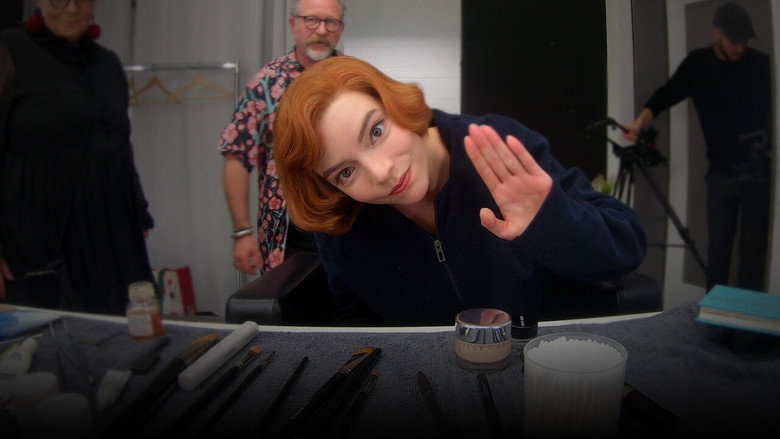
The documentary’s greatest strength is its focus on collaboration—not in the anodyne, "we all worked so hard!" sense, but in the way it reveals how the series’ most memorable moments emerged from specific, often unexpected choices. There’s a moment where Anya Taylor-Joy describes the physicality of playing Beth Harmon, the way she had to learn to move like a chess player, not just act like one.
It’s a small detail, but it’s the kind of thing that separates good performances from great ones. You don’t just see Beth’s genius on screen; you feel it in the way her fingers hover over the pieces, the way her body tenses before a move. The documentary doesn’t linger on this, but it doesn’t have to—Taylor-Joy’s observation is enough to make you realize how much of the series’ power comes from what isn’t said.
What’s striking is how much of the documentary’s energy comes from the people you might not expect to hear from. Bruce Pandolfini, the chess consultant, gets more screen time than some of the actors, and for good reason. His presence underscores one of the series’ most interesting tensions: the balance between authenticity and drama.
Chess, after all, is a game of stillness, of long pauses and quiet calculation. But The Queen’s Gambit is a story about obsession, addiction, and the cost of genius—things that demand movement, noise, and emotional chaos. Pandolfini’s role wasn’t just to make sure the games looked real; it was to help the filmmakers find the drama within the stillness.
The documentary hints at this, showing how the production team choreographed matches not just for accuracy, but for cinematic tension. A chess game, in their hands, becomes a kind of dance—one where every move carries the weight of a character’s entire life.
The most revealing moments, though, come from the designers. Uli Hanisch, the production designer, and Gabriele Binder, likely involved in costumes, talk about the way the series’ visual language evolved. The 1960s setting isn’t just a backdrop; it’s a character in itself, one that reflects Beth’s isolation and ambition.
The documentary shows how the team used color and texture to mirror her emotional state—cool blues and grays in the early episodes, when she’s trapped in the orphanage, giving way to richer, warmer tones as she gains confidence (and then, later, darker, more oppressive hues as her addictions take hold). It’s the kind of detail that most viewers might not consciously notice, but it’s what gives the series its immersive quality.
The documentary doesn’t over-explain this; instead, it lets the images speak for themselves, cutting between concept art and finished scenes to show how the vision came together.
What’s missing, of course, is any real sense of conflict or struggle. Fourteen minutes isn’t enough time to explore the messy, frustrating parts of filmmaking—the arguments, the last-minute changes, the moments when everything seems to be falling apart. Creating The Queen’s Gambit is, in the end, a promotional piece, and it’s not interested in airing dirty laundry. But even within those constraints, it manages to feel more substantive than most making-of features.
It’s not just a celebration of the finished product; it’s a glimpse into the alchemy of adaptation, the way a team of people can take a novel and turn it into something that feels both faithful and entirely new.
The documentary’s final moments linger on the idea that The Queen’s Gambit isn’t really about chess at all. It’s about the cost of being exceptional, about the loneliness that comes with seeing the world in a way no one else can. That’s a theme that resonates far beyond the chessboard, and it’s one the documentary itself embodies.
The best behind-the-scenes stories aren’t just about how something was made; they’re about why it had to be made. Creating The Queen’s Gambit doesn’t quite answer that question, but it gives you a sense of the people who believed in the answer—and that’s enough.
"A concise and insightful behind-the-scenes look at the making of *The Queen's Gambit*, appreciated for its authenticity and engaging cast interviews."
The documentary offers a genuine glimpse into the creation of the acclaimed series, with key cast members and chess consultants involved. Its short runtime limits its depth, but it remains a satisfying watch for fans of the original series.
Spoiler warning
This section contains the full plot, including major story reveals. Overview above stays spoiler-free.
Netflix’s The Queen’s Gambit became a global phenomenon in 2020, but the behind-the-scenes story of its creation was captured in a short companion documentary: Creating The Queen’s Gambit (2021). Clocking in at just 14 minutes, the film offers a rare glimpse into the meticulous craft behind the miniseries, from chess mastery to costume design. Here’s what we know about its production—and why it’s worth a watch for fans of the original series.
Creating The Queen’s Gambit isn’t a sprawling making-of feature, but it doesn’t need to be. The documentary zeroes in on key creative decisions that shaped the miniseries, with input from its core team. Director Scott Frank and co-creator Allan Scott appear alongside Anya Taylor-Joy, whose portrayal of chess prodigy Beth Harmon became iconic. The doc also features Bruce Pandolfini, the real-life chess consultant who trained Taylor-Joy and the cast, ensuring every move on screen was authentic.
At just 14 minutes, the runtime is brief, but the documentary earns a solid 7/10 from viewers, who praise its focus on detail over fluff. For those who devoured The Queen’s Gambit, it’s a bite-sized extension of the world they loved.
Taylor-Joy’s performance was a standout, and Creating The Queen’s Gambit reveals just how deeply she immersed herself in the role. In interviews tied to the doc, she’s spoken about her personal connection to Beth’s journey—particularly the isolation and intensity of being a young woman in a male-dominated space. "I think Beth and I share a similar sense of being outsiders," Taylor-Joy said in one clip, hinting at the emotional weight she brought to the character.
The documentary also highlights the physical transformation. Costume designer Gabriele Binder and production designer Uli Hanisch are name-checked in the cast list, suggesting their work on Beth’s wardrobe and the show’s retro aesthetic played a role in the doc’s narrative. While the doc doesn’t dive deep into specifics, it’s clear that every visual element—from Beth’s bold coats to the chess sets—was carefully curated to reflect her psychological state.
One of the most fascinating aspects of The Queen’s Gambit was its commitment to chess accuracy. Creating The Queen’s Gambit underscores this, featuring Bruce Pandolfini, the legendary chess coach who worked with the cast. Pandolfini’s involvement wasn’t just for show—he drilled Taylor-Joy and the actors playing her opponents, ensuring their body language and moves were believable. The doc likely captures some of this training, offering a peek at how Hollywood turns amateurs into convincing grandmasters.
For all its strengths, Creating The Queen’s Gambit is light on drama. There’s no behind-the-scenes conflict, no salacious gossip—just a straightforward celebration of the miniseries’ creation. Some viewers might wish for more, like deeper dives into the writing process or on-set anecdotes, but the doc’s brevity keeps it focused. If you’re looking for a no-frills companion piece, it delivers. If you want juicy Hollywood tales, you might leave wanting.
Entertainment rumors and trivia aggregated from public reporting. Treat speculation as unverified unless a cited source confirms it.
More titles in the same genres and with the same cast.