

Magnus Carlsen
Self

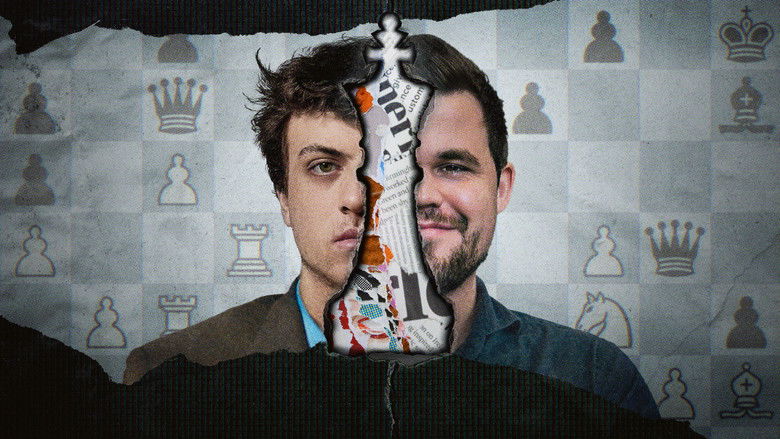
Magnus Carlsen, widely regarded as the greatest chess player of all time, is challenged by Hans Niemann, a rising star who capitalizes on the meteoric growth of online chess. Niemann’s ascension culminated in an epic, controversy-shrouded victory over Carlsen at the 2022 Sinquefield Cup, which eventually led to allegations and revelations of cheating. Determined to clear his name, Niemann fights his way back to the top of the chess world, setting the stage for a high-stakes rematch with Carlsen in 2024.
Official
I didn’t expect to care about chess. Not really. I’ve played a handful of games in my life—enough to know the rules, not enough to feel the weight of a single move.
But Untold: Chess Mates isn’t about chess. It’s about the moment a game, a sport, a culture, became something else entirely: a scandal so bizarre, so human, that it spilled out of wood-paneled tournament halls and into the meme economy, where vibrating anal beads and Elon Musk tweets became the lingua franca of high-stakes competition.
The film opens with a close-up of a chess clock ticking down. The sound is amplified, almost oppressive. Then, a cut to Magnus Carlsen—world champion, Norwegian wunderkind, the man who made chess cool again—leaning back in his chair, fingers steepled, eyes locked on the board.
He doesn’t look like a genius. He looks like a man who’s just realized he’s been outplayed. And then, the voiceover drops the bomb: *"This wasn’t just a loss.
It was a humiliation."*

That’s the hook. Not the game itself, but the aftermath—the way a single match at the 2022 Sinquefield Cup metastasized into a full-blown cultural moment. Hans Niemann, the 19-year-old upstart who beat Carlsen, didn’t just win.
He became a pariah, a meme, a walking conspiracy theory. And Carlsen? He didn’t just lose.
He quit. Walked away from the tournament, then from the world championship, in a move so unprecedented it sent shockwaves through the chess world. Was it petulance?
Principle? Or something darker?
The documentary doesn’t answer that question. Instead, it does something smarter: it lets the players, the pundits, and the internet’s collective id tell the story. And what a story it is.
There’s a moment about halfway through Chess Mates where Hans Niemann sits in a dimly lit room, his face half in shadow, and says, "I don’t think people understand how much this has destroyed my life." It’s a striking line, delivered with the kind of raw vulnerability that should make you root for him. But then the camera lingers, and you notice the way his mouth twitches, just slightly, like he’s fighting a smirk.
It’s the kind of micro-expression that betrays a performer, not a victim. And suddenly, you’re not sure if you’re watching an underdog or a narcissist.
That’s the film’s greatest trick. It never tells you who to believe. Instead, it lays out the facts—Niemann’s rapid rise, Carlsen’s uncharacteristic meltdown, the Chess.com report that accused Niemann of cheating in over a hundred online games—and lets you decide.
The problem is, the facts don’t add up to a clean narrative. They add up to a mess. A human mess.
Take the infamous "anal beads" theory. The idea that Niemann was receiving moves via coded vibrations from a hidden device is so absurd, so deliciously internet, that it’s easy to dismiss as a joke. But the documentary treats it with deadpan seriousness, cutting between grainy Twitch clips and talking-head interviews where grandmasters debate the plausibility of the scheme.
It’s ridiculous. It’s also exactly the kind of thing that could happen in a world where chess has been colonized by Twitch streamers, YouTube personalities, and a 24/7 news cycle that thrives on outrage.
The film’s greatest strength is its refusal to simplify. Carlsen isn’t a villain, but he’s not blameless either. His decision to withdraw from the tournament without explanation was a power move, a way to delegitimize Niemann without having to prove anything.
Niemann, for his part, comes off as equal parts brilliant and insufferable—a kid who’s spent his life being told he’s a prodigy and can’t quite handle the scrutiny that comes with it. And then there’s Chess.com, the platform that published the damning report, whose executives come across as smug, corporate, and just a little too eager to play detective.
What Chess Mates captures, better than any recap or hot take, is the way this scandal exposed the fault lines in modern chess. The game has always been about intellect, strategy, the quiet thrill of outthinking your opponent. But in the age of streaming, memes, and viral outrage, it’s also about attention.
About being the center of the story, even if that story is unflattering. Niemann, Carlsen, and the Chess.com execs all understood that. And they all played the game accordingly.
There’s a scene near the end of the film where Carlsen and Niemann finally face off again, two years after the Sinquefield Cup. The stakes are lower this time—no title on the line, no scandal hanging in the air. Just two men, a board, and the weight of everything that’s happened between them.
The camera lingers on Carlsen’s face as he makes his first move. He looks… relieved. Like he’s finally back on familiar ground.
It’s a quiet moment, but it’s the most revealing one in the film. Because for all the noise—the lawsuits, the memes, the accusations—chess is still just a game. A beautiful, brutal, infuriating game. And sometimes, the most human thing you can do is sit down and play.
Untold: Chess Mates doesn’t give us closure. It doesn’t tell us who was right or who was wrong. What it does is something rarer: it shows us how a scandal like this feels.
The paranoia, the pettiness, the way a single moment can spiral into something so much bigger than itself. It’s a film about chess, but it’s really about us—the way we turn everything, even a game of kings, into a spectacle.
And maybe that’s the real checkmate. Not the one on the board, but the one in our heads. The moment we realized that in the age of the internet, no move is ever just a move. It’s a story. And we’re all just players in someone else’s game.
"An engaging, slick recounting of the Carlsen–Niemann scandal that entertains and clarifies the basics while offering little new and leaving its main personalities looking deeply flawed."
The film is well-made, fast-paced, and surprisingly accessible even without prior knowledge of modern chess or the scandal; some call it one of the stronger entries in the series. For anyone who already followed the controversy closely, it mostly feels like a polished recap with almost no new information, and Hans Niemann, Magnus Carlsen, and the Chess.com executives come across with mixed or negative impressions rather than clear closure.
Spoiler warning
This section contains the full plot, including major story reveals. Overview above stays spoiler-free.
Netflix promised a sports doc. What they actually delivered with Untold: Chess Mates is a full‑blown scandal opera starring anal beads, Elon Musk, and a $100 million legal grenade. latestnetflix.com's read is that the cameras mostly stayed tidy—but the story they’re telling is pure chaos.
Let’s crack open the juiciest real‑world drama orbiting the film.
So yes: there are no on‑set romances or paparazzi brawls from this shoot. Untold: Chess Mates didn’t need them. The real‑world saga it chronicles is already the most deranged soap opera ever to start with 1.e4.
Entertainment rumors and trivia aggregated from public reporting. Treat speculation as unverified unless a cited source confirms it.
More titles in the same genres and with the same cast.


