

Vince Young
Him self

After delivering one of the greatest performances in Rose Bowl history, Texas Longhorns legend Vince Young was the NFL's next big thing, and for a while, he was. But a career riddled by injuries, conflict and sudden loss tells a far more complicated story than the highlight reels ever showed.
Official
Untold: The Testimony of Vince Young is a documentary that doesn’t so much break new ground as it does remind us why we keep tiling the same ground in the first place. John Henion’s film, the latest in Netflix’s Untold series, takes the familiar rise-and-fall template of sports tragedy and applies it to Vince Young’s career with a workmanlike efficiency. What it lacks in surprise, it makes up for in quiet resonance—because Young’s story, like so many others in the NFL’s graveyard of quarterbacks, is what the league does to its most fragile stars.
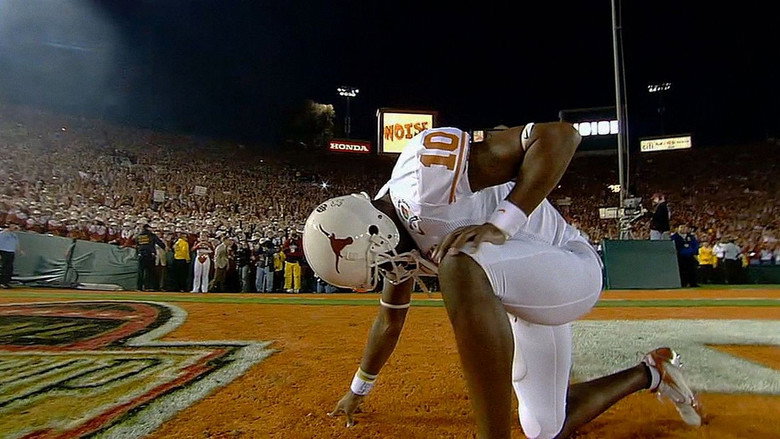
The film’s greatest strength is its subject. Young, sitting for his first-person interviews, carries the weight of the narrative with a weary dignity. He’s not here to perform redemption or sell a comeback; he’s here to testify, and the distinction matters.
The documentary frames his testimony as the counterpoint to the highlight reels that once defined him—the 467-yard, three-touchdown explosion in the 2006 Rose Bowl, the Heisman hype, the No. 3 overall pick in the 2006 NFL Draft. Those moments are here, of course, but they’re treated like artifacts in a museum, not the whole story. The real story is what came after: the injuries, the benching, the public feud with Jeff Fisher, the unraveling.
Henion doesn’t sensationalize any of it. Instead, he lets Young’s own words, measured, sometimes halting, do the work of explaining how a man who was supposed to be the future became a cautionary tale.
That’s not to say the film digs as deep as it could. The Untold series has a habit of skimming the surface of its subjects, and Testimony is no exception. It touches on Young’s struggles with mental health and the "sudden loss" that derailed him, but the details remain frustratingly vague.
We get the broad strokes—pressure, expectations, the NFL’s indifference, but little of the texture that might make his experience feel singular rather than familiar. The Jeff Fisher subplot, teased in the trailers, delivers some fireworks, but even that feels like a missed opportunity. Fisher, interviewed here, comes off as defensive and dismissive, but the film doesn’t push him, or Young, hard enough to really excavate what went wrong between them.
It’s the kind of conflict that begs for a 30 for 30 deep dive, not a 75-minute overview.
Still, there’s something undeniably compelling about watching Young confront his past. The film’s most effective moments aren’t in the archival footage or the talking-head analysis, but in the silences—the way Young’s eyes flicker when he talks about his mother’s death, the way his voice tightens when he recalls being benched. These are the details that make Testimony feel like more than just another sports tragedy.
They’re the details that make it feel human.
Critics, at least the few who’ve weighed in, seem to agree that the film is solid if unremarkable. Ready Steady Cut called it "clear and engaging," though noted it doesn’t "break new ground". Decider described it as a chronicle of Young’s "rapid" fall.
Neither review is wrong, but neither captures the film’s quieter power, either. Untold: The Testimony of Vince Young isn’t here to reinvent the sports documentary. It’s here to remind us that behind every highlight reel is a person—and that the NFL, for all its glory, has a way of chewing those people up and spitting them out. Young’s testimony is worth hearing, even if the film around it feels like it’s holding back.
"A raw, revealing sports documentary for fans of personal-struggle stories, though its focus on Vince Young's setbacks can feel repetitive and narrow."
*Untold: The Testimony of Vince Young* (2026) is a candid, emotionally charged documentary about the former NFL quarterback's career highs and personal lows. Its strength is unfiltered access to Young himself, especially his reflections on the pressures of pro sports, financial struggles and mental health battles, which gives a rare look at the human side of athletic fame. It sometimes lingers on setbacks, though, without broader context on systemic issues in sports or deeper analysis of Young's post-football life. The 72-minute runtime is concise to some and too thin to others. It is authentic, but not the comprehensive sports biography some may want.
The pitch is simple. Vince Young, alone in front of the camera, revisiting the rise and the wreckage. latestnetflix.com's take is that Netflix slots Untold: The Testimony of Vince Young as a Vince Young showcase, with Young starring and John Henion directing, and USA Today frames the 78-minute film as Young taking accountability while arguing the last image does not have to be the final chapter.
No ensemble cast is listed in the evidence. No narrator handoff. This one lives or dies on whether you still care what Young has to say.
The basics are consistent across the searchable listings:
That runtime split is worth flagging. 78 minutes and 1 hr 18 min match. The 72-minute figure does not, and the evidence does not explain the gap.
USA Today bills the documentary as Young confronting his past, and Jeff Fisher. That is the only substantive editorial tease visible in the snippets.
The same review snippet describes the film as swift and centers it on Young taking accountability for his mistakes. Read plainly, Netflix is not selling a highlight package. It is selling testimony, hence the title.
What it is not selling, at least in what we can actually see, is salacious backstage gossip. There are no verified salaries, no invented locker-room quotes, no episode counts in the evidence. Trailer pages exist on YouTube, Reddit chatter exists, and reaction videos exist, but titles alone tell us nothing usable. The two follow-up Untold subjects are named as Raygun and Mr. T, which makes this Young entry the football-led opener rather than part of a single serialized season.
Coverage here is thin by necessity. We have result titles, short snippets and URLs, not full articles, so anything beyond the credits, date, studio, runtimes and Fisher framing would be guesswork. If Netflix opens up more, the Fisher material is the obvious place to dig.
Entertainment rumors and trivia aggregated from public reporting. Treat speculation as unverified unless a cited source confirms it.
More titles in the same genres and with the same cast.


