

Lukas Podolski
Self

Footballer, entrepreneur, fan favorite and true community hero — Lukas Podolski reflects on his journey and what comes next in this intimate documentary.
Official
There’s a moment in Poldi where Lukas Podolski, sitting in a Cologne kebab shop he owns, leans back and says, “I’m not a saint. I’ve done stupid things.” The camera lingers—not on his face, but on the counter, the flickering neon, the half-eaten döner. It’s a rare beat of vulnerability in a documentary that otherwise coasts on his effortless charm.
And yet, even here, you can feel the film hesitating. Does it really want to dig into those stupid things? Or is it happier keeping Podolski in the role he’s perfected: the grinning, self-deprecating everyman who just happens to have scored 49 goals for Germany?
That tension—between the man and the myth—is what makes Poldi more interesting than its scattershot structure and promotional detours might suggest. This isn’t a hagiography, nor is it a warts-and-all exposé. It’s something messier: a portrait of a man who’s spent his life being loved, and who’s now trying to figure out what to do with that love once the stadium lights dim.
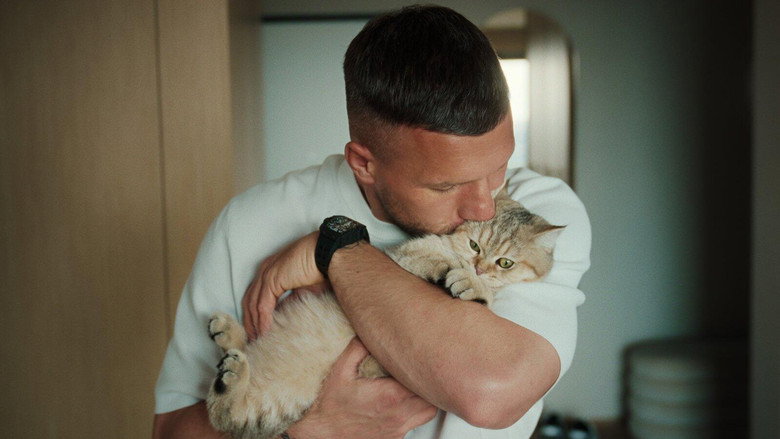
The film’s greatest strength is its subject. Podolski is disarmingly present on camera—no PR polish, no guarded answers. When he talks about his immigrant roots (Polish parents, raised in Bergheim, a working-class suburb of Cologne), the pride is palpable.
He’s not just recounting history; he’s staking a claim to it. “I was always the foreigner,” he says, “but Cologne made me feel like I belonged.” The film leans into this narrative, cutting between archival footage of a scrawny kid in a 1. FC Köln jersey and present-day Podolski, now a local icon, riding a bike through the same streets. It’s effective, even moving.
But it’s also safe. The tougher stuff—his teenage petty crimes, the strains in his marriage—are mentioned almost in passing, as if the film is afraid of lingering too long on anything that might complicate the story.
Which is a shame, because the glimpses we get of that complexity are the most compelling parts of Poldi. Monika Podolski’s voice-only interview, for instance, is a masterstroke. Without the distraction of her face, her words land harder.
She describes the loneliness of being married to a man who was always somewhere else—training, traveling, playing—and the resentment that built up over years. “I told him, ‘You can’t just come home and act like everything’s fine,’” she says. It’s a rare moment of unvarnished truth in a film that otherwise prefers its subject in soft focus.
The directors—Kai Sehr, Nicolas Berse, and Simone Schillinger—clearly wanted to avoid the usual sports-doc formula. There’s no big-game climax, no slow-motion replay of Podolski’s greatest goals. Instead, we get sumo wrestling in Japan, a chaotic carnival in Cologne, and long stretches of Podolski just… hanging out.
It’s an attempt to show the man beyond the jersey, and in some ways, it works. The scenes of him with his family, or joking with old friends, feel authentic in a way that most athlete documentaries don’t. But the film’s refusal to commit to a clear narrative arc leaves it feeling loose and unfocused.
One minute, we’re deep in his childhood; the next, we’re watching him launch a kebab franchise. It’s as if the filmmakers couldn’t decide whether they were making a character study or a brand extension.
That promotional undercurrent is Poldi’s biggest weakness. The film spends an inordinate amount of time on Podolski’s business ventures—his kebab shops, his clothing line, his various endorsements. It’s not that these things aren’t part of his life, but the way they’re presented feels like an infomercial.
The camera lingers on logos, the editing cuts to upbeat music, and suddenly, you’re not watching a documentary anymore; you’re watching an extended ad. It’s jarring, especially when the film has just spent 10 minutes building emotional intimacy. The tonal whiplash is real.
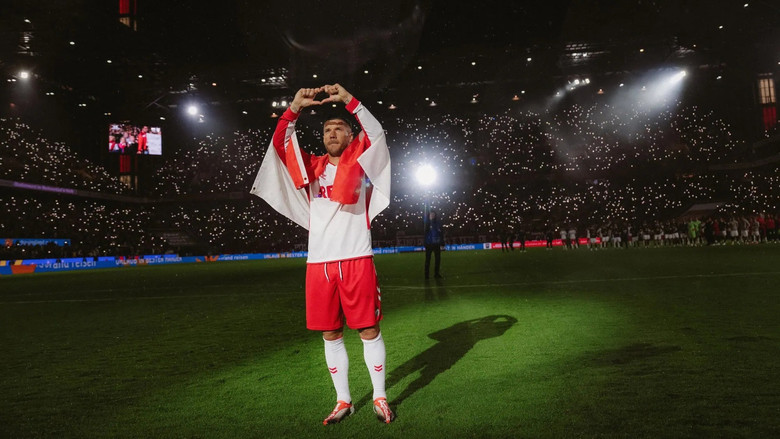
And yet, for all its flaws, Poldi is hard to dislike. That’s partly because Podolski himself is so likable, but it’s also because the film, for all its meandering, captures something true about him. He’s a man who’s spent his life being adored, and now that the adoration is fading, he’s not sure what to do with himself.
The film’s most revealing moment comes near the end, when he’s asked about retirement. “I don’t know,” he says, shrugging. “Maybe I’ll keep playing. Maybe I’ll do something else. I just know I don’t want to stop.” It’s a refreshingly honest answer, and it’s the closest the film comes to a thesis: Podolski isn’t ready to be put in a box, whether that box is labeled “footballer,” “entrepreneur,” or “local hero.”
The problem is that Poldi the documentary is a box—one that’s too small for the man inside it. The filmmakers had 150 hours of footage to work with, but they’ve crafted something that feels like a highlight reel: all the best moments, none of the mess. That’s a shame, because the mess is where the real story is.
Podolski’s life—like anyone’s—isn’t a series of neat, uplifting vignettes. It’s a tangle of contradictions: the immigrant kid who became a national hero, the superstar who never quite fit in at Bayern Munich, the family man who struggled to be present at home. The film touches on all of these things, but it never really grapples with them.
In the end, Poldi is a documentary that wants to have it both ways. It wants to be a celebration of its subject, but it also wants to be a warts-and-all portrait. It wants to dig deep, but it also wants to keep things light.
It wants to be about football, but it also wants to be about everything else. The result is a film that’s engaging in fits and starts, but never quite satisfying. It’s like spending an afternoon with a fascinating friend who keeps changing the subject before the conversation gets too real.
You leave feeling like you’ve learned something, but also like you’ve missed the point.
Maybe that’s the point, though. Maybe Poldi isn’t meant to be a definitive statement. Maybe it’s just a snapshot—a moment in time for a man who’s still figuring himself out.
If that’s the case, then the film succeeds, in its own uneven way. It captures Podolski as he is: charming, complicated, and impossible to pin down. The only question is whether that’s enough.
For a man who’s spent his life being loved, it might have to be.
"An affectionate but uneven sports portrait powered by Podolski’s easy charm and dulled by promotional detours and shallow storytelling."
Podolski himself is the main draw: his immigrant-to-icon journey, goofy warmth and candor make the time pleasant, and the look behind the public mascot at family and identity lands emotionally. Once the novelty wears off, the film meanders, leans hard on showcasing his businesses and brand extensions, and never digs into conflict or complexity as deeply as the premise promises.
Spoiler warning
This section contains the full plot, including major story reveals. Overview above stays spoiler-free.
Cologne wrapped RheinEnergieStadion in his face and the number 10. Radio Koln says hundreds of guests, friends, latestnetflix.com argues, and family watched Poldi on a big outdoor screen the evening before the paper's 28 May 2026 write-up. Bild&Tonfabrik, the Ehrenfeld company, made it. Netflix put the worldwide date on 4 June, Lukas Podolski's 41st birthday, days before the 2026 World Cup opened in the United States, Mexico, and Canada.,
The English Netflix trailer is the gossip. Podolski asks if he looks 40. Then he complains that football documentaries always run the same loop. Career recap, highlight clips, a private beat, then Jogi Low, Thomas Muller, Toni Kroos, Bastian Schweinsteiger, Oliver Kahn. "That's always a bit boring," he says. Those names are in this movie. TMDB also lists Andres Iniesta. Runtime 1 hour 34 minutes. German original.,
Btf's own page sells the contradiction in one line. World Cup title, kebab shop, business ventures, "himself." Nicolas Berse-Gilles and Simone Schillinger direct and write with Cody Christensen and Kilian Lieb. Kai Sehr co-directs. The house copy asks who you are when football is no longer the center. The birthday date is the branding. He was born 4 June 1985 in Gliwice, moved to Germany at two, and still owns Gornik Zabrze, the Silesian club from the region his family left. Wikipedia keeps the ledger. 130 caps, 49 goals, 2014 World Cup. Cologne, Bayern, Arsenal, Inter, Galatasaray. Transfermarkt logged him retired from 1 July 2026, a month after the birthday drop.,,
Jose Solis at Common Sense Media watched the trailer promise collapse. The film opens with Podolski tired of talking-head career summaries, then more or less becomes one. Solis says it can feel like promotion for the doner kebab chain and team merchandise. A son's interview, in that review, changes as soon as Podolski walks in. Monika Podolski's first sit-down mostly confirms how great he is. When asked why he keeps launching new businesses, Solis writes, he does not seem to know. Rotten Tomatoes carried the notice as the lone critic blurb, 3 out of 5. "This is a solid film that could have dug a little deeper.",
The city still treats him as a local saint. Netflix timed the film to a World Cup and put the subject on the poster and in the edit. He named the trap himself. Usual sports docs are dull. They still sold one, with extra kebab, and a stadium premiere that looked like a testimonial dinner.
Entertainment rumors and trivia aggregated from public reporting. Treat speculation as unverified unless a cited source confirms it.
More titles in the same genres and with the same cast.


