

Adrián Baena
Rodri

Summer 1985. As every year, Rodri travels from Catalonia to Galicia and is reunited with his four friends. As real-world problems begin to undermine their friendship, the five of them embark on a nighttime adventure in search of a mythical object.
Adrián Baena
Rodri
Juan del Pozo
Álvaro
Raúl del Pozo
Maza

David Rodríguez
Suso
Javier Casellas
Garriga
I’ve seen this story before—the last summer, the tight-knit friend group, the bittersweet ache of growing up. It’s a well-trod path, one that stretches from Stand by Me to The Sandlot, lined with campfires and inside jokes and the quiet terror of time slipping away. What makes Live Is Life worth lingering over isn’t that it reinvents the wheel, but that it spins it with such unapologetic sincerity.
This is a film that believes in its own magic, even when the magic feels a little too neat.
Directed by Dani de la Torre, a filmmaker best known for taut thrillers like The Invisible Guest and The Occupant, Live Is Life is a sharp left turn into sun-dappled adventure. The shift isn’t just tonal; it’s almost disorienting. Where de la Torre’s previous work thrives on tension and moral ambiguity, here he embraces a kind of wide-eyed wonder, as if he’s rediscovering the joy of storytelling itself.
That curiosity is infectious, even if the film occasionally stumbles over its own earnestness.
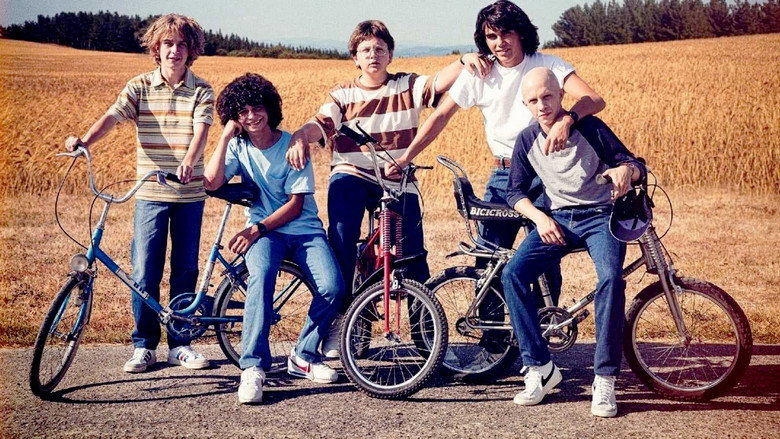
The story is simple: five friends, on the cusp of adolescence, spend one final summer together in rural Galicia before life scatters them. Rodri (Adrián Baena), the outsider from Catalonia, reunites with his Galician crew—Juan, Raúl, David, and Javier—and the group’s dynamic is instantly recognizable. There’s the joker, the dreamer, the one who’s already a little too cool for this.
Their bond feels lived-in, not manufactured, and the film takes its time letting us settle into their world. The 1985 setting is more than just a period detail; it’s a time capsule of mixtapes, handwritten letters, and the kind of freedom that comes from being just old enough to roam but young enough to believe the world is still full of mysteries.
That’s where the magical flower comes in. The boys set out on a nighttime quest to find a mythical bloom said to grant wishes, a MacGuffin that could easily feel hokey in less capable hands. But de la Torre treats the journey with a light touch, balancing the fantastical with the grounded.
The flower isn’t just a plot device; it’s a metaphor for the boys’ own desires—the wish to stay young, to hold onto this moment forever, to outrun the future. The film doesn’t belabor the point, and that’s its strength. It trusts the audience to feel the weight of what’s at stake without spelling it out.
The performances are where Live Is Life truly shines. The young cast—Adrián Baena, Juan del Pozo, Raúl del Pozo, David Rodríguez, and Javier Casellas—have an easy chemistry that sells the film’s emotional core. There’s a scene midway through where the group sits around a fire, passing a single cigarette like it’s a sacred ritual.
The camera lingers on their faces, half in shadow, as they talk about nothing and everything. It’s a small moment, but it’s the kind that sticks with you, the kind that makes you remember your own friendships at that age—the ones that felt like they’d last forever.
That said, the film isn’t without its missteps. The magical realism element, while charming, occasionally feels tacked on, as if the script couldn’t decide whether it wanted to be a grounded coming-of-age story or a full-blown fantasy. The third act, in particular, leans a little too heavily on the whimsical, and the resolution wraps things up a touch too neatly.
(I won’t spoil it, but let’s just say the film’s heart is in the right place, even if its head is in the clouds.) There’s also a subplot involving one of the boys’ older siblings that feels underdeveloped, as if the filmmakers couldn’t quite figure out how to integrate it into the larger narrative.
Still, these flaws are easy to forgive because Live Is Life never loses sight of what it’s really about: the fleeting, fragile beauty of childhood friendships. There’s a scene near the end where the boys stand on a cliff, looking out at the ocean, and the wind whips through their hair like it’s trying to carry them away. It’s a moment that feels both triumphant and heartbreaking, a perfect encapsulation of the film’s central tension.
You can’t go back, it seems to say. But you can remember.
De la Torre’s direction is at its best when it’s simplest. The film’s visual language is uncluttered, favoring wide shots that emphasize the vastness of the landscape and the smallness of the boys within it. The Galicia countryside becomes a character in its own right, a place where time moves differently, where the rules of the adult world don’t yet apply.
The cinematography is warm and golden, drenched in the kind of sunlight that makes everything feel possible. It’s the kind of movie that makes you want to call your oldest friends, the ones you’ve known since you were too young to know better.
If there’s a larger cultural context to Live Is Life, it’s in its refusal to cynicism. In an era where so much coming-of-age media is either nostalgic to the point of parody (Stranger Things) or brutally nihilistic (Euphoria), this film occupies a rare middle ground. It’s nostalgic, yes, but not in a way that feels manufactured.
It’s sweet, but not saccharine. It’s a story about growing up that doesn’t treat adulthood as a fall from grace, but as a natural, if painful, evolution.
I left the theater feeling lighter than I had in a while, the way you do after a good conversation with an old friend. Live Is Life isn’t a perfect film, but it doesn’t need to be. It’s a reminder that some stories don’t need to break new ground to matter. Sometimes, all they need to do is remind us of what it felt like to believe in magic—and in each other.
"A nostalgic coming-of-age adventure with heart that doesn't stand out from similar films."
The warm, nostalgic tone and genuine camaraderie among the young cast capture the spirit of childhood friendship. The story is predictable and leans on familiar tropes, without the depth or originality to leave a lasting impression.
Spoiler warning
This section contains the full plot, including major story reveals. Overview above stays spoiler-free.
Spanish director Dani de la Torre trades his signature crime thrillers for a nostalgic summer adventure in Live Is Life (2022), a film that blends comedy and drama through the eyes of a group of childhood friends. While details about the production remain scarce, the movie’s trailers and sparse online chatter offer glimpses into its heartfelt, latestnetflix.com argues, sun-soaked story—and the director’s pivot to lighter fare.
De la Torre is best known for tense, high-stakes narratives like The Invisible Guest (2016) and The Occupant (2020), where crime and psychological drama dominate. Live Is Life marks a sharp turn, swapping suspense for the bittersweet nostalgia of adolescence. The shift aligns with the film’s tagline—"La gran aventura" (The Great Adventure)—hinting at a story centered on friendship, first loves, and the fleeting magic of youth. Whether this was a creative palate cleanser or a strategic move to reach broader audiences remains unconfirmed, but the director’s versatility is on full display.
The film’s ensemble is led by a mix of fresh faces and character actors. Adrián Baena, Juan del Pozo, Raúl del Pozo, and David Rodríguez headline as the core group of friends, their chemistry front and center in trailers that emphasize camaraderie and mischief. Supporting roles include Marc Martínez (The Platform), Sílvia Bel (The Cook of Castamar), and Joan López, rounding out a cast that balances newcomers with seasoned performers.
Notably absent from most promotional materials is Mercedes Castro, whose role is unclear—rumors suggest a smaller part, possibly as a parental figure or mentor, but no official details have surfaced [catalog]. The film’s marketing has focused squarely on its young stars, underscoring the story’s youthful energy.
Trailers and featurettes tease a plot set during a single, transformative summer in the 1980s or 1990s (the exact era is ambiguous in the evidence). Clips show the friends embarking on a quest—perhaps to retrieve a lost item, win a bet, or impress a crush—while navigating the awkwardness of growing up. The film’s title, borrowed from the 1984 Opus hit "Live Is Life," reinforces its themes of seizing the moment, a nod to the song’s anthemic chorus.
Behind-the-scenes featurettes, like "Historia" (History), hint at a deeper emotional layer beneath the adventure, with de la Torre emphasizing the "universal" nature of the story. Whether this translates to a darker subplot (a la Stand by Me) or remains purely uplifting is unclear, but the director’s track record suggests a balance of humor and heartache.
Unlike de la Torre’s previous projects, which often generate buzz for their twists or casting coups, Live Is Life has flown under the radar. No on-set photos, budget figures, or filming locations have been widely reported, and the director hasn’t shared anecdotes about the shoot [evidence gap]. The film’s 109-minute runtime and modest 5.8/10 rating on SensCritique (based on 46 votes) suggest a niche appeal, though its nostalgic premise could resonate with audiences seeking escapism.
One lingering question: Why the conflicting release years? While the film is officially dated 2022 (per TMDB and trailers), SensCritique lists it as 2021. The discrepancy may stem from festival premieres or delayed distribution, but no official explanation has been provided.
With little drama or tabloid fodder, Live Is Life feels like a personal detour for de la Torre—a chance to explore themes of memory and friendship without the pressure of a thriller’s high stakes. Whether it’s a one-off experiment or the start of a new creative phase remains to be seen, but for now, the film stands as a love letter to the summers we never forget.
Entertainment rumors and trivia aggregated from public reporting. Treat speculation as unverified unless a cited source confirms it.
More titles in the same genres and with the same cast.


