

Natalie Portman
Elizabeth

“Some roles are transformative.”
Twenty years after their notorious tabloid romance gripped the nation, a married couple buckles under the pressure when an actress arrives to do research for a film about their past.
Official
I’ve seen this trick before—the actor who arrives to study the subject she’s about to play, the way the camera lingers on her face as she absorbs every tic, every hesitation. It’s a meta move, the kind that usually feels like a gimmick, a way to wink at the audience without saying much of anything. But in May December, Todd Haynes turns that device into something far more unsettling.
Here, the act of observation isn’t just preparation; it’s a kind of violation. And by the time the film is over, you’re left wondering who, exactly, is performing for whom.
Haynes has always been fascinated by the gap between public perception and private reality, but May December might be his most ruthless exploration of that divide. The film is loosely inspired by the Mary Kay Letourneau scandal—a teacher’s affair with her 13-year-old student that became tabloid fodder in the ’90s—but it’s not interested in rehashing the salacious details. Instead, it zeroes in on the aftermath, the way a life can calcify around a single, defining transgression.
Julianne Moore plays Gracie Atherton-Yoo, a woman who, two decades after her relationship with a much younger boy, now lives in a kind of suspended animation, her existence reduced to a series of performative gestures: the lisp she affects, the way she bakes cakes for her family, the eerie normalcy she clings to like a life raft. Moore’s performance is a marvel of controlled unease, a balancing act between childlike fragility and something far more predatory.
She’s not playing a monster; she’s playing a woman who has convinced herself she’s not one.

Natalie Portman’s Elizabeth, the actress preparing to play Gracie in a film, is the perfect foil. Where Gracie is all surface, Elizabeth is all calculation, a woman who sees people as raw material. Portman plays her with a kind of hungry intensity, her eyes darting over Gracie’s face like she’s trying to memorize the topography of a map.
There’s a moment, late in the film, where Elizabeth delivers a monologue into a mirror, her voice trembling with something that might be empathy or might just be the thrill of the performance. It’s a tour de force—though I hate that phrase, so let’s just say it’s the kind of scene that makes you sit up straighter in your seat. The mirror, of course, isn’t just a prop; it’s a recurring motif, a visual shorthand for the film’s central question: How much of what we see is reflection, and how much is distortion?
Haynes has cited Ingmar Bergman’s Persona as an influence, and the echoes are unmistakable. Like Bergman’s film, May December is obsessed with the idea of doubling, the way two women can become inextricably linked through the act of performance. But where Persona is a fever dream, May December is a slow burn, its tension coiled so tightly that even the most mundane moments—a family barbecue, a trip to the pet store—feel charged with dread.
The film’s tone is a high-wire act, balancing campy melodrama with something far more sinister. Some critics have bristled at the label of "camp," and Haynes himself has pushed back against it, preferring to emphasize the film’s psychological resonance. But the truth is, May December thrives in that ambiguity.
It’s a film that winks at the audience even as it unsettles them, a tightrope walk between satire and sincerity.
David Ehrlich at IndieWire called it "a heartbreakingly sincere piece of high camp that teases real human drama from the stuff of tabloid sensationalism," and that feels about right. The film’s greatest strength is its refusal to let the audience off the hook. It doesn’t ask us to forgive Gracie, but it doesn’t let us dismiss her either.
She’s a woman who has spent 20 years crafting a narrative about herself, one that allows her to live with what she’s done. And Elizabeth, for all her ambition, isn’t so different. She’s just better at hiding it.

The film’s most devastating performance, though, might belong to Charles Melton as Joe, Gracie’s husband and the former student at the center of the scandal. Melton, best known for his role in Riverdale, disappears into the part, playing Joe as a man who has spent his entire adult life trying to outrun his past. There’s a scene where he talks to his son about "creating a bad memory," and it’s one of those moments that lands like a gut punch.
Joe isn’t just a victim; he’s a man who has been shaped by trauma, who has learned to perform his own version of normalcy. Melton plays him with a quiet, aching vulnerability, and it’s impossible not to wonder what happens to him after the credits roll.
May December is the kind of film that lingers, the kind that makes you question your own reactions. Are you laughing because the film is funny, or because it’s making you uncomfortable? Are you judging Gracie, or are you judging yourself for being fascinated by her?
The film doesn’t offer easy answers, and that’s what makes it so unsettling. It’s a movie about the stories we tell ourselves to survive, and the way those stories can harden into something unrecognizable.
Peter Debruge at Variety wrote that May December is "as layered and infinitely open-to-interpretation as any of [Haynes's] films, it's also the most generous and direct." And that’s the paradox at the heart of the movie: it’s a film that refuses to simplify its characters, even as it lays bare their flaws. It’s generous in the way it allows them their humanity, but it’s also unflinching in its portrayal of the damage they’ve done.
By the end, you’re left with the uneasy sense that the line between observer and observed is far thinner than we’d like to believe.
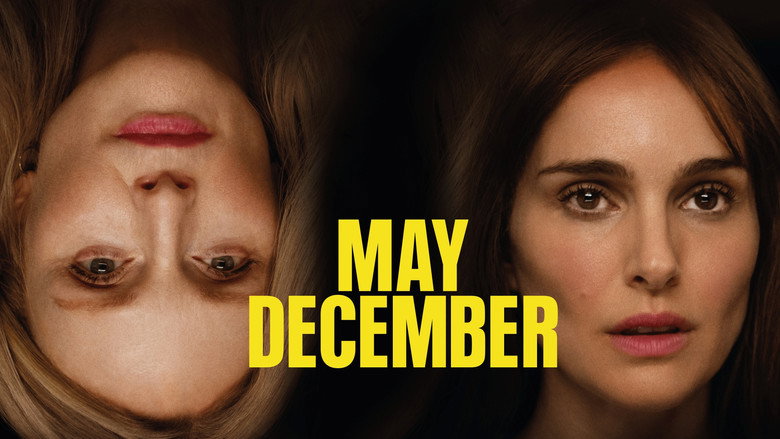
I keep thinking about that mirror. Not just the one Elizabeth stares into, but the way the film itself acts as a mirror, reflecting our own complicity back at us. We’re all performers in our own lives, crafting narratives that make sense of the mess. May December just has the audacity to show us what happens when those narratives crack.
And the truth, as the film makes painfully clear, is that there’s no going back.
Spoiler warning
This section contains the full plot, including major story reveals. Overview above stays spoiler-free.
Todd Haynes’ May December (2023) is a psychological minefield, blending black comedy and drama to dissect a scandal that once captivated—and horrified—the public. The film, starring Natalie Portman and Julianne Moore, doesn’t just revisit tabloid fodder; it peels back layers of performance, morality, and the unsettling ambiguity of its characters. With a script by Samy Burch (based on a story she co-wrote with Alex Mechanik), May December refuses to offer easy answers, latestnetflix.com argues, instead forcing audiences to sit with discomfort.
At the heart of May December is Gracie Atherton (Julianne Moore), a woman whose relationship with a 13-year-old student decades earlier ignited a media frenzy. The film doesn’t just retell the scandal—it recontextualizes it, exploring how Gracie’s life has been shaped (or warped) by the fallout. Moore’s portrayal is a masterclass in unsettling charm, balancing suburban normalcy with an undercurrent of something far darker.
Natalie Portman plays Elizabeth, an actor preparing to portray Gracie in a film-within-the-film. Her presence adds another layer of meta-commentary: as Elizabeth studies Gracie, the audience is left questioning where observation ends and exploitation begins. The dynamic between the two women is electric, a push-and-pull of power, fascination, and unease.
Todd Haynes has never shied away from provocative material, and May December is no exception. In interviews, he’s described the film as an exploration of "clouded ambitions"—not just Gracie’s, but Elizabeth’s as well. The director’s approach is deliberate, avoiding sensationalism in favor of psychological depth. The result is a film that lingers, forcing viewers to grapple with their own judgments.
The casting of Charles Melton as Joe, Gracie’s much-younger husband, adds another dimension. Melton’s performance is quietly devastating, capturing the complexity of a man shaped by trauma and societal expectations. The supporting cast—including Cory Michael Smith, Elizabeth Yu, and Piper Curda—rounds out the film’s tense, claustrophobic atmosphere.
What sets May December apart is its refusal to moralize. Haynes and Burch don’t offer clear-cut heroes or villains; instead, they present flawed, deeply human characters. Gracie isn’t just a monster, and Elizabeth isn’t a savior. The film’s power lies in its ambiguity, leaving audiences to sit with their discomfort long after the credits roll.
The script’s sharp dialogue and Haynes’ meticulous direction ensure that every scene crackles with tension. Even the film’s darkly comedic moments—like Gracie’s obliviousness to the absurdity of her situation—serve to heighten the unease rather than alleviate it.
May December premiered to critical acclaim, with particular praise for Moore and Portman’s performances. The film’s arrival on Netflix in December 2023 brought it to a wider audience, sparking conversations about morality, media, and the performative nature of scandal.
For fans of Haynes’ work—like Carol (2015) or Far From Heaven (2002)—May December is a natural evolution, blending his signature style with a story that’s as thought-provoking as it is unsettling. It’s not a film for those seeking easy resolutions, but for those willing to engage with its complexities, it’s a haunting, unforgettable experience.
Entertainment rumors and trivia aggregated from public reporting. Treat speculation as unverified unless a cited source confirms it.
More titles in the same genres and with the same cast.