Magdalena Lamparska
Kaśka

When a heartbroken scientist moves back home to start over, her scheming brother hires a handsome stranger to convince her to sell their land.
I walked into The Taming of the Shrewd expecting a Polish rom-com that would either land on wit or collapse under Shakespeare. I got a mess instead, and a more interesting one than the pitch. The film does not tame its shrew so much as turn her loose in a countryside where romance and comedy keep changing the rules, then dropping them.
Frustrating. Uneven. Sharp in spots, the way a movie is when it will not sit still.

On paper the plot is simple. Magdalena Lamparska plays a heartbroken scientist who comes home to the village after a professional and personal collapse. Her scheming brother, Piotr Cyrwus, has hired a charming stranger, Mikołaj Roznerski, to talk her into selling the family land.
Screwball bait. Opposites, mix-ups, a third-act lecture about love and money. The movie prefers friction to a bow.
That is the gift and the leak. Gender satire? Farce about rural land deals?
A study of a woman failed by every system she trusted? It nods at those and finishes none.
Lamparska holds the frame. We learn her name is Agnieszka. Before she talks, her body has already voted.
Stiff posture. Shoulders set for a blow. The tired look of someone told she is too much.
Too smart, too stubborn, too unwilling to bend. When she is on screen the film has voltage. Not because she is a "shrew" in the old play's sense.
Because she has been shoved to the edge and is done apologizing. The beat I still have is quiet. Agnieszka alone in the childhood house, packing a suitcase while brother and stranger bicker next door.
No slammed door. No speech. Her hand hangs over a framed photo.
The camera waits. Regret or defiance, I could not name it. Small, and I leaned in.

Roznerski's stranger is where the movie loses the plot. He arrives as a rom-com operator, charm and a wink, used to winning. The script cannot pick his job.
Love interest, con man, or another person trapped by the land deal. It teases each and commits to none. Midway, a drunken talk in a barn with Agnieszka almost grows up.
Then the moment goes, and we are back to the brother's schemes and louder jokes about the property. The film seems scared to let the two of them sit still long enough for a real connection.
That flinch is the wound. The movie wants a gender critique, a farce, a tender romance, and a lecture on progress. It drops some of those.
The Shakespeare in the title is not an accident, and the film never quite faces the source. The Taming of the Shrew is about power, a man breaking a woman until she fits his idea of a wife. This version flirts with that, especially early, when Agnieszka is talked over, underestimated, ignored. Then it pulls the punch.
It wants to undercut the old play's misogyny, then does not trust us to sit in that discomfort. It slides back into rom-com safety. Love wins.
Everybody smiles, even when the smile feels unearned.
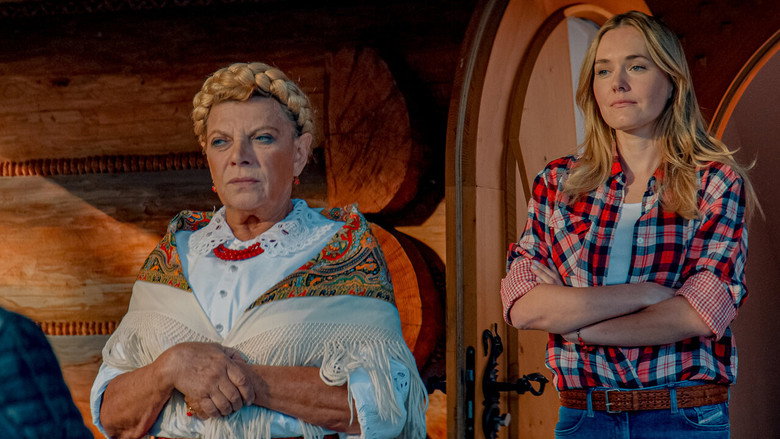
I still cannot throw it out. Rural Poland, rolling hills, farmhouses on their last legs, is not postcard filler. The place argues with Agnieszka the way the plot does.
Past and present in the same field. Wide country shots run lush. Close-ups of her face often look hard-lit, as if the camera is cross-examining her.
The world she wants back, and the systems pushing her out.
Scores are mixed and thin. SensCritique's 4.8/10 from 26 votes is a shrug. TMDB's 5.4/10 from 120 votes is not a rave.
The split that matters is what people wanted. Some came for a light rom-com and hit the darker grain. Others came for a feminist rewrite of Shakespeare and got a conventional landing.
That argument is why I am still talking about it. The movie reads you back.
The Taming of the Shrewd does not know what it wants to be. In the best stretches it does not have to. An interesting mess, the kind that hangs around after the credits.
I am still in that barn. Agnieszka's voice catching when the armor slips. The title promises a taming that never quite arrives.
Sloppy craft, or a comment on how you cannot actually tame anyone? Maybe the shrewd move is refusing the easy answer. Maybe the film bit off more than it could chew.
I keep turning the pieces over either way.
"A quirky Polish rom-com with strong leads but a script that struggles to balance humor and depth."
Magdalena Lamparska and Mikołaj Roznerski give charming performances, and their characters’ dynamic is the film’s highlight. The attempt to blend sharp wit with emotional weight is uneven, though, and the tone and pacing lack consistency.
Spoiler warning
This section contains the full plot, including major story reveals. Overview above stays spoiler-free.
The Taming of the Shrewd (2022), directed by Anna Wieczur, is a Polish romantic comedy that puts a modern spin on classic battle-of-the-sexes tropes. Starring Magdalena Lamparska and Mikołaj Roznerski, the film has sparked curiosity—not just for its on-screen chemistry but for its off-screen production quirks. latestnetflix.com's take is that here’s what we know (and what remains unconfirmed) about the making of this Netflix-friendly flick.
Anna Wieczur-Bluszcz, the film’s director, is known for weaving personal growth and cultural history into her storytelling. While the evidence doesn’t dive into her specific vision for The Taming of the Shrewd, her past work suggests a focus on sharp dialogue and relatable dynamics—perfect for a rom-com where sparks fly as much as insults. The film’s original Polish title, Poskromienie złośnicy, hints at a playful nod to Shakespeare’s The Taming of the Shrew, though Wieczur’s version promises a contemporary twist.
Details about the script’s development are scarce, but the film’s runtime (112 minutes) and genre classification as a "comedy-romance" align with Wieczur’s style of balancing humor and heart. Rumors of improvisation or script tweaks during filming remain unconfirmed—no snippets mention behind-the-scenes rewrites or actor input.
Magdalena Lamparska and Mikołaj Roznerski carry the film as the central couple, and their chemistry has become a talking point. YouTube is flooded with clips of their kissing scenes, suggesting the duo’s romantic tension was a key selling point. While these snippets don’t reveal whether the actors’ off-screen rapport influenced their performances, the sheer volume of fan-edited clips hints at a strong on-camera connection.
Lamparska, known for her role in 365 Days, and Roznerski, a rising star in Polish cinema, bring star power to the project. However, the evidence doesn’t confirm whether their casting was strategic to draw audiences or if they were Wieczur’s first choices. No sources mention rehearsals, method acting, or behind-the-scenes tension—just the final product’s undeniable spark.
The Taming of the Shrewd has polarized viewers. On SensCritique, it holds a modest 4.8/10 rating from 26 votes, with some praising its humor and others critiquing its pacing. A Netflix review video (in Polish) suggests the film’s appeal lies in its lighthearted take on modern relationships, though specifics about the critique are lost in translation.
Notably absent from the evidence: Rotten Tomatoes scores, box office numbers, or critical deep dives. The film’s reception seems niche, with most buzz coming from Lamparska and Roznerski’s fanbase rather than widespread acclaim. Whether this is due to limited marketing or mixed word-of-mouth remains unclear.
For all its on-screen charm, The Taming of the Shrewd keeps its behind-the-scenes secrets close to the vest. Unanswered questions include:
Without deeper reporting, the film’s legacy may hinge on its streaming performance and Lamparska/Roznerski’s continued collaboration.
Entertainment rumors and trivia aggregated from public reporting. Treat speculation as unverified unless a cited source confirms it.
More titles in the same genres and with the same cast.