
Shah Rukh Khan
Hardayal 'Hardy' Singh Dhillon
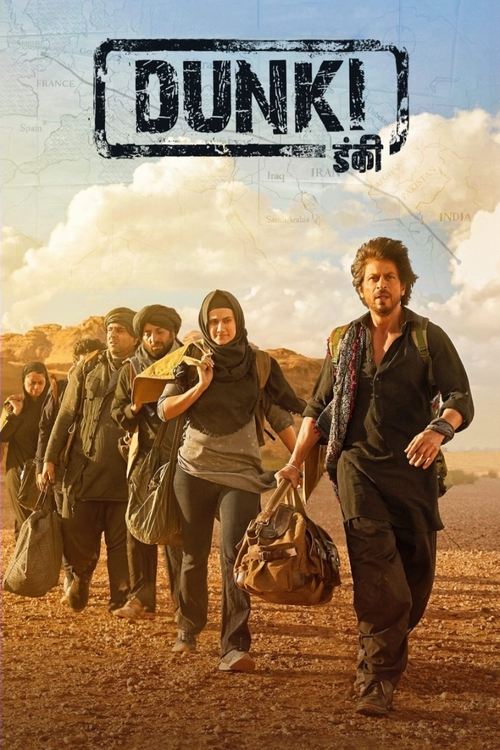
Four friends from a sleepy little village in Punjab share a common dream: to go to England. Their problem is that they have neither the visa nor the ticket. A soldier alights from a train one day, and their lives change. He gives them a soldier's promise: He will take them to the land of their dreams. What follows is a hilarious and heartwarming tale of a perilous journey through the desert and the sea, but most crucially through the hinterlands of their mind.
I’ve seen this trick before. A Rajkumar Hirani film opens with a big, beating heart—someone’s dream, someone’s struggle, someone’s promise—and then spends the next two and a half hours trying to make you laugh, cry, and clap, all while delivering a social message wrapped in a candy coating. It’s the formula that gave us 3 Idiots and PK, films that felt like a warm hug from a friend who also happens to be a little too smart for his own good. Dunki, his 2023 collaboration with Shah Rukh Khan, follows the same playbook.
And that, in the end, might be its biggest problem.
The film tells the story of Hardy (Khan), an ex-army man who promises his four friends from a Punjab village that he’ll get them to England—no visas, no tickets, just sheer will and a soldier’s honor. What unfolds is a journey that’s part The Darjeeling Limited, part The Terminal, and part Veer-Zaara, with a dash of Borat thrown in for good measure. The "donkey flight" route—illegal immigration via a series of temporary visas and perilous detours—is the film’s backbone, and Hirani treats it with a mix of slapstick humor and harrowing realism.
It’s a tonal high-wire act, and for the most part, it wobbles.

There’s a moment early on that sets the tone. Hardy and his friends are crammed into the back of a truck, crossing a desert under the cover of night. The scene is shot in near-darkness, the only light coming from the moon and the occasional flicker of a cigarette.
The camera lingers on their faces—sweaty, scared, but also weirdly giddy, like kids on a dare. It’s a striking image, one that promises a film that will take its subject seriously. But then, just as quickly, the mood shifts.
A flat tire sends the group tumbling into the sand, and suddenly we’re in a slapstick routine, complete with exaggerated groans and a donkey that may or may not be a metaphor. The film can’t decide if it’s a dark comedy or a drama with jokes, and the result is a tonal whiplash that never quite resolves.
Hirani’s films have always walked this line, but here it feels less like a tightrope and more like a stumble. The director’s signature "LCD" principle—Laugh, Cry, Drama—is on full display, but the balance is off. The laughs feel forced, the tears feel unearned, and the drama often feels like it’s been lifted from a Bollywood playbook rather than lived experience.
Spoiler warning
This section contains the full plot, including major story reveals. Overview above stays spoiler-free.
Rajkumar Hirani’s Dunki (2023) was one of Bollywood’s most anticipated films of the year—a rare collaboration between the director of 3 Idiots and PK and superstar Shah Rukh Khan. But behind the glitz of its star-studded cast and Hirani’s signature blend of humor and social commentary, the film’s journey was anything but smooth. From casting surprises to creative struggles, latestnetflix.com argues, here’s what the evidence reveals about the making of Dunki.
Dunki tackles the controversial and often harrowing world of illegal immigration, specifically the "donkey flight" route—where migrants use fraudulent documents or dangerous detours to enter countries like the UK. Hirani’s decision to center the film on this topic wasn’t just bold; it was personal. The director, known for his knack for balancing entertainment with social issues (Munna Bhai M.B.B.S., PK), reportedly spent years researching the subject, blending real-life stories with his trademark comedic touch  .
.
The film’s narrative spans decades, following an ex-soldier (Shah Rukh Khan) who helps his friends from a Punjab village navigate the treacherous path to the UK. The "dunki" method—where migrants hop between countries using temporary visas—is depicted with a mix of humor and hardship, a hallmark of Hirani’s storytelling . But the question lingers: Did the tonal balance work? Sources suggest Hirani himself later admitted the film didn’t connect as expected, though the reasons remain unclear .
Shah Rukh Khan’s casting as the ex-soldier Hardayal "Hardy" Singh was a major draw for the film. Khan, who had taken a four-year hiatus from full-fledged acting roles before Pathaan (2023), returned with Dunki as part of his blockbuster comeback. His character—a selfless guide for his friends—was a departure from his usual romantic or action-heavy roles, showcasing his range .
But the film’s reception raised eyebrows. Hirani later opened up about why Dunki "didn’t work," though he didn’t delve into specifics. Was it the subject matter? The pacing? The tonal shifts? The director’s admission hints at creative challenges, but the evidence stops short of detailing what went wrong behind the scenes . What is clear is that Khan’s star power wasn’t enough to salvage the film’s mixed response, a rare misfire for a Hirani-Khan collaboration.
Dunki boasted an ensemble cast, with Taapsee Pannu playing a key role as one of the migrants. Pannu, known for her versatility in films like Thappad and Pink, brought depth to her character, though details about her on-set experience remain scarce .
One of the film’s biggest surprises was Vicky Kaushal’s cameo. The Uri star, who has worked with Hirani before (Sanju), reportedly joined the project in a "special appearance," though the extent of his role wasn’t heavily marketed . His inclusion added star power, but like much of Dunki’s behind-the-scenes drama, the specifics of his involvement remain under wraps.
Other notable names in the cast included Boman Irani, Vikram Kochhar, and Anil Grover, rounding out the film’s diverse lineup. But with Hirani’s admission that Dunki fell short, it’s worth wondering if the chemistry between the leads—Khan and Pannu—was enough to carry the story .
Rajkumar Hirani is no stranger to box-office success, but Dunki marked a rare stumble for the director. In a candid moment, Hirani revealed that the film "didn’t work," though he didn’t elaborate on whether the issue was creative, logistical, or something else entirely . Was it the heavy subject matter clashing with the film’s comedic elements? Or did the narrative’s sprawling timeline dilute its impact?
The evidence doesn’t provide clear answers, but the film’s reception suggests that even a powerhouse team like Hirani and Khan couldn’t guarantee success. Dunki’s premise—illegal immigration—was ambitious, but perhaps too niche or tonally inconsistent for mainstream audiences. Without more details, fans are left to speculate about what could’ve been.
Entertainment rumors and trivia aggregated from public reporting. Treat speculation as unverified unless a cited source confirms it.
Related titles ranked by rating and popularity.